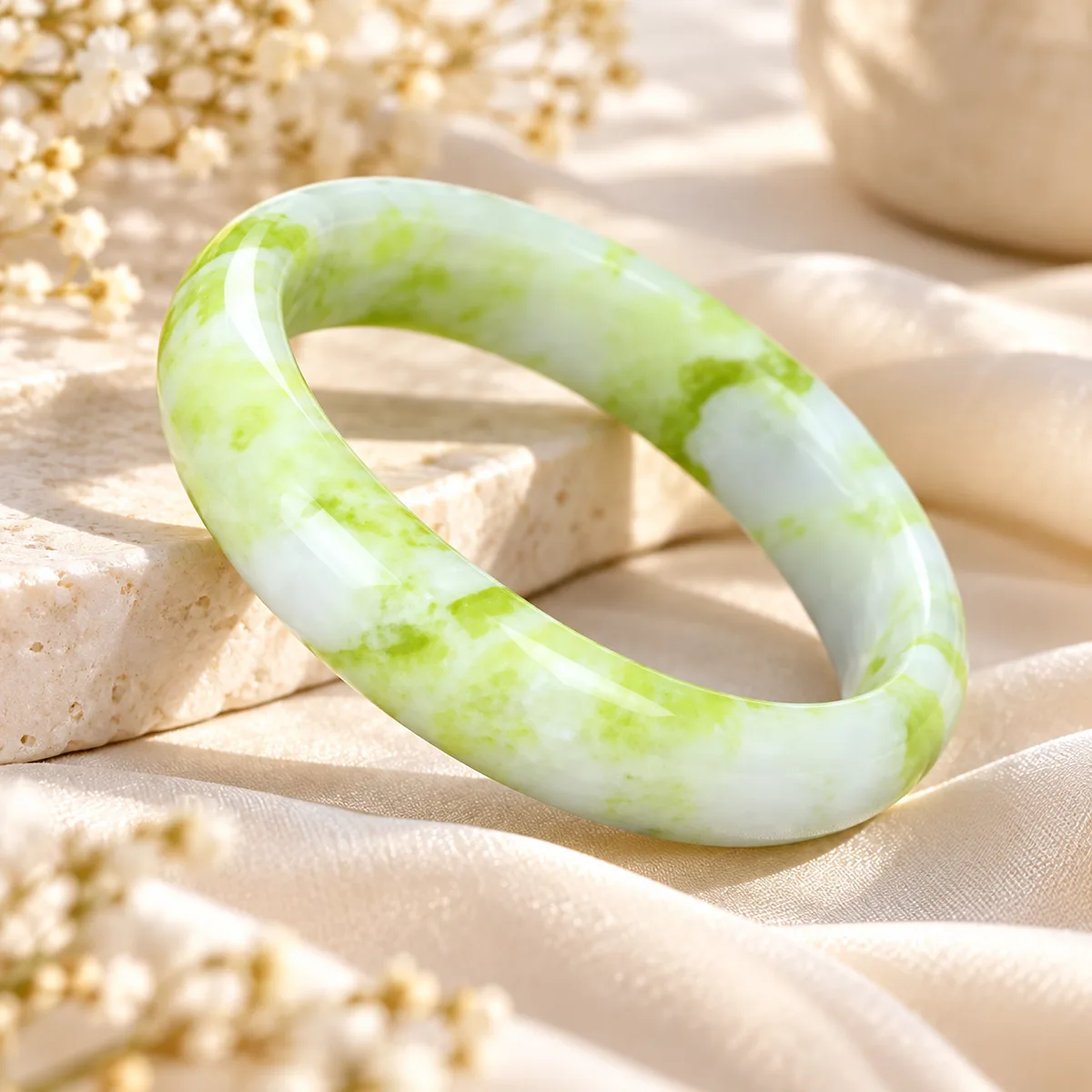
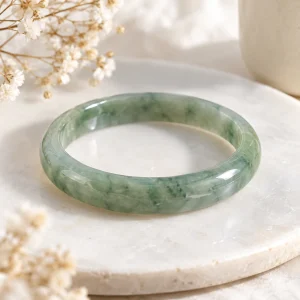
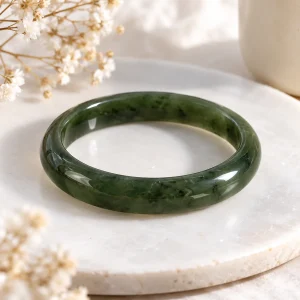
Green and white jade bangle, mottled through the stone
50,90 €
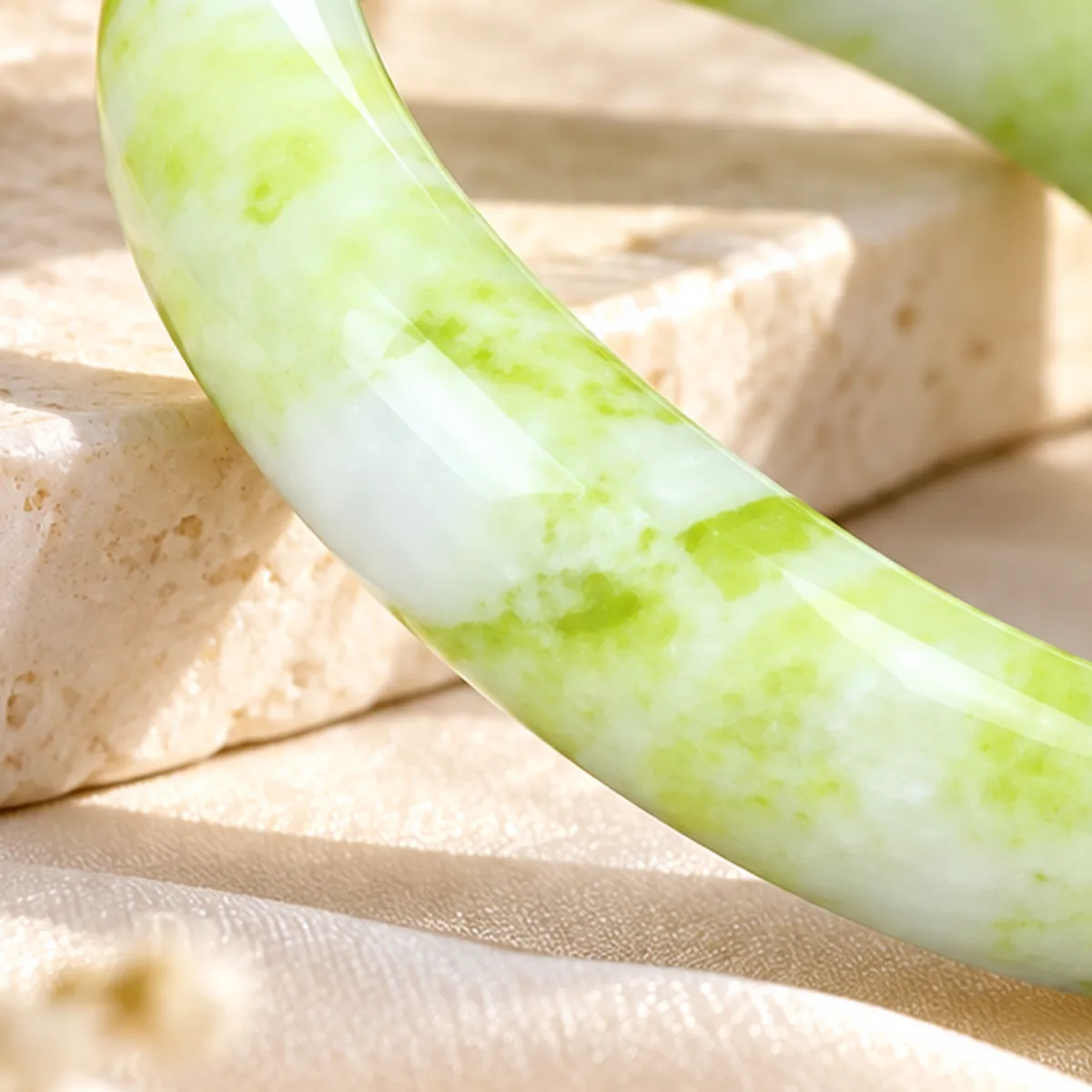
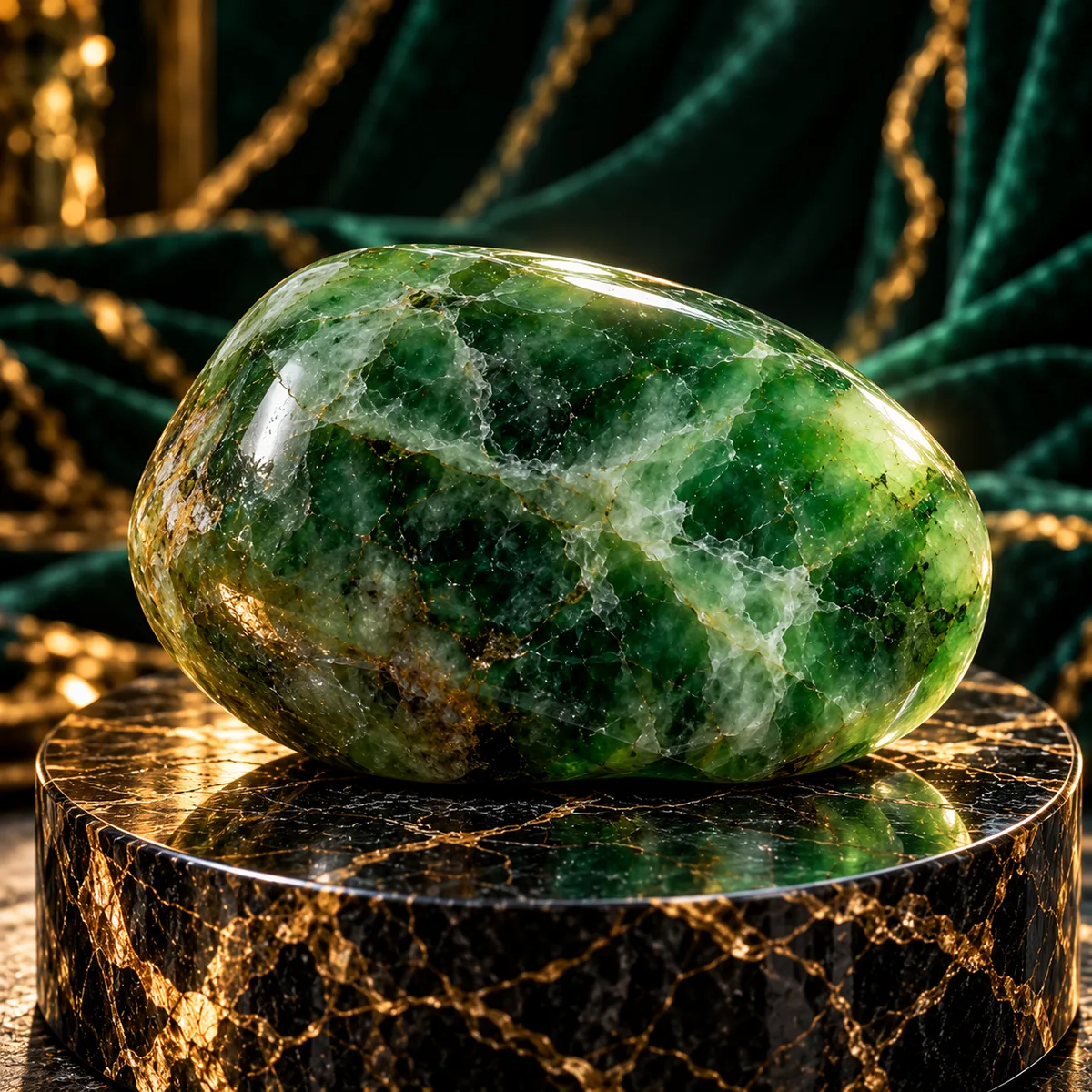
Green and white jade bangle, cut from a single block. Patches of a vivid green swim in a very pale ground, and the pattern falls differently on every ring: the photographs show one example, not yours.
Sold subject to weighing, and I say so from the start: this contrast is also the one a dyed quartzite gives. If the scale comes down towards 2.65, the word jade leaves the title. Why I take that precaution.
It is taken at the inside diameter, not at the wrist, and it does not open. Measure before ordering.
A green and white jade bangle, cut from a single block, where patches of a vivid green swim in a very pale ground. It is the most contrasted model in the section, and it is also the one I am most careful about: this exact pattern is the one imitation reproduces best. I explain it below, and I say what I do about it.
In four lines
A pale ground crossed by green patches, which fall differently on every ring.
Cut from a single block, with no hinge, no clasp, no seam.
Sold subject to weighing: it is the most imitated pattern in the section.
Treatment status undetermined, and the page writes it rather than let anything be assumed.
Why I put this reference under condition
A vivid, almost acid green, laid in clean patches on a white ground: it is pretty, it is what makes the piece interesting, and it is exactly the look a dyed quartzite gives. The colourant lodges in the porosity of the rock and spreads there in zones, which produces that frank contrast between coloured patches and a ground left pale.
Real jade can perfectly well show that mottling, and many old bangles do. But the eye does not tell the two apart, and I am not going to pretend otherwise to sell a ring. So I weigh before putting it on sale, and the result conditions the page. If it comes down towards 2.65, the word jade leaves the title and the piece is presented for what it is. The names that do not denote jade.
It is the only answer I know how to give to this problem, and it holds in one sentence: measure rather than assert.
No two rings ever fall the same way
The mottling cannot be ordered. It comes from the way the colour was distributed in the original block, and the cut of the ring passes through it at random. One bangle will have a wide green patch on top and an almost white back, the next will be speckled all the way round. The photographs show one example, not yours.
It is something to know before ordering, and it is also what people like in this model: you choose a pattern, not a reference identical to the last one.
It does not open, so it is measured beforehand
It is not your wrist you must measure, it is the passage of the hand. Hand closed, thumb folded as far as it will go into the palm, take the circumference at the widest point and divide by 3.14: that gives you the minimum inside diameter. Add a millimetre or two, because a bangle that just passes passes once, cold, and will not pass again on a hot day. The method in detail, and the size guide.
Outside Burma, country of extraction not confirmed
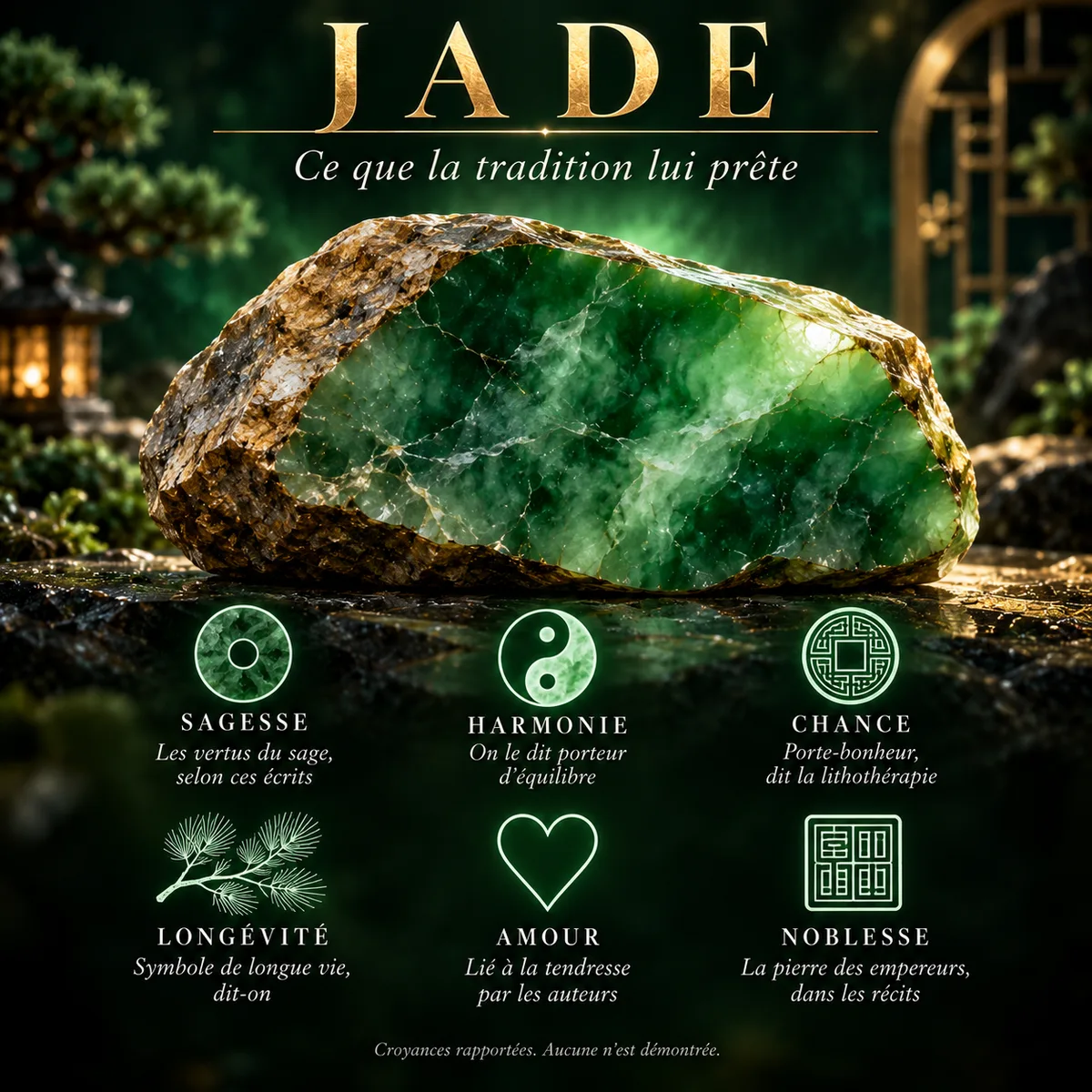
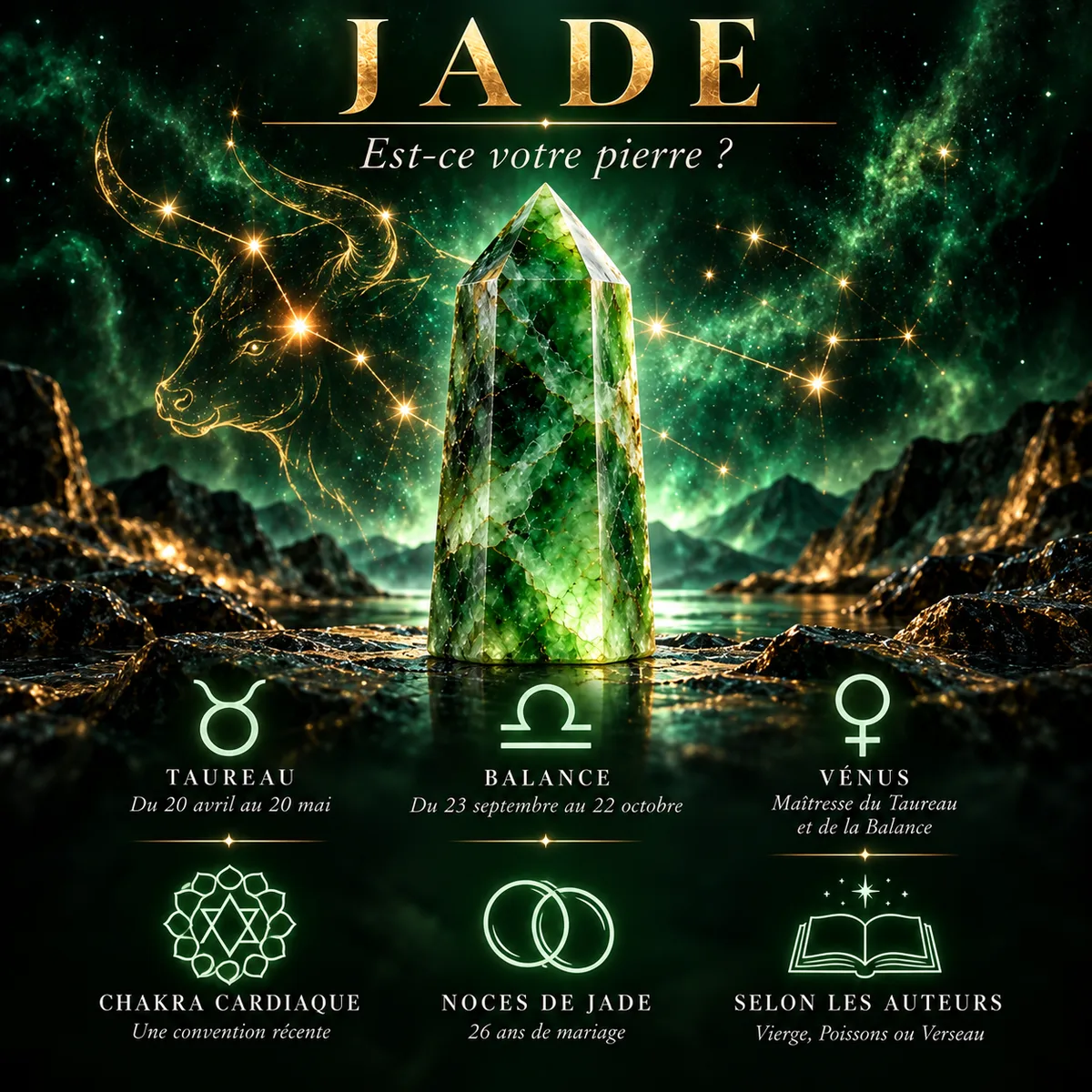
What tradition attributes to the jade bangle
What follows changes register, and I flag it rather than blending it into the rest of the page. Nothing here is demonstrated. These are customs and beliefs, which I report because they are part of the history of this stone. No piece in this shop is sold as a remedy, and I claim no effect for this one.
The left wristSeveral Chinese traditions associate wearing the bangle on the left wrist with the idea of receiving rather than giving. The custom is widespread; no basis is known for it other than custom itself. What tradition puts into a jade bracelet.
Never taking it offThe bangle is put on once and kept, sometimes for a lifetime. The closed shape has much to do with it: it is not a piece you choose in the morning, it is an object you wear.
The bangle that breaksTradition holds that a broken bangle took the blow in place of its wearer. It is a reading after the event, and it says above all how much attachment goes into a piece worn for a long time.
White and greenThe old Chinese texts classify jades by colour before classifying them by species, and white holds the first rank there, ahead of green. A ring carrying both has no particular standing in that hierarchy: it is a modern reading, not a tradition.
Dispatched within 48 hours of your order being confirmed, for delivery within 14 days from dispatch. I keep no buffer stock, and I won’t promise a timeframe I couldn’t meet.
Postage charges
€6.99 to any destination, free on orders of €47 or more to France, Belgium, Switzerland and Luxembourg. The exact amount appears in the cart before you pay.
The packaging, and why it matters
Every piece ships in its own pouch, kept apart from the others. This isn’t about presentation: the hardness of jade is ordinary, between 6 and 6.5 for nephrite and 6.5 to 7 for jadeite, and the quartz in everyday dust sits at 7. Two pieces of jewellery that travel together end up scratching each other.
Fourteen days to change your mind
With no need to explain yourself. An email is enough to open a return, there is no form to fill in. Return postage is at your expense, unless the piece doesn’t match its listing or arrives damaged.
The wrong size is the main reason for a return in this category, and jade cannot be resized the way a solid metal band can. Two minutes of measuring almost always prevents it. The size guide.
Warm water, mild soap, a soft cloth. A very soft brush for the hollows of a carving. That’s all, and it’s enough.
What you must never do, and why
No ultrasonic cleaner, no steam, no solvent, no heat source. This isn’t a token precaution: the treatment status of my pieces is not established. My supplier doesn’t know, and weighing establishes the mineral without saying anything about a possible resin impregnation. Resin tolerates neither heat nor solvents, so every piece is handled as though it might contain some. The information sheet on treatments.
Scratches, and where they come from
Jade is tough, meaning very hard to break: its interlocking crystal structure resists fracturing, and that is why axes could be shaped from it in the Neolithic. Its hardness, on the other hand, is ordinary, 6 to 6.5 for nephrite and 6.5 to 7 for jadeite. The quartz in everyday dust sits at 7: that is what dulls jade, not knocks. The difference between the two.
Day to day
Put the piece on after perfume and cream, never before. Take it off for housework, gardening and sport, where the knocks against corners happen. Store each piece on its own, in its pouch. On a strand of beads, the thread wears out before the stone: it gets restrung, and there is nothing abnormal about that.
My name is Jade. I’m French, from Morbihan, and based in Tallinn. I choose the pieces and have them set: I mine nothing, I cut nothing, and I don’t do the metalwork myself. The work I do is the sorting, and with this material that is what decides everything.
I am neither a gemmologist, nor a lapidary, nor a therapist, and I don’t claim to be.
I weigh, I don’t certify
Before putting a reference online, I order one example of it for myself. When it reaches me unset, I weigh it in air, then suspended from a thread in a glass of water: the ratio of the two masses gives the density, and that figure separates jadeite, nephrite, serpentine and dyed quartzite without ambiguity.
One example per reference, not every piece. I don’t handle the piece that goes out to you, and I would rather say so than let you believe otherwise. The method, with its three limits.
What I can’t know
The treatment status of my pieces. My supplier doesn’t know, and the scales say nothing about it: they establish the mineral, not the resin impregnation. Only infrared spectroscopy in a laboratory would settle it, and I don’t have that done. So you will never read “jadeite A”, “type A” or “untreated” on this site. The information sheet.
Where my jade comes from
No Burmese jadeite, and the first reason is a legal one. Not the reason you read everywhere: the JADE Act of 2008 did indeed ban these stones in the United States, but that ban was lifted on 7 October 2016. What applies today dates from 8 April 2021: the US Treasury sanctioned Myanma Gems Enterprise, the state-owned company that controls the Burmese gem trade. So there is no general ban, but an American is not allowed to trade with that entity, and a stone never tells you where it has passed through. One single supply chain for ten markets: it has to hold up for the most demanding of them. When an origin isn’t confirmed to me in writing, the listing doesn’t state it. My sourcing policy.