Dyed jade: recognizing an added colour
This page covers only one treatment, dyeing: where colour settles when it has been added, which shades do not exist as such in jade, what a white lamp shows in ten seconds, and why a stone with no visible trace is not therefore an unaltered stone.
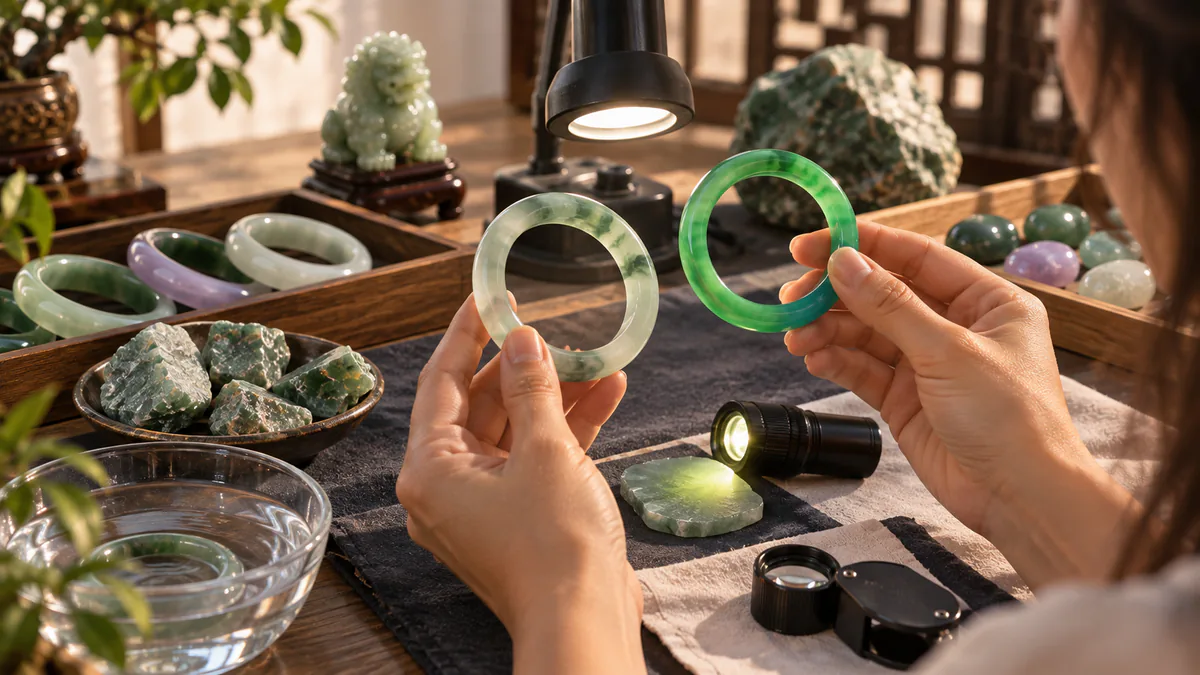
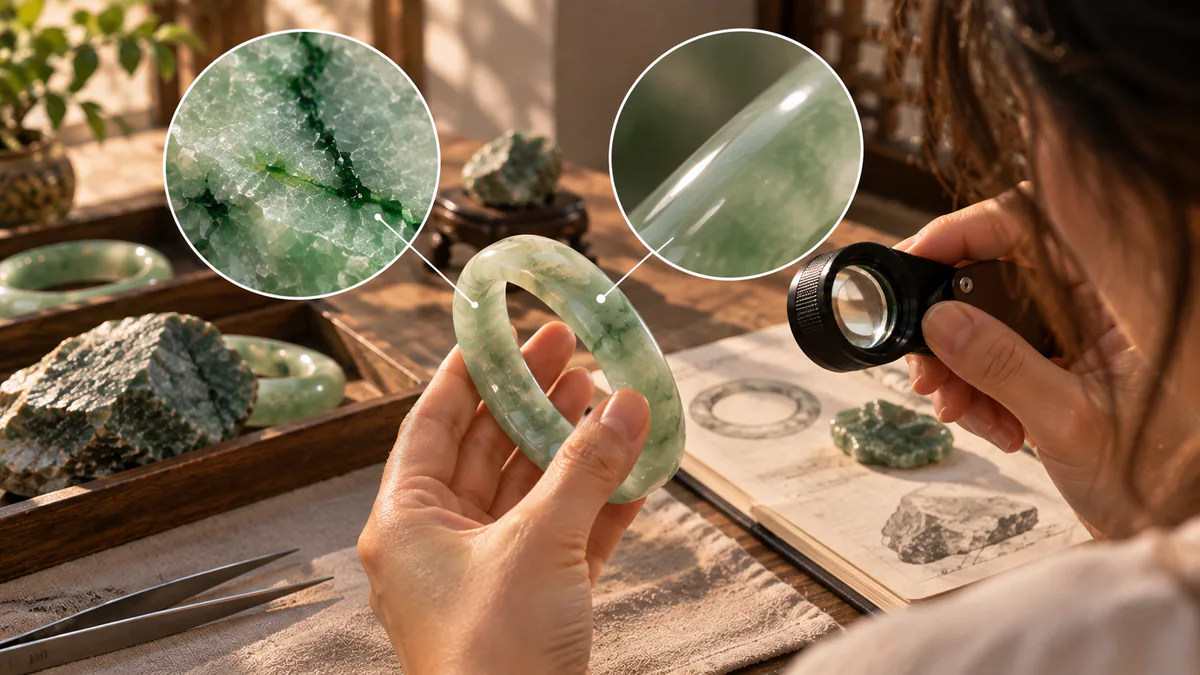
An added colour is recognized by where it sits, not by its shade: it builds up in cracks, around drill holes and where the stone thins, whereas an original colour lives in the grain and stops with it.
This is the only place on this site where I advise looking rather than weighing: my scale cannot see any dye, which occupies voids that were already there without shifting the density enough to show. A loupe, on the other hand, sees what the scale never will.
My name is Jade, and I run a jade jewellery workshop: I choose the pieces, have them set, and weigh one example of each reference before it goes on sale. I am not a gemmologist or a therapist, and this article teaches you to see one thing without certifying anything.
What is done to a stone when it is dyed
Dyeing is the oldest and simplest treatment applied to jade: a dye, heat, time. In the trade classification, it carries the letter C: type A, B and C jade.
Everything else on this page follows from one commonsense sentence: a dye does not pass through a crystal. It takes whatever is already open, the micro-cracks, the boundaries between grains, the channels an acid bath has carved. An original colour, by contrast, comes from an atom lodged in the crystal lattice, chromium or iron for greens, and is distributed the way the grain is distributed.
A colorless resin follows the same paths, and only one property separates them: one is transparent, the other is coloured. As it settles, the dye traces the network it has followed, while resin fills it without tracing it. That is why this article exists and has no counterpart about resin, whose trace can only be found in a laboratory.
One distinction remains, and only one branch of it concerns this page. A real jade whose colour has been changed is still jadeite or nephrite, and that is the one that calls for looking. Another stone that has been dyed, quartzite around 2.65 or serpentine around 2.6, is not jade at all, and the scale is enough to expose it: stones sold as jade, weighing.
The four places where colour builds up
I always look in the same order, from the most telling to the most discreet, in daylight, in the shade rather than full sun, with a 10x loupe if you have one. The trade terms used here are explained in the jade glossary.
- Cracks and the network of crazing. This is the main sign. An added colour becomes denser there than elsewhere and follows the lines the way ink follows the fibers of paper. An original colour runs underneath without underlining them.
- Drill holes. On a bead, the drill opened the stone at two points and the bath got in there before anywhere else. A deeper ring of colour around the hole can be seen without any instrument.
- Areas where the stone thins. The rim of a cabochon, the edge of a plaque, the bottom of a carved motif: the dye concentrates there because there is less material to pass through.
- Contact with the setting and the thread. Colour that spills onto the metal or the glue does not come from the stone. The thread reads even better when removed: a cord whose threaded section has taken on the colour of the beads is a clear signal (thread and cord).
The colours that do not exist as such
Some shades sold as jade match no known colour of jadeite or nephrite, and they need no loupe. Fuchsia, true blue and perfectly even apple green almost always come from quartzite that has been through a dye bath. So does deep purple: jadeite does have a mauve, lavender, but it is pale, hazy, uneven, and diffuses through the grain. The details shade by shade are in pink, blue and red jade, and the real palette in the colours of jade stone.
One pattern is worth remembering, because it helps with colours I have not listed: the more saturated and perfectly even a shade is across the whole piece, the more explaining it needs. A rock made of interlocking grains or matted fibers is rarely uniform. A bath, on the other hand, is uniform by design.
Green, and what makes it difficult
Green is the colour people expect from jade, and the one where dyeing hides best, since original green is abundant: green jade stone. An original jadeite green is often uneven, in patches, veins or clouds, whereas a dyed green tends to be everywhere at once, except denser in the cracks. A vivid green, translucent, inexpensive jadeite has also rarely escaped the bath (the one-to-a-hundred price gap).
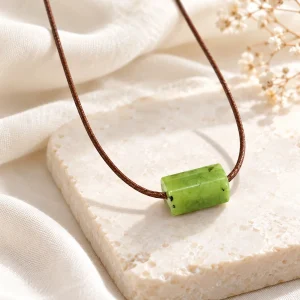
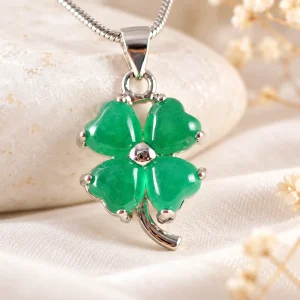
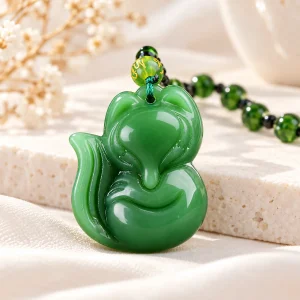
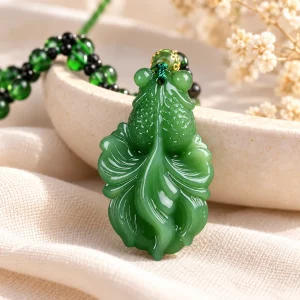
Pendants whose mineral and measurement I publish
The lamp, and how to hold the stone
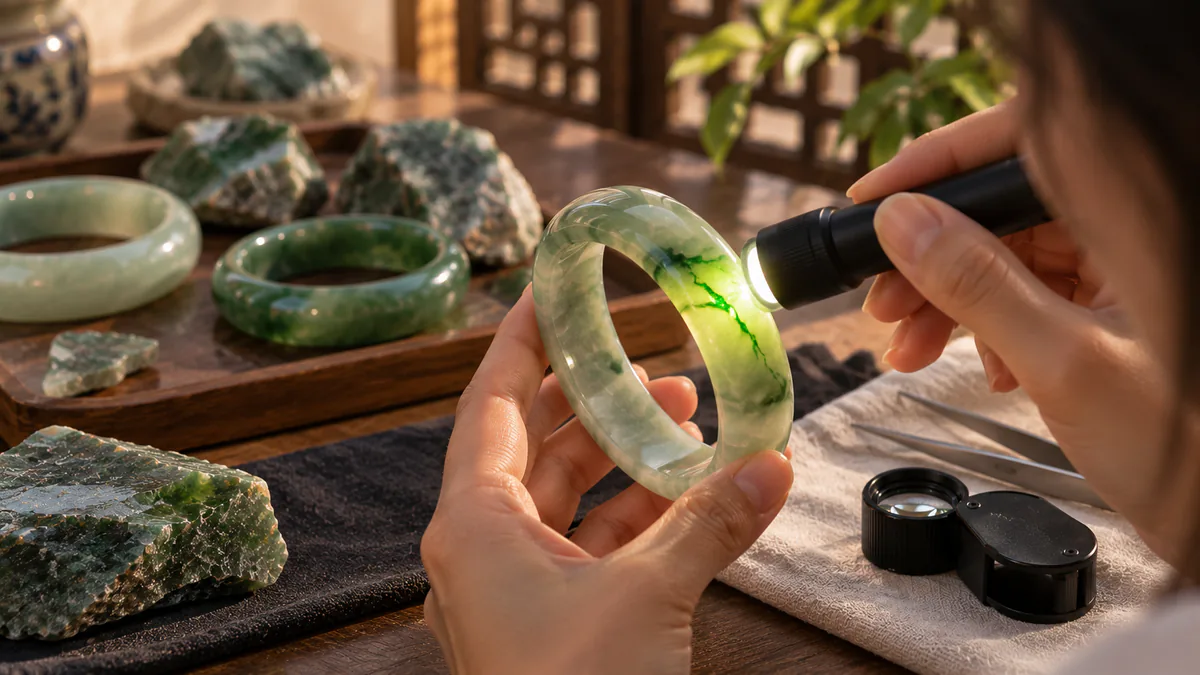
A white pocket torch, or a phone placed behind the stone, changes the examination completely. Two techniques, depending on thickness.
- Transmitted light, on a thin or translucent piece: the lamp right against the back of the stone. Colour stops being a surface and becomes a volume, where streaks show up as a mesh of darker lines.
- Raking light, on an opaque piece: the lamp almost parallel to the surface. It reveals the cracks, and shows whether the colour follows them.
A jade whose colour stays evenly distributed under the lamp proves nothing: it simply shows nothing to see. That is useful, but in one direction only.
The instruments I do not have
Gemmology has tools that go further, and I would rather name them than suggest my lamp replaces them: the colour filter long used on green jadeites, the handheld spectroscope, and infrared spectroscopy, which alone settles the question of resin. I own none of them, so I will not tell you what they show.
What catches the eye without proving anything
Several signals circulate as proof when they are only reasons to look more closely.
- A shade that is too even. It raises a question, it does not settle it: some original pieces are remarkably regular, and that is what makes them valuable.
- A low price. It makes treatment likely without proving it: there are inexpensive jades for good reasons, an ordinary colour or an opaque piece.
- A stone that has changed colour. Wear, cosmetics and light are enough to explain it without any dye being involved: what explains it.
- The solvent-soaked cotton swab. Recommended everywhere, and I do not do it: solvent attacks any resin, dulls a polish and damages a cord, for a result that says nothing when it is negative (how to clean jade stone).
The better-known countertop tests, scratching, sound, the feeling of cold, are examined one by one in how to recognise genuine jade. None of them concerns colour.
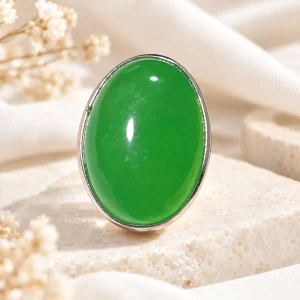
Jade rings, chosen one by one
What a seller must write when colour has been added
French Decree No. 2002-65 of 14 January 2002 answers clearly here, which is rare enough to point out: its Article 2 expressly names dye among the treatments that require the name to be completed, and the exception in its Article 3 only covers bleaching without the addition of coloring agents. The exception therefore closes itself off to dyeing. A dyed stone can be sold perfectly well, provided this is stated: the problem is not added colour, it is added colour kept quiet. A full tour of the text is in jade and the 2002 decree, and the disclosure obligation in the treatment information sheet.
What this article does not say
Here is the reversal not to make, and I spell it out rather than let an observation method turn into a guarantee. Seeing a trace lets you conclude that colour has been added. Not seeing one lets you conclude nothing. A stone with few cracks gives dye little to hold on to, careful dyeing stays discreet, and dyeing is in any case only one treatment among others: resin impregnation leaves no visible trace at all.
The consequence applies to my pieces as well as yours: I never write that a stone is untreated, natural or type A, and I do not imply it through well-placed silence. My supplier does not know the treatment status of their goods, my scale does not tell me, and this article does not either.
What I do about it on my own pieces
I weigh one example of each reference before putting it online and publish the number, its date and the mineral it points to, jadeite between 3.25 and 3.36, nephrite between 2.90 and 3.03: what I publish on every product page. That measurement says nothing about colour, which is why the catalogue has no pink, blue or deep purple: I do not want to have to argue about a shade whose origin I cannot establish. The word genuine does stay on my product pages, and it covers only one thing, real jade rather than serpentine or dyed quartzite (buying jade jewellery).
Questions I get asked
How can I tell if my jade is dyed?
Look at where the colour is rather than what colour it is. Under a loupe and in front of a lamp, dye concentrates in cracks, around drill holes and at thinned edges. An original colour is distributed through the grain and ignores the crazing.
Is dyed jade fake jade?
Not necessarily. Dyed jadeite is still jadeite: the mineral is real, its colour has been redone. A fuchsia bracelet sold as jade is dyed quartzite, a different stone under a name that does not belong to it: stones sold as jade.
Does the colour of dyed jade wash out?
Not with lukewarm water and mild soap, the only cleaning I do. The trade does report, however, that the colour fades in light over the years and that a solvent can make it migrate. No ultrasonic cleaners or steam, on any piece.
Is a stone with no visible trace untreated?
No, and that is the central point of this page. No trace means the dye cannot be seen, not that there is none, and it says nothing about resin impregnation, which is invisible to the eye and under a loupe. Only infrared spectroscopy settles it: type A, B and C jade.
Does the weighing you publish detect a dye?
No. It establishes the mineral, jadeite or nephrite rather than serpentine or quartzite, which is already a lot in this market. A dye occupies voids that were already there and does not shift the density enough to show: the protocol and its limits.
Is it legal to sell dyed jade?
Yes, provided it is disclosed. Article 2 of French Decree No. 2002-65 names dye among the treatments that require the name to be completed, and the exception in Article 3 only covers bleaching without the addition of coloring agents.
Where I checked
What comes from a named source. Articles 2, 3 and 10 of French Decree No. 2002-65 of 14 January 2002 on the trade in gemstones and pearls, whose text I reread on 9 September 2026: dye is named in Article 2, and the restriction to no added coloring agents appears in Article 3. The density ranges are those of the mineralogical literature, whose limits vary by a few hundredths from one database to another: I cite them without attributing them to any organization, since I did not take them from a single one. The fading of a dye in light and its migration on contact with a solvent are what the trade reports: I have not measured them.
What is a dated market observation. On 8 September 2026, I opened the top-ranking French pages in this field. None stated the mineral of its pieces, so none stated whether their colour had been added either, and none published the Article 10 sheet. I noted five uses of the A, AA, AAA scale, which has no standing in any standard, including one product title combining AA quality with the word genuine. I report wording, I name no site, and I do not legally characterize anyone’s practise. The same day, my supplier confirmed that they do not know the treatment status of their goods.
What is my own reasoning. The explanation through open paths, a dye that follows cracks because it cannot pass through a crystal, is my way of accounting for what can be observed: it is not a measurement. The order in which I look at the four areas, refusing the solvent-soaked cotton swab and the absence of pink and blue in the catalogue are decisions, not established facts. If you find an error here, write to me: I will correct it and note the change.
In one sentence
Dyeing is the only one of the three states in the classification that leaves something to see, and that something is not a colour but a location; recognizing it teaches you to rule a piece out, never to guarantee another: jade stone and its two minerals, the shop.