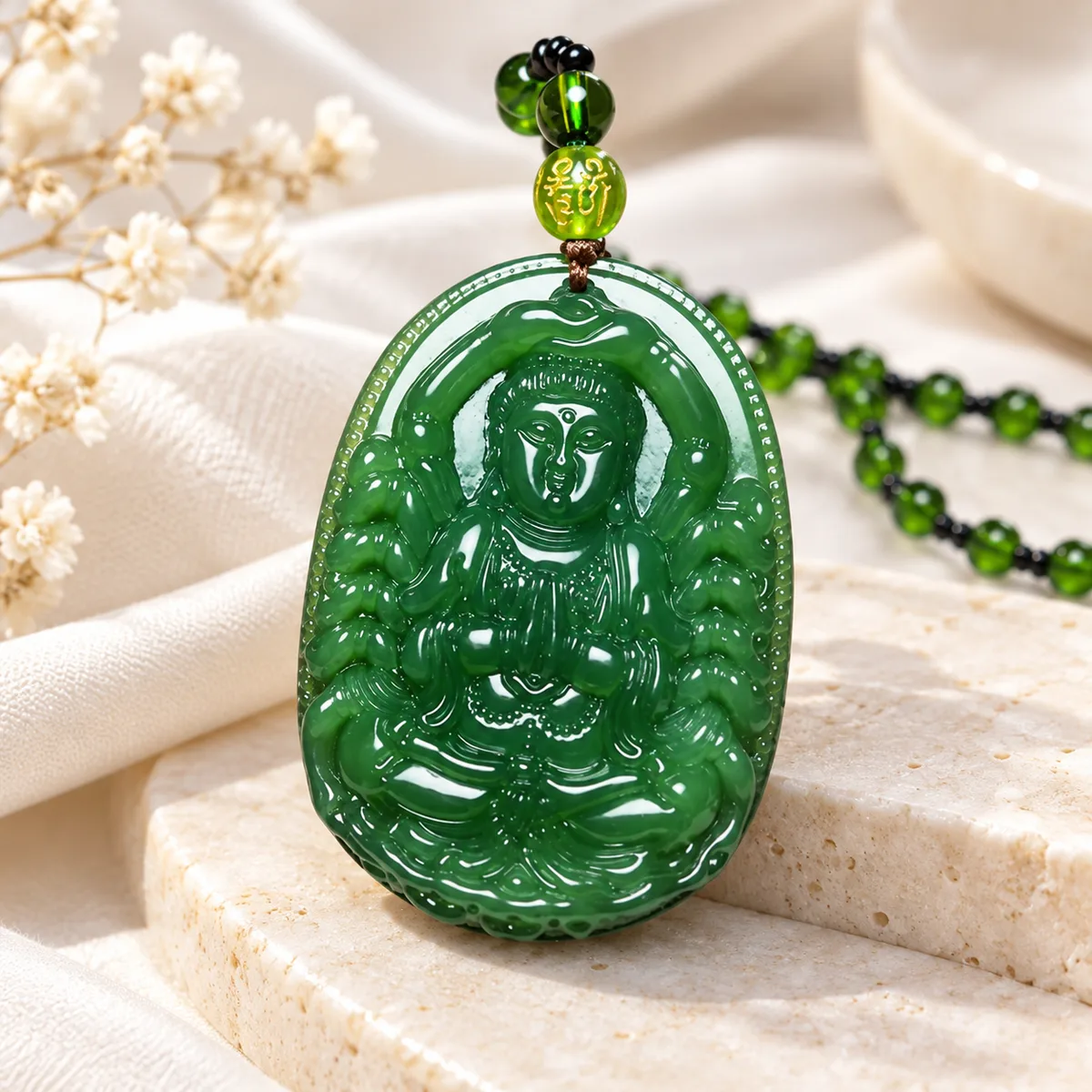
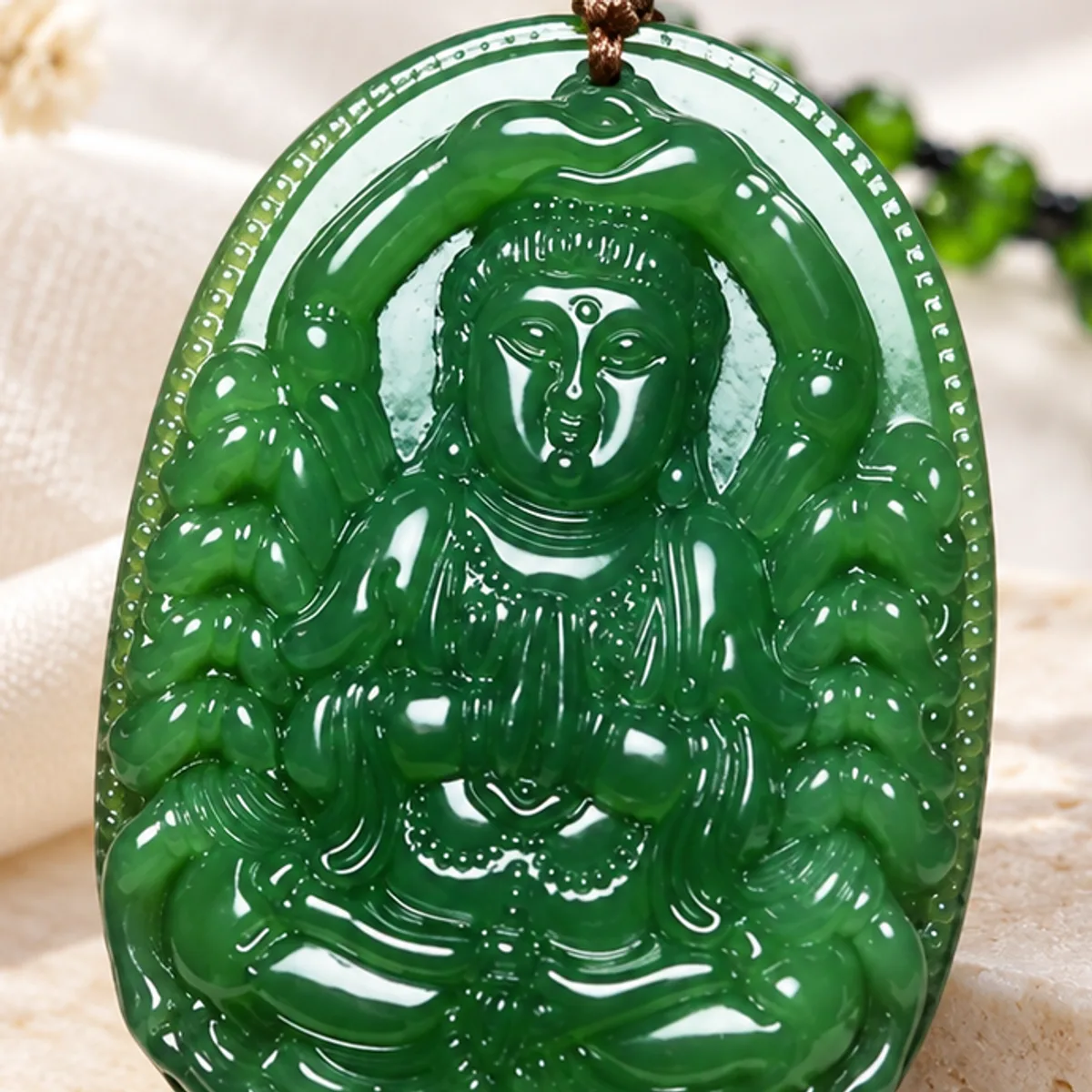
Jade guanyin pendant: a large oval plaque edged with a beaded fillet, the figure carved in relief seated on a lotus, a halo behind the head. Knotted to a strand of green and black beads.
Guanyin is not the Buddha: she is a bodhisattva, the figure of compassion. The shop sells both pieces, and each one says so.
The beads of the strand are not announced as jade, and the page says so. The plaque unties, so it weighs: the record will be published. Why I write it down.
A jade guanyin pendant: a large oval plaque, edged with a beaded fillet, where the figure is carved in relief seated on a lotus, hands joined, a halo behind the head. It is the biggest piece in the set. It is knotted to a strand of green and black beads.
In four lines
Guanyin seated on a lotus, carved in relief in the plaque.
Halo engraved behind the head, beaded fillet all round the rim.
The biggest piece in the set: it covers much of the palm.
The record will be published: the plaque unties, so it weighs.
Guanyin is not the Buddha
The confusion is constant, and it is worth clearing up. The Buddha is a man who reached awakening. Guanyin is a bodhisattva, that is a being who has reached awakening and refuses to enter it while others have not. It is neither the same figure nor the same story.
She is recognised by her posture and her attributes: seated on a lotus, often with a vial or a willow branch in hand, sometimes standing on a wave. The laughing Buddha with the round belly seen on so many pendants is in fact neither of them, it is Budai, a Chinese monk.
This is the widest piece in the whole set: it covers a good part of the palm, and the strand of beads has to carry a real weight. The hanging hole is drilled high in the stone, above the halo, which puts the load in the right place.
The relief is modelled rather than cut: the face, the folds of the robe and the petals of the lotus rise from the ground in successive steps, with no burin stroke anywhere. That is what gives the figure its softness, and it is also far longer to execute than an engraving.
A large plaque wears differently from a small subject: it is seen, it lies flat on the sternum, and it calls for an open neckline. This is not a discreet pendant, and it is better to know that before ordering.
What the stone is, and what remains to be established
The green is deep and even across the whole plaque, which is rarer than it sounds: on a piece this size a natural stone usually shows clouds or veins. That evenness therefore deserves checking, and the weighing will do it.
What is sold under the name jade is very often serpentine, around 2.6, or dyed quartzite, around 2.65, while nephrite starts at 2.90 and jadeite at 3.25. On this reference the measurement is possible, since the knot undoes.
Outside Burma, country of extraction not confirmed
What tradition attributes to Guanyin and to jade
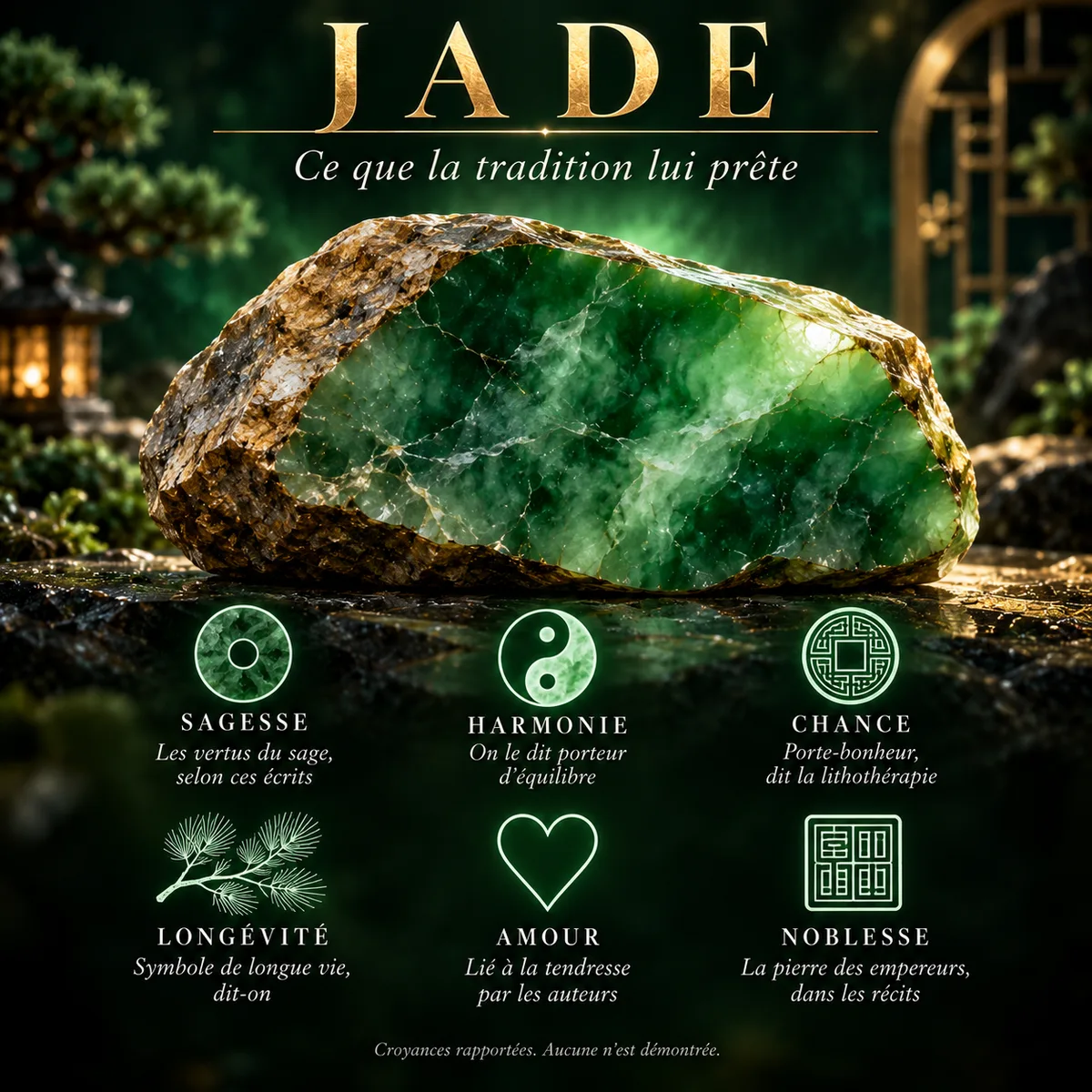
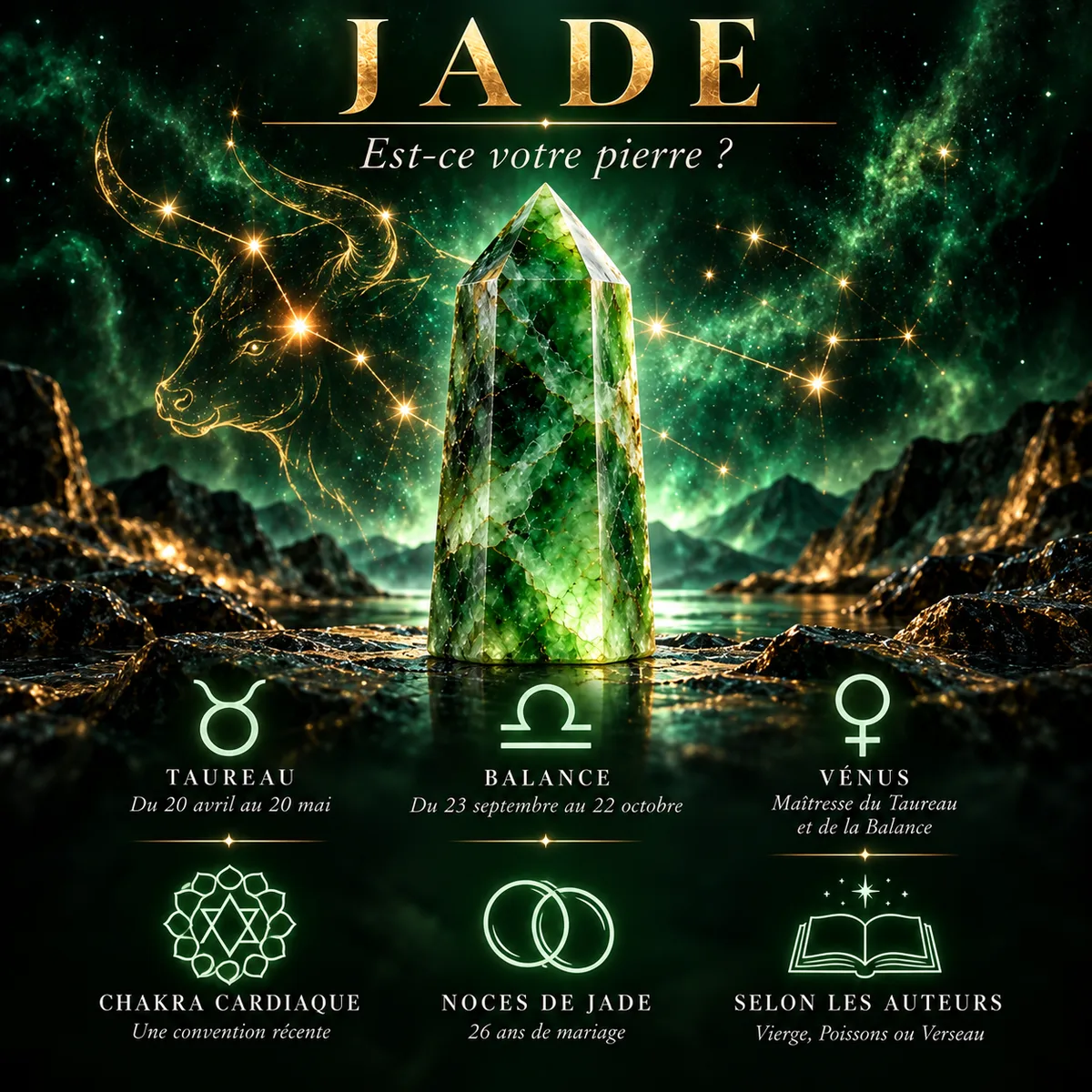
What follows changes register, and I flag it rather than blending it into the rest of the page. Nothing here is demonstrated. These are customs and beliefs, which I report because they are part of the history of this stone. No piece in this shop is sold as a remedy, and I claim no effect for this one.
She who hears the cries of the worldThe name translates word for word as she who observes the sounds of the world. Guanyin is the figure of compassion in East Asian Buddhism, and the vow attributed to her is to hear every distress, wherever it comes from.
A figure that changed genderIn ancient India, Avalokiteshvara is male. In China the figure feminises gradually from the Tang and becomes decidedly female under the Song. It is one of the best documented iconographic transformations in Buddhism.
The man wears GuanyinA widespread Chinese saying has it that men wear Guanyin and women the Buddha, each receiving what they would otherwise lack: gentleness for one, patience for the other. It is a custom, not a rule, and nobody is bound by it.
A stone of moral virtueIn Confucian thought, jade is associated with qualities of character rather than effects on the body: uprightness, constancy, restraint. It is the best documented meaning of them all.
Dispatched within 48 hours of your order being confirmed, for delivery within 14 days from dispatch. I keep no buffer stock, and I won’t promise a timeframe I couldn’t meet.
Postage charges
€6.99 to any destination, free on orders of €47 or more to France, Belgium, Switzerland and Luxembourg. The exact amount appears in the cart before you pay.
The packaging, and why it matters
Every piece ships in its own pouch, kept apart from the others. This isn’t about presentation: the hardness of jade is ordinary, between 6 and 6.5 for nephrite and 6.5 to 7 for jadeite, and the quartz in everyday dust sits at 7. Two pieces of jewellery that travel together end up scratching each other.
Fourteen days to change your mind
With no need to explain yourself. An email is enough to open a return, there is no form to fill in. Return postage is at your expense, unless the piece doesn’t match its listing or arrives damaged.
Warm water, mild soap, a soft cloth. A very soft brush for the hollows of a carving. That’s all, and it’s enough.
What you must never do, and why
No ultrasonic cleaner, no steam, no solvent, no heat source. This isn’t a token precaution: the treatment status of my pieces is not established. My supplier doesn’t know, and weighing establishes the mineral without saying anything about a possible resin impregnation. Resin tolerates neither heat nor solvents, so every piece is handled as though it might contain some. The information sheet on treatments.
Scratches, and where they come from
Jade is tough, meaning very hard to break: its interlocking crystal structure resists fracturing, and that is why axes could be shaped from it in the Neolithic. Its hardness, on the other hand, is ordinary, 6 to 6.5 for nephrite and 6.5 to 7 for jadeite. The quartz in everyday dust sits at 7: that is what dulls jade, not knocks. The difference between the two.
Day to day
Put the piece on after perfume and cream, never before. Take it off for housework, gardening and sport, where the knocks against corners happen. Store each piece on its own, in its pouch. On a strand of beads, the thread wears out before the stone: it gets restrung, and there is nothing abnormal about that.
My name is Jade. I’m French, from Morbihan, and based in Tallinn. I choose the pieces and have them set: I mine nothing, I cut nothing, and I don’t do the metalwork myself. The work I do is the sorting, and with this material that is what decides everything.
I am neither a gemmologist, nor a lapidary, nor a therapist, and I don’t claim to be.
I weigh, I don’t certify
Before putting a reference online, I order one example of it for myself. When it reaches me unset, I weigh it in air, then suspended from a thread in a glass of water: the ratio of the two masses gives the density, and that figure separates jadeite, nephrite, serpentine and dyed quartzite without ambiguity.
One example per reference, not every piece. I don’t handle the piece that goes out to you, and I would rather say so than let you believe otherwise. The method, with its three limits.
What I can’t know
The treatment status of my pieces. My supplier doesn’t know, and the scales say nothing about it: they establish the mineral, not the resin impregnation. Only infrared spectroscopy in a laboratory would settle it, and I don’t have that done. So you will never read “jadeite A”, “type A” or “untreated” on this site. The information sheet.
Where my jade comes from
No Burmese jadeite, and the first reason is a legal one. Not the reason you read everywhere: the JADE Act of 2008 did indeed ban these stones in the United States, but that ban was lifted on 7 October 2016. What applies today dates from 8 April 2021: the US Treasury sanctioned Myanma Gems Enterprise, the state-owned company that controls the Burmese gem trade. So there is no general ban, but an American is not allowed to trade with that entity, and a stone never tells you where it has passed through. One single supply chain for ten markets: it has to hold up for the most demanding of them. When an origin isn’t confirmed to me in writing, the listing doesn’t state it. My sourcing policy.