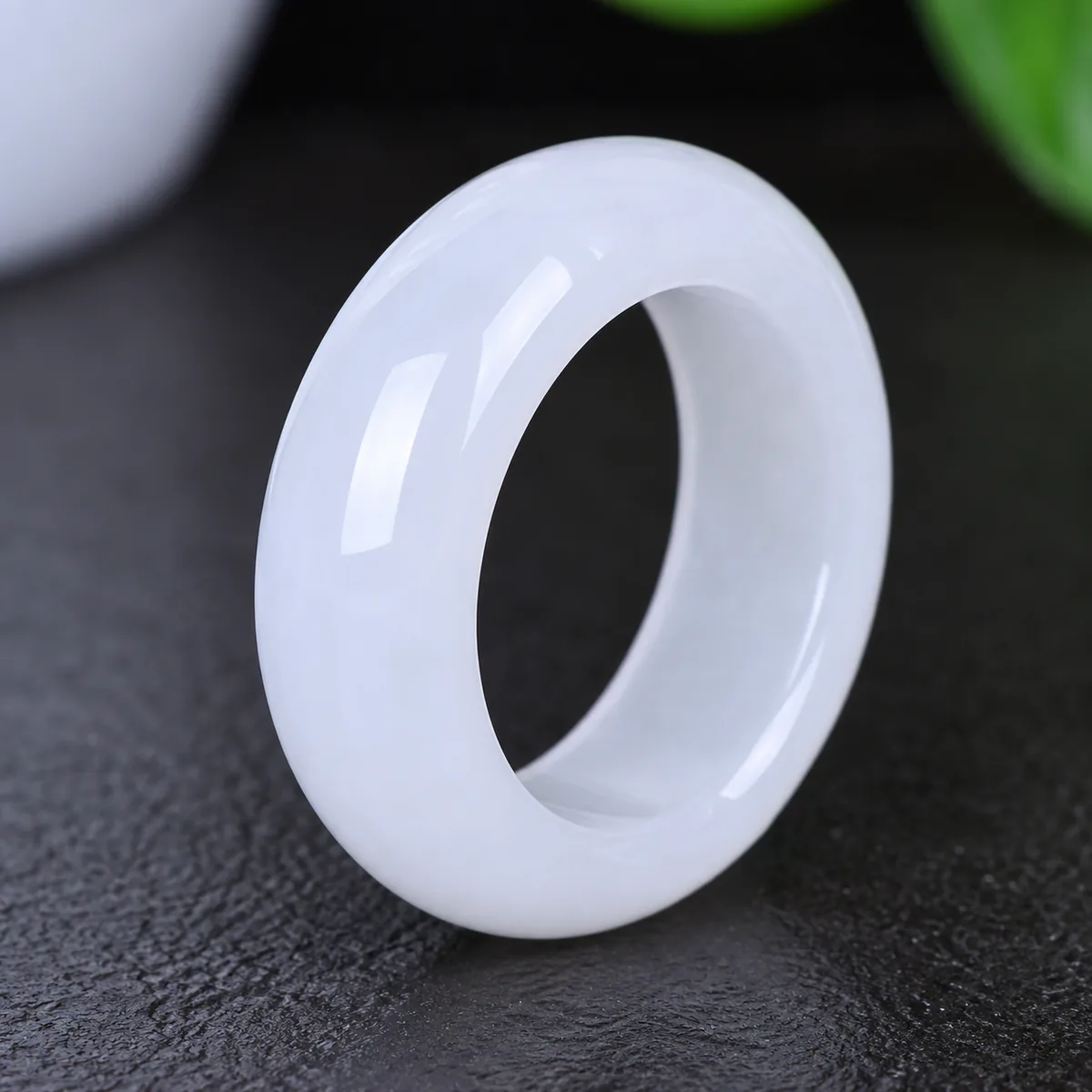
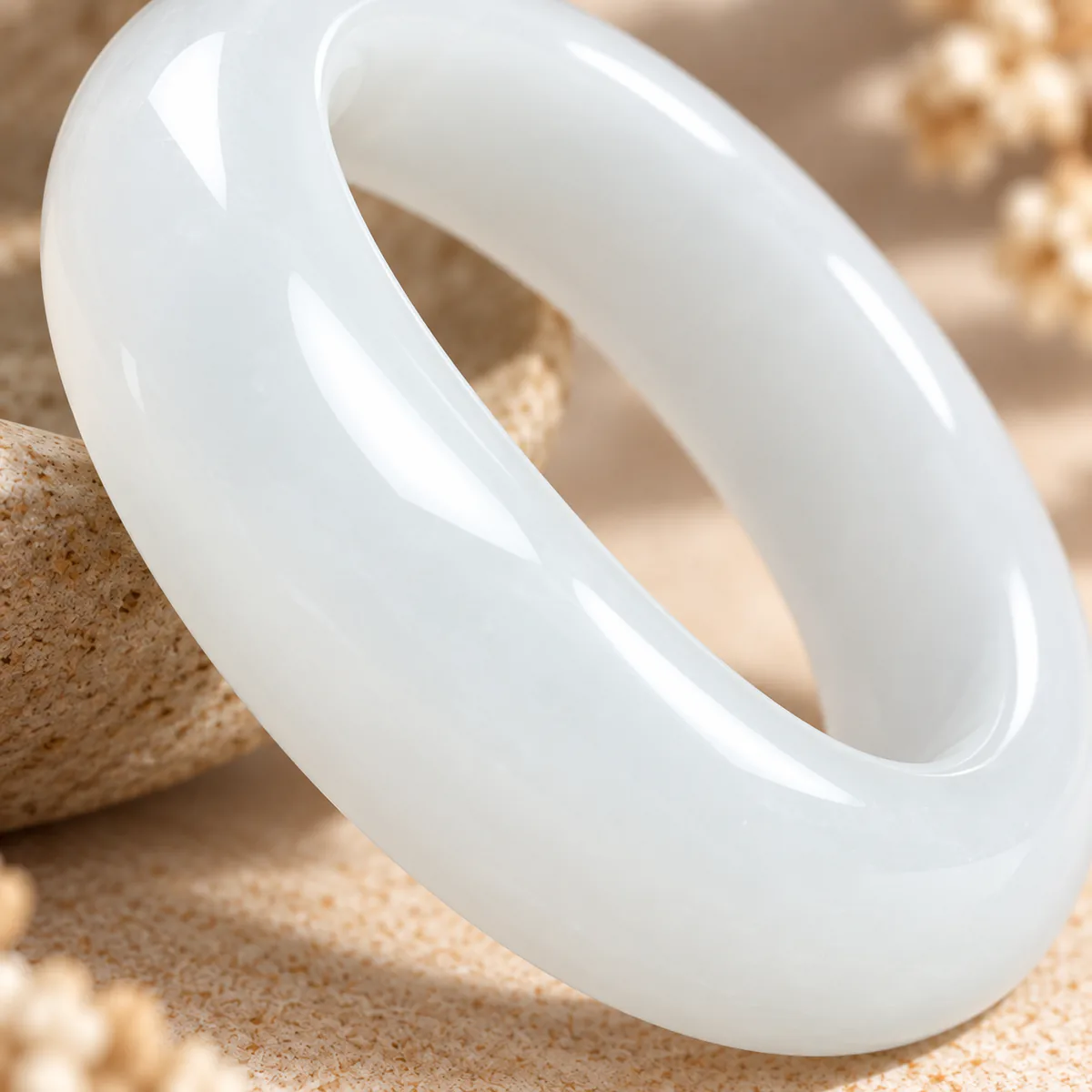
White jade ring, a solid nephrite band

62,90 €

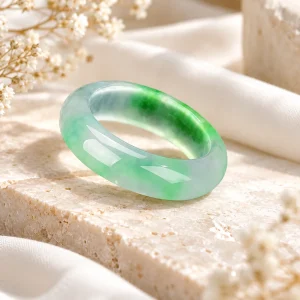
A white jade ring carved from a single block: a solid band, domed, a luminous white with a bright polish. No metal, no solder.

On its own or stacked, it goes with all your rings. A stone ring cannot be resized: measure at the end of the day, and if you usually wear fine bands, take the size above.

Nephrite, weighing of the example to come. Treatment status not determined.

How to measure your size: the guide, family by family

French sizing: the finger circumference in millimetres, so a 54 measures 54 mm.

Category:

A white jade ring carved from a single block of stone: a solid band, domed, a luminous white that the light passes through at the edges. No metal, no setting, no solder. The stone does everything.

In four lines

  • A solid band, carved from one block, with no metal at all.
  • A luminous white, bright polished, translucent at the edges.
  • A wide, domed band, smooth on the inside of the finger.
  • It cannot be resized: this page helps you choose well.

Carved from a single block

This white jade ring has no mounting, no head, no claws. To obtain a band like this one, you start from a block of stone, you drill it, you hollow it out, then you shape and polish the band until it is perfectly smooth. A good part of the block is lost along the way: only the ring remains.

The result is an object of a single material, with no joint and no solder, where nothing interrupts the curve. The inner edges are softened: the ring slides onto the finger and is quickly forgotten.

A porcelain white

The white is clear and luminous, with the glow of a fine porcelain. Where the band thins out, at the edges, the light enters the stone and turns it almost milky. The bright polish catches the reflections at every movement of the hand.

It is a white that flatters every complexion, from fair skin to olive, and stays elegant from the beach to the office.

What to wear it with

On its own, on the index or middle finger, it makes a statement ring, graphic and understated. Stacked, it slips between fine gold or silver rings, to which its white gives relief. With no metal, it clashes with no other piece.

Its solid band shape makes it entirely unisex: it is worn on a man’s finger as on a woman’s, and even on the thumb in the largest sizes.

Choosing your size, and why it matters here

A metal ring can be enlarged or tightened by a jeweller. A ring carved from stone, never: there is nothing to stretch, nothing to cut. So the size is chosen once, and with care, in the dropdown above the buy button.

Two pieces of advice avoid almost every mistake. Measure the finger at the end of the day, when it is at its largest. And remember that a wide band grips more than a fine one at the same finger circumference: if you hesitate between two sizes, or if you usually wear fine rings, take the size above, just one. Measuring your finger in two minutes.

Wearing it, and keeping it beautiful

Nephrite is the tougher of the two stones called jade: its interwoven fibers absorb the small knocks of daily life. But a ring is the piece of jewellery that takes the most hits, and a sharp knock against a hard surface can crack any stone. Take it off for sport, for DIY, for gardening and for the weights room. Hardness and toughness, the difference.

For care, lukewarm water, a mild soap and a soft cloth are enough. A white shows its glow best when creams and hand sanitizer are kept away from it: take it off while your hands dry. Never ultrasonics, steam or solvent. Care in detail.
Additional information

StoneNéphrite
ColourWhite
Stone shapeSolid band
MotifNo motif
MountingNone
MetalNone
SettingNo setting
Worn byUnisex
Paired stonesNone, jade only
Mineral familyCalcic amphibole
Hardness (Mohs)6 to 6.5
Reference density2.90 to 3.03 g/cm³
ToughnessExceptional, interlocking crystals
TreatmentNot determined
OriginOutside Burma, country of extraction not confirmed

What tradition attributes to a jade band

What follows changes register, and I flag it rather than blending it into the rest of the page. Nothing here is demonstrated. These are usages and beliefs, old and documented, that I report because they are part of the history of this stone. No piece of jewellery in this shop is sold as a treatment, and I attribute no effect to this one.

A stone of moral virtue In Confucian thought, jade is associated with qualities of character rather than with effects on the body: uprightness, constancy, restraint. It is the best documented meaning of all.
The archer's ring In China, archers wore a thick ring of jade or bone on the thumb to draw the string. Under the last dynasty it became an ornament of rank, worn by men who no longer shot a bow.
The endless circle A solid band has neither beginning nor end. In many cultures that shape has been read as a sign of continuity and commitment, and it is one of the oldest readings of the wedding ring.
The stone of eternity Under the Han dynasty, princes were buried in shrouds made of jade plaques sewn with gold thread, because jade was credited with the power to preserve the body. Excavation showed that it did not.

These readings are told, they are not verified. The moral virtues in Confucius, the virtues attributed to jade, told honestly, and what jade has been in China.

A stone does not replace a doctor and treats nothing: the full disclaimer is here.

Delivery times

Dispatched within 48 hours of your order being confirmed, for delivery within 14 days from dispatch. I keep no buffer stock, and I won’t promise a timeframe I couldn’t meet.

Postage charges

€6.99 to any destination, free on orders of €47 or more to France, Belgium, Switzerland and Luxembourg. The exact amount appears in the cart before you pay.

The packaging, and why it matters

Every piece ships in its own pouch, kept apart from the others. This isn’t about presentation: the hardness of jade is ordinary, between 6 and 6.5 for nephrite and 6.5 to 7 for jadeite, and the quartz in everyday dust sits at 7. Two pieces of jewellery that travel together end up scratching each other.

Fourteen days to change your mind

With no need to explain yourself. An email is enough to open a return, there is no form to fill in. Return postage is at your expense, unless the piece doesn’t match its listing or arrives damaged.

The wrong size is the main reason for a return in this category, and jade cannot be resized the way a solid metal band can. Two minutes of measuring almost always prevents it. The size guide.

It is all set out here, with no fine print.

The simple routine

Warm water, mild soap, a soft cloth. A very soft brush for the hollows of a carving. That’s all, and it’s enough.

What you must never do, and why

No ultrasonic cleaner, no steam, no solvent, no heat source. This isn’t a token precaution: the treatment status of my pieces is not established. My supplier doesn’t know, and weighing establishes the mineral without saying anything about a possible resin impregnation. Resin tolerates neither heat nor solvents, so every piece is handled as though it might contain some. The information sheet on treatments.

Scratches, and where they come from

Jade is tough, meaning very hard to break: its interlocking crystal structure resists fracturing, and that is why axes could be shaped from it in the Neolithic. Its hardness, on the other hand, is ordinary, 6 to 6.5 for nephrite and 6.5 to 7 for jadeite. The quartz in everyday dust sits at 7: that is what dulls jade, not knocks. The difference between the two.

Day to day

Put the piece on after perfume and cream, never before. Take it off for housework, gardening and sport, where the knocks against corners happen. Store each piece on its own, in its pouch. On a strand of beads, the thread wears out before the stone: it gets restrung, and there is nothing abnormal about that.

Cleaning jade jewellery and storing it.

What I do, and what I don’t

My name is Jade. I’m French, from Morbihan, and based in Tallinn. I choose the pieces and have them set: I mine nothing, I cut nothing, and I don’t do the metalwork myself. The work I do is the sorting, and with this material that is what decides everything.

I am neither a gemmologist, nor a lapidary, nor a therapist, and I don’t claim to be.

I weigh, I don’t certify

Before putting a reference online, I order one example of it for myself. When it reaches me unset, I weigh it in air, then suspended from a thread in a glass of water: the ratio of the two masses gives the density, and that figure separates jadeite, nephrite, serpentine and dyed quartzite without ambiguity.

One example per reference, not every piece. I don’t handle the piece that goes out to you, and I would rather say so than let you believe otherwise. The method, with its three limits.

What I can’t know

The treatment status of my pieces. My supplier doesn’t know, and the scales say nothing about it: they establish the mineral, not the resin impregnation. Only infrared spectroscopy in a laboratory would settle it, and I don’t have that done. So you will never read “jadeite A”, “type A” or “untreated” on this site. The information sheet.

Where my jade comes from

No Burmese jadeite, and the first reason is a legal one. Not the reason you read everywhere: the JADE Act of 2008 did indeed ban these stones in the United States, but that ban was lifted on 7 October 2016. What applies today dates from 8 April 2021: the US Treasury sanctioned Myanma Gems Enterprise, the state-owned company that controls the Burmese gem trade. So there is no general ban, but an American is not allowed to trade with that entity, and a stone never tells you where it has passed through. One single supply chain for ten markets: it has to hold up for the most demanding of them. When an origin isn’t confirmed to me in writing, the listing doesn’t state it. My sourcing policy.

The whole story.