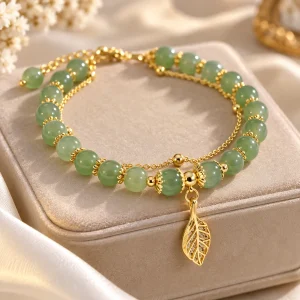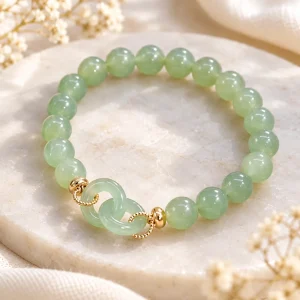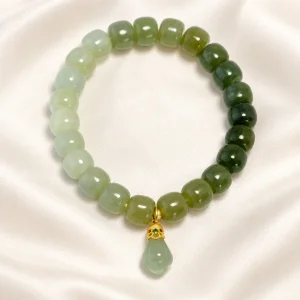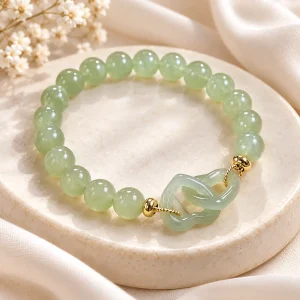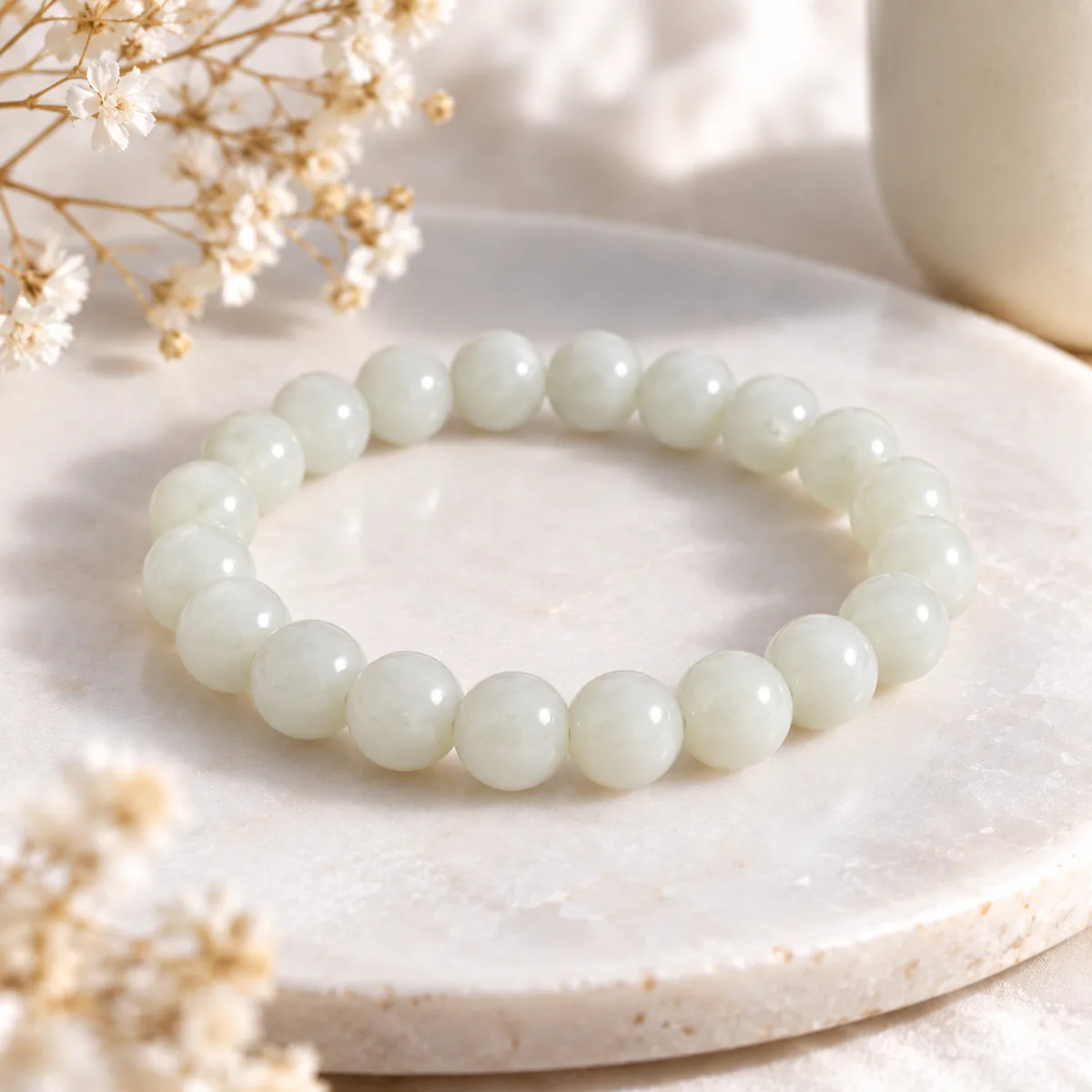
A white jade bracelet in a single strand, in round nephrite beads of a very pale white that pulls slightly toward sea green. The luster is greasy rather than glassy, and the light enters a millimetre or two at the edge of the beads. No clasp.
In four lines
- One strand of round nephrite beads, no clasp, no metal.
- Very pale white with a slight green cast, greasy luster, not glassy.
- Sized by wrist measurement: the strand goes on by stretching.
- White is the colour where one measurement is not enough. The listing explains why.
On a White Stone, One Measurement Is Not Enough, and That Is the Useful Part of This Listing
On a green stone the scale settles it fast: serpentine is at 2.6, nephrite at 2.9, and ten percent apart is not up for discussion. On a white stone, two imitations share the market, and each one escapes a different test.
Quartzite, milky white, weighs about 2.65: the scale sends it home immediately. But it is harder than nephrite, 7 against 6 to 6.5, so no scratch test will ever expose it.
Dolomitic marble, sold under invented names, does the opposite. It weighs about 2.85, within two percent of nephrite’s lower bound: the scale alone hesitates. Its hardness, though, sits around 3 to 4, it scratches under a steel point, and the gap with nephrite is enormous.
In other words, density covers hardness’s blind spot, and hardness covers density’s. Taken together, the two close the case; taken alone, neither does. That is why a white jade listing that shows one figure and stops there does not prove what it thinks it proves, even when the figure is true.
On this reference, the shop’s rule is written in advance: if the weighing does not return a nephrite result, the piece takes back its mineral name and the word jade leaves its title. It will not stay online under a name it does not deserve. The names that do not describe jade.
What These Beads Show
The white is not a chalk white. It pulls discreetly toward sea green, and it is not rigorously the same from one bead to the next: some are a little milkier, others grayer, and a few carry a barely visible cloud inside.
That is the opposite of a warning sign. What should give you pause on a strand is twenty rigorously identical beads: perfect regularity is what a dye bath produces, not what rock produces.
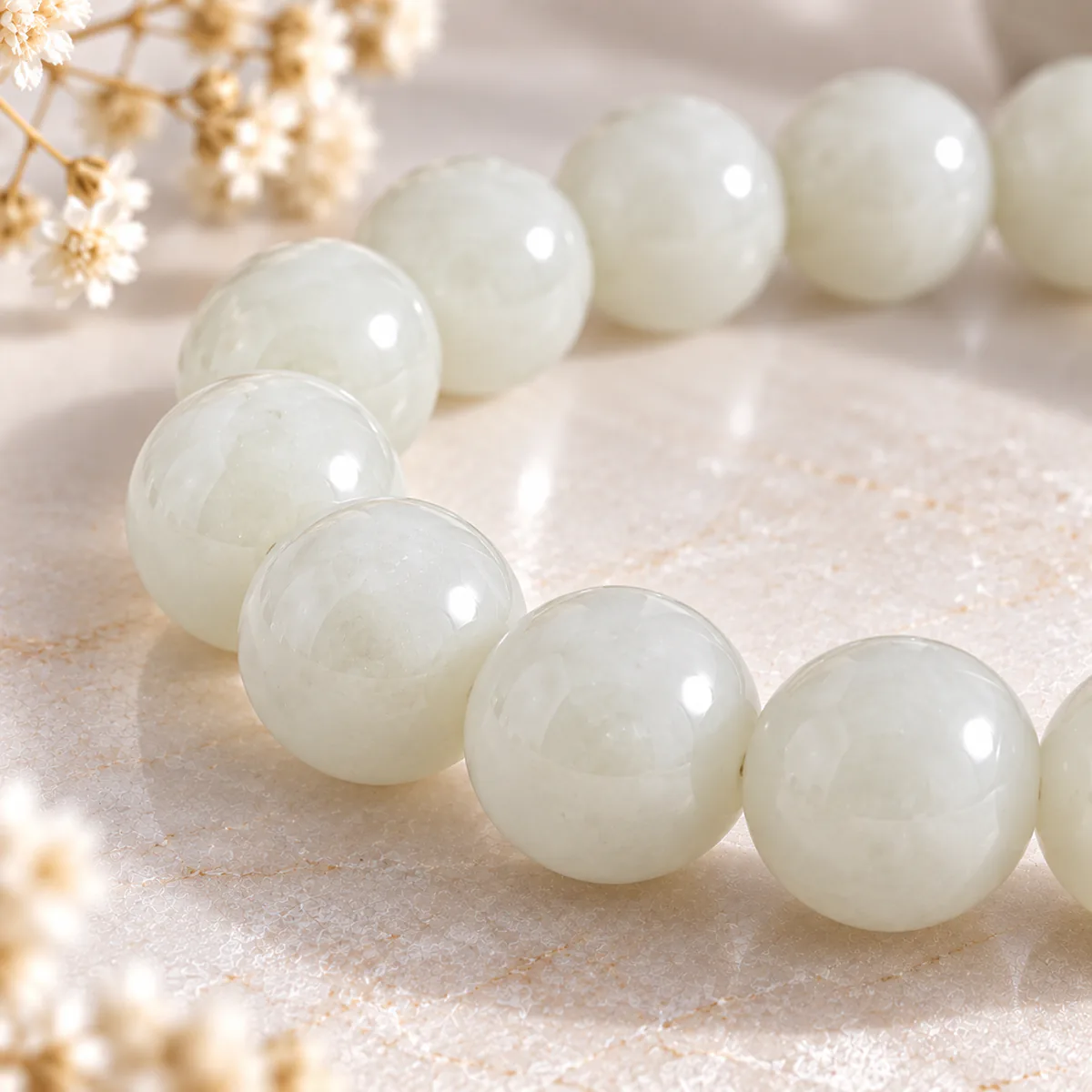
Luster is the other thing to look at, and it shows clearly in the second photograph. Nephrite returns a greasy, slightly soapy light, because it is made of interlocking fibers and not of grains. Marble returns a sugary, grainy light that catches in small points. That is not proof, it is a first sort, and it can be done with the naked eye. The checks that need no equipment at all.
Mutton Fat, the Name I Will Not Write
The finest white nephrites carry in China the name yangzhi yu, translated as mutton fat jade. It is a name of appearance and of quality, not a mineral name: it describes a dense white, very slightly creamy, with no visible structure.
There is no numerical threshold separating a mutton fat nephrite from any other, no laboratory certifies it, and that is exactly why it gets stuck onto anything white. So you will not find it in the title of this listing, nor in any other in this shop. A name that cannot be verified is worth no more than a promise.
Nephrite, and Why White Mattered Before Green
Nephrite is a calcium amphibole, one of the two minerals the word jade covers; the other is jadeite, a pyroxene. The two are entirely unrelated, and Alexis Damour established that in 1863. What sets them apart.
In imperial China the jade that was sought after was for a long time white, not green: the pale nephrite of the Khotan deposits, to the west, supplied court objects for nearly two thousand years. Jadeite’s brilliant green only arrives in the eighteenth century. White is not a discount jade, then, it is the original one. What jade has been in China.
The Strand, the Wrist Measurement and the Elastic
There is no clasp. A strand of beads with no clasp is strung on an elastic cord that does not show between the beads: that is what I will check on the example, like the rest. It goes on by stretching, so it is sized by wrist measurement, not by a chain length. How to measure it in two minutes.
Elastic is the most practical and the least durable way to string beads: it slackens, then it gives way, usually without warning. Put it on by rolling it over your hand rather than pulling on it, and take it off before sports and the shower. When it goes, a jeweller restrings it for a few euros and not one bead is lost.
A White Stone Gets Dirty, and It Shows
That is the practical difference between this strand and a dark green one: a pale bead shows everything. Creams, perfumes and skin oils leave a yellowish film that settles first around the drill hole, where the cord rubs, then spreads across the surface.
The routine is simple and it is enough: lukewarm water, mild soap, a soft cloth, fully dry before putting it back on. Perfume goes on before the bracelet, never over it. Never an ultrasonic cleaner, never steam, never solvents: since the treatment status is unknown, any resin there might be would not survive them, and ultrasound attacks the cord first. Nephrite’s hardness stays ordinary, 6 to 6.5, and it is the quartz in dust, which rates 7, that dulls beads over time. Hardness and toughness, and care in detail.