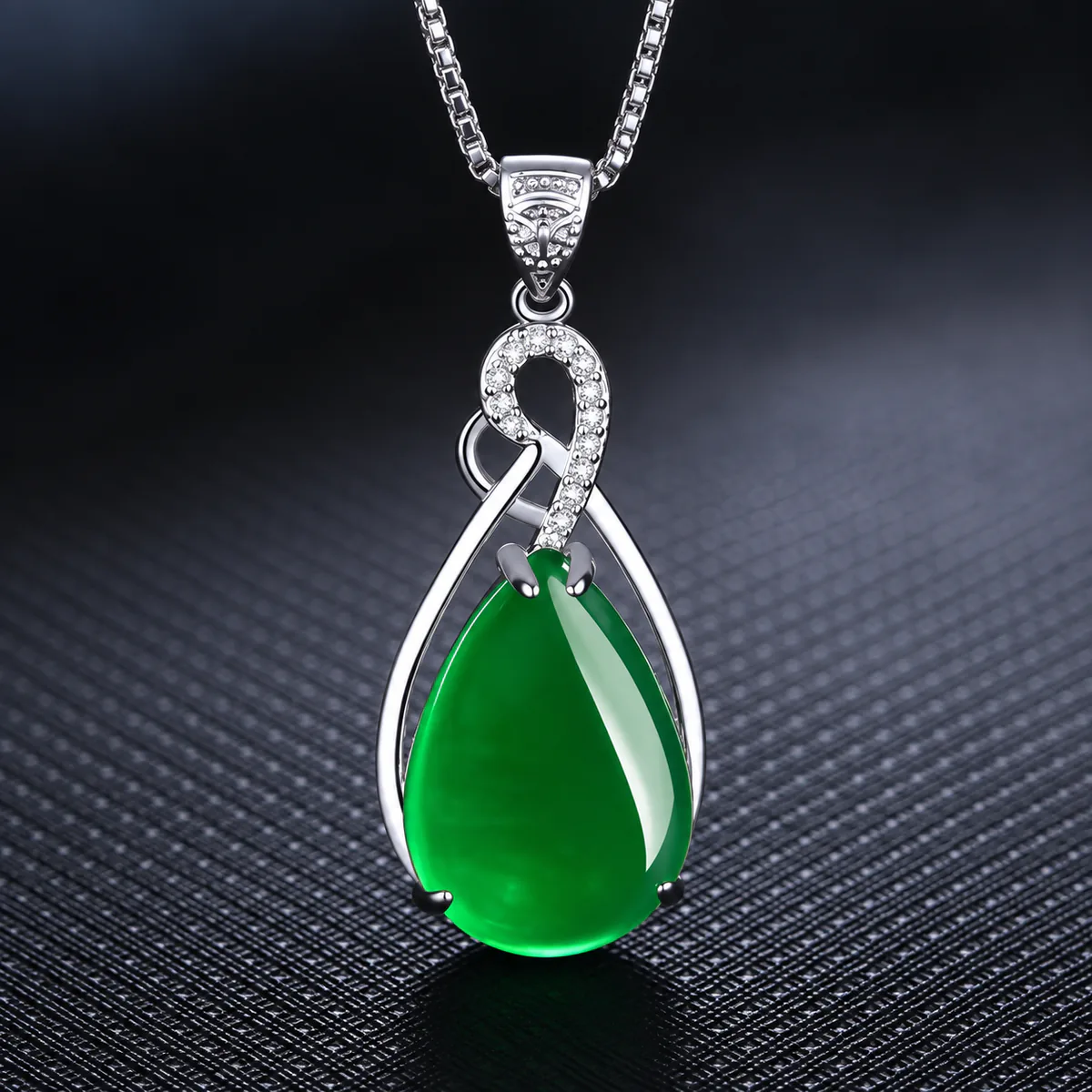
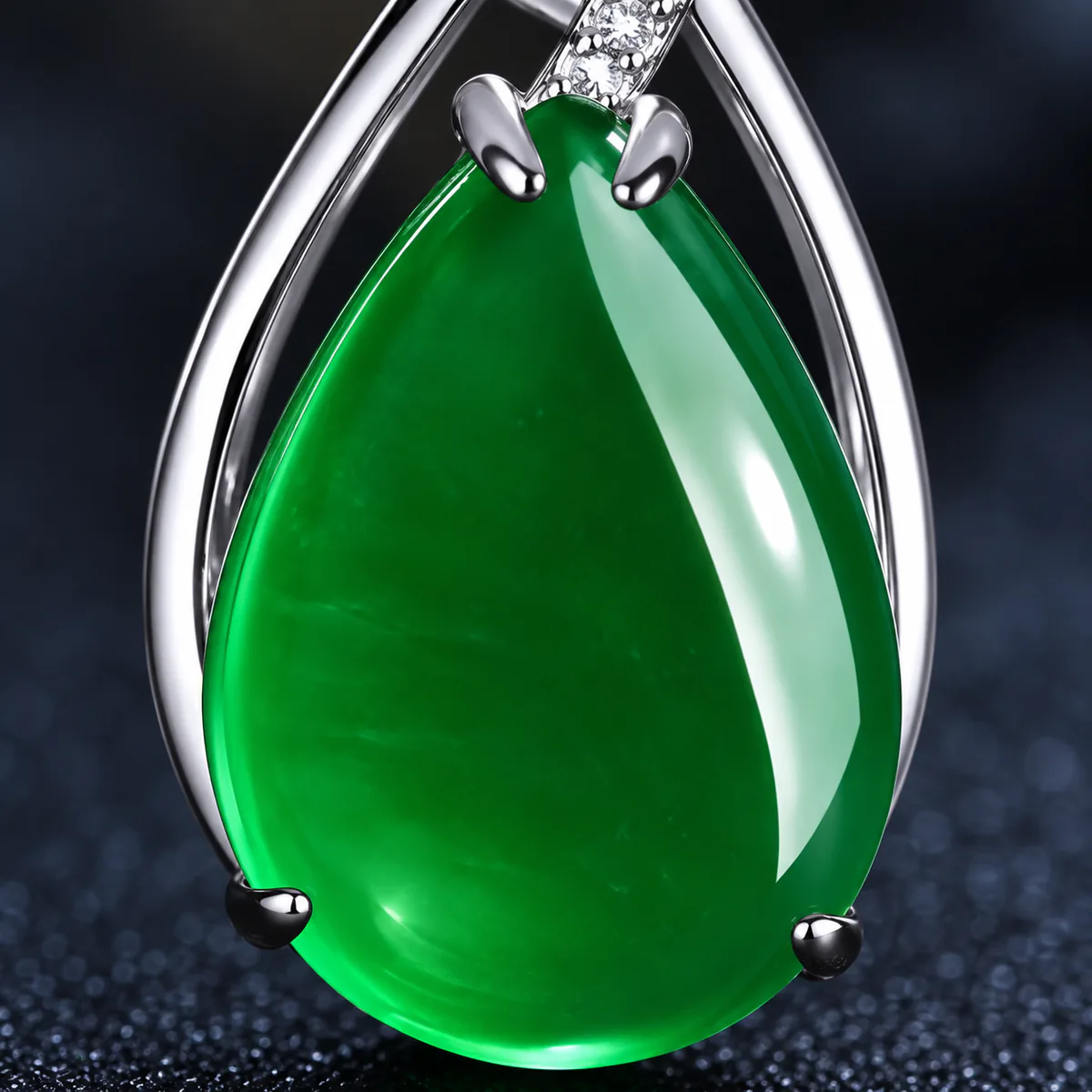
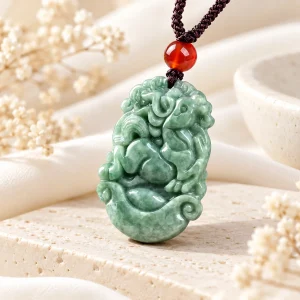
Green jade pendant, teardrop cabochon held by four claws in an openwork frame. The stone stays visible over almost all of its surface, girdle included.
Bail and loop paved with small white stones, which my supplier does not name and which I will not call diamond, or topaz, or zircon. Chain included.
A deep and very even green. Set, therefore not weighable, and treatment status not determined: this page discusses that evenness rather than boasting about it.
A green jade pendant set on a teardrop cabochon, held by four claws in an openwork frame that wraps it without covering it. The bail and the loop are paved with small white stones. The chain is included. The green is deep, translucent, and very even.
In four lines
Teardrop cabochon, four-claw set in an openwork frame.
Pavé of white stones on the bail and the loop, not identified.
Chain included. Its length has not been confirmed to me in writing.
A deep and very even green: this page discusses that evenness further down.
A very even green, and what I can say about it
This cabochon is a deep, clear, translucent green, remarkably even from one edge to the other. That is what makes it beautiful, and it is also what should be discussed rather than boasted about.
A perfectly uniform colour on a natural stone is rare, because chromium did not settle to order. It can come from severe sorting through a large lot, or from a coloured impregnation. I do not know which of the two, I have not had it analysed, and the treatment status of this piece is not determined, like that of this whole catalogue. What the letters A, B and C cover.
What I refuse to write is the opposite: not “untreated”, not “natural”, not “A jadeite”, not “type A”. Those four words are the ones the market uses exactly when it does not know, and French decree no. 2002-65 makes silence about a treatment an offence, not discretion. I weigh, I do not certify.
The white pavé, and why it has no name here
The bail and the loop carry some twenty small white stones set in pavé. My supplier does not name them. At that size, a cubic zirconia, a white topaz and a diamond look very much alike, and it takes a loupe and practise to tell them apart. So I will not call them by any of those names.
This is not excessive caution: naming a stone wrongly is precisely what the decree on designations penalises, and a shop that calls a zircon a “diamond” has already lost the right to explain the difference between jade and serpentine.
The teardrop and the claws, what this setting changes
The cabochon is cut as a teardrop, taller than it is wide, and domed. Four fine claws hold it, two at the top, two at the bottom, and the openwork frame passes on either side without ever covering the stone. So you see the jade over almost all of its surface, girdle included, which a closed setting forbids.
In exchange, an exposed stone takes edge knocks first. Jade is tough, that is, very hard to break, but its hardness is ordinary: the quartz in ambient dust, which rates 7, dulls a cabochon far more surely than a knock does. The difference between hardness and toughness.
Why I write green jade pendant, and not simply jade pendant
Because the word jade on its own does not say much. What is sold under that name is very often serpentine, labelled “new jade” or “Korean jade”, or dyed quartzite, sold as “Malaysia jade”. None of those names designates jade.
On a bare stone, the scale settles it: the four markers in the record are separated by far more than the uncertainty of a kitchen scale. On a set stone, it does not settle anything. This page says so, and that is all the solid ground I can offer you on this particular piece. The checks you can make yourself.
Additional information
Stone
Jadéite
Colour
Clear green
Stone shape
Drop
Motif
No motif
Mounting
Chain
Metal
Sterling silver 925
Setting
Claw set
Worn by
Women
Paired stones
White stones, not identified
Mineral family
Sodium aluminium pyroxene
Hardness (Mohs)
6.5 to 7
Reference density
3.25 to 3.36 g/cm³
Toughness
Exceptional, interlocking crystals
Treatment
Not determined
Origin
Outside Burma, country of extraction not confirmed
What tradition attributes to a jade pendant
What follows changes register, and I flag it rather than blending it into the rest of the page. None of it is proven. These are customs and beliefs, old and documented, which I report because they are part of the history of this stone. No piece of jewellery in this shop is sold as a treatment, and I claim no effect for this one.
The stone worn against the skinJade takes the temperature of the body in a few minutes and keeps it. That is a physical property, conductivity, and several traditions have made something quite different of it. I stay with the first.
The teardropThe teardrop shape carries no symbolic charge of its own in the Chinese tradition of jade: it is a modern jewellery cut, Western in origin. I say so rather than inventing a history for it.
A stone of moral virtueIn Confucian thought, jade is associated with qualities of character rather than effects on the body: uprightness, constancy, restraint. It is the best documented meaning of them all.
Imperial greenThe market calls imperial green a clear, translucent green, and the phrase circulates with no fixed definition: it is neither a standard, nor an official grading, nor a guarantee of anything. I use it on none of my pages.
Dispatch within 48 hours of your order being confirmed, for delivery within 14 days from dispatch. I keep no stock in reserve, and I will not promise a date I could not meet.
Shipping Costs
€6.99 whatever the destination, free on orders over €47 to France, Belgium, Switzerland and Luxembourg. The exact amount is shown in your basket before you pay.
The Packaging, and Why It Matters
Every piece travels in its own pouch, kept apart from the others. This is not a question of presentation: the hardness of jade is unremarkable, between 6 and 6.5 for nephrite and 6.5 to 7 for jadeite, and the quartz in ordinary household dust sits at 7. Two pieces of jewellery that travel together arrive marked.
Fourteen Days to Change Your Mind
No need to give a reason. An email is enough to open a return; there is no form to fill in. Return postage is at your expense, unless the piece does not match its listing or arrives damaged.
Lukewarm water, mild soap, a soft cloth. A very soft brush for the hollows of a carving. That is all, and it is enough.
What You Must Never Do, and Why
No ultrasonic cleaners, no steam, no solvents, no heat source. This is not a precaution for show: the treatment status of my pieces is undetermined. My supplier does not know it, and weighing identifies the mineral without telling me anything about a possible resin impregnation. Resin withstands neither heat nor solvents, so every piece is handled as though it might contain some. The information sheet on treatments.
Scratches, and Where They Come From
Jade is tough, meaning very difficult to break: its structure of interlocking crystals resists cracking, and that is what made it usable for axe heads in the Neolithic. Its hardness, by contrast, is unremarkable, 6 to 6.5 for nephrite and 6.5 to 7 for jadeite. The quartz in ordinary household dust sits at 7: that is what dulls a jade, not knocks. The difference between the two.
Day to Day
Put the piece on after perfume and cream, never before. Take it off for housework, gardening and sport, where knocks against hard edges are common. Store each piece on its own, in its pouch. On a strand of beads, the thread wears out before the stone: it gets restrung, and there is nothing abnormal about that.
My name is Jade. French, from Morbihan, living in Tallinn. I choose the pieces and have them mounted: I mine nothing, I cut nothing, and the metalwork is not done by my hand. What I bring is the selection, and with this material that is what decides everything.
I am not a gemmologist, not a lapidary, not a therapist, and I do not claim to be.
I Weigh, I Do Not Certify
Before a listing goes online, I order one example of it for myself. When it reaches me unmounted, I weigh it in air, then suspended from a thread in a glass of water: the ratio of the two masses gives the density, and that figure separates jadeite, nephrite, serpentine and dyed quartzite without ambiguity.
One example per listing, and not every piece. I do not handle the piece that is sent to you, and I would rather write that down than let you believe otherwise. The method, with its three limits.
What I Cannot Know
The treatment status of my pieces. My supplier does not know it, and the scales do not tell me: they identify the mineral, not the resin impregnation. Only infrared spectroscopy in a laboratory would settle it, and I do not have that done. So you will never read “Grade A jadeite”, “Type A” or “untreated” on this site. The information sheet.
Where My Jade Comes From
No Burmese jadeite, and the first reason is legal. Not the one you read everywhere: the JADE Act of 2008 did ban these stones in the United States, but that ban was lifted on 7 October 2016. What applies today dates from 8 April 2021: the US Treasury sanctioned Myanma Gems Enterprise, the state company that controls the Burmese gem trade. So there is no blanket ban, but a US person is not allowed to trade with that entity, and a stone never tells you where it has been. A single supply chain serves ten markets, so it has to hold up in the most demanding of them. When an origin is not confirmed to me in writing, the listing does not state it. My origin charter.