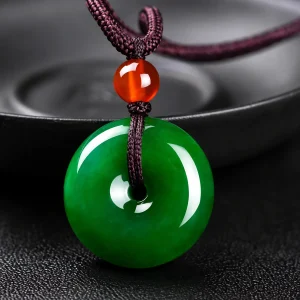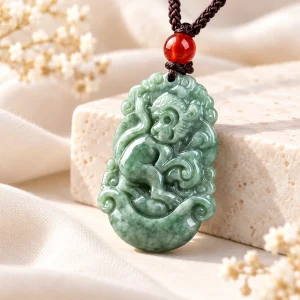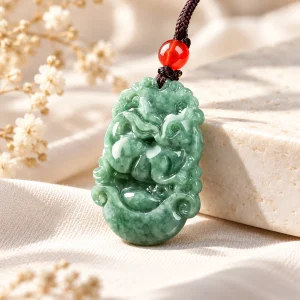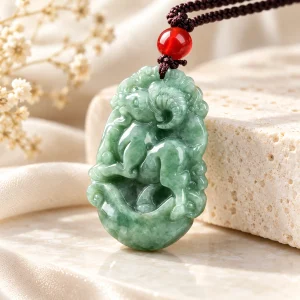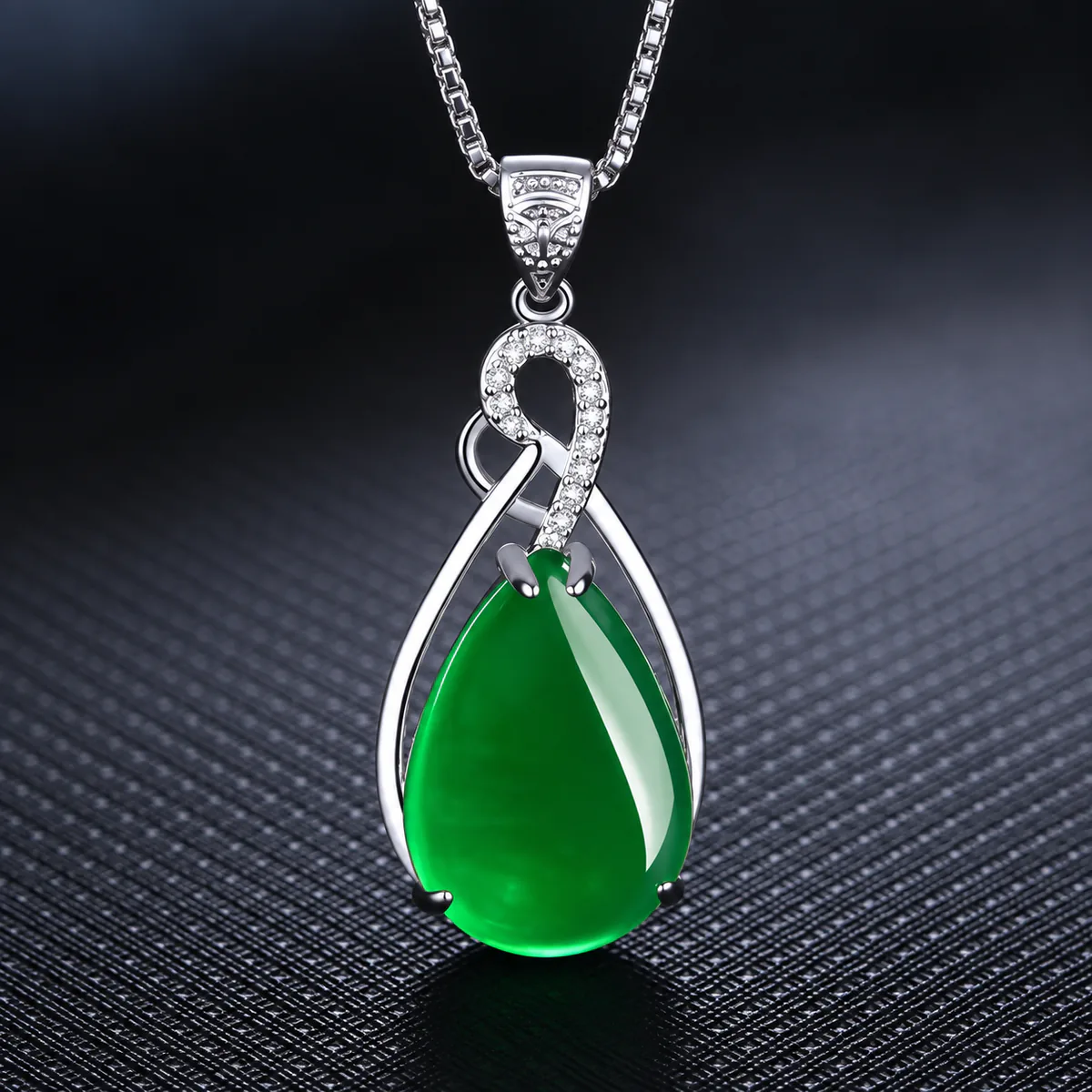
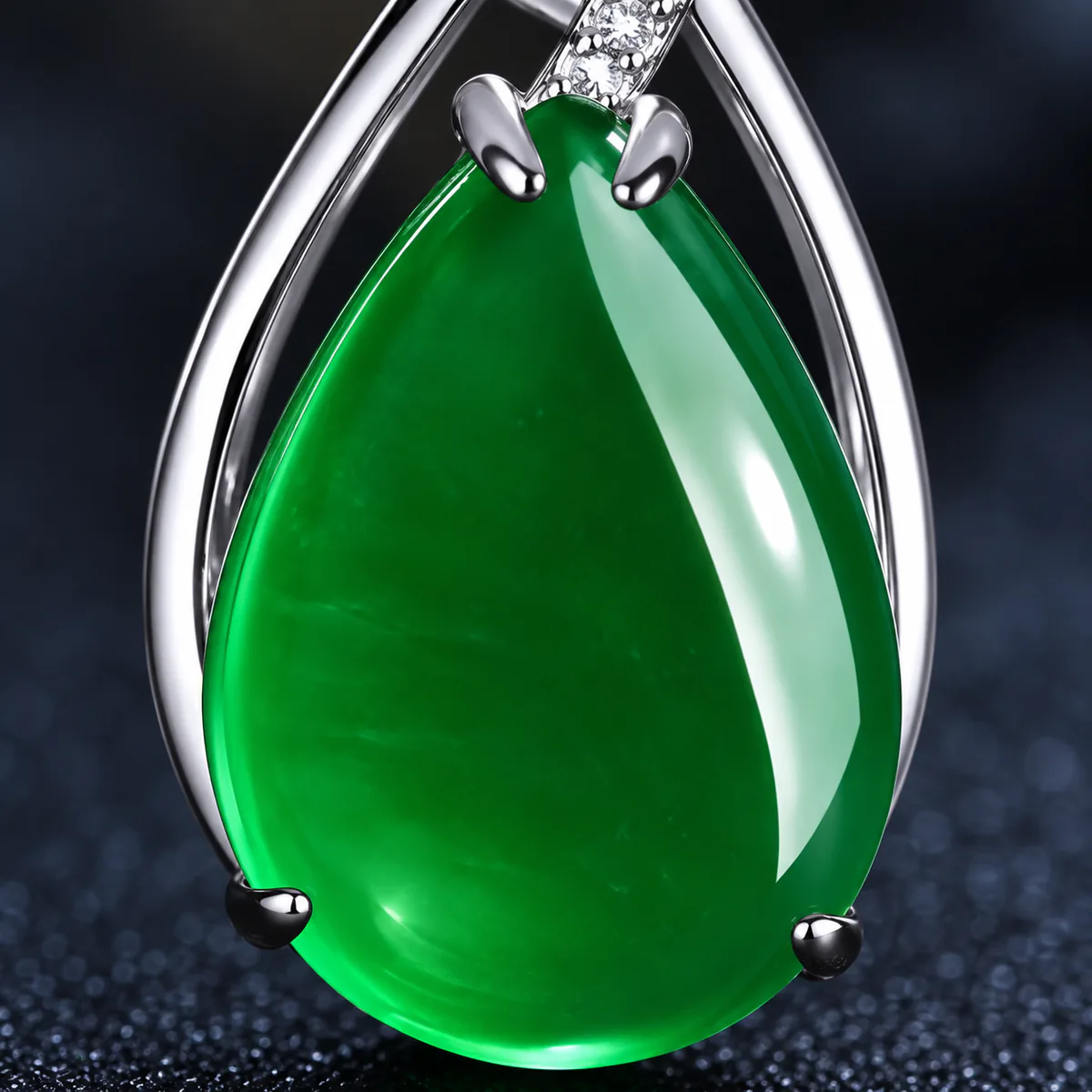
A green jade pendant set on a teardrop cabochon, held by four claws in an openwork frame that wraps it without covering it. The bail and the loop are paved with small white stones. The chain is included. The green is deep, translucent, and very even.
In four lines
- Teardrop cabochon, four-claw set in an openwork frame.
- Pavé of white stones on the bail and the loop, not identified.
- Chain included. Its length has not been confirmed to me in writing.
- A deep and very even green: this page discusses that evenness further down.
A very even green, and what I can say about it
This cabochon is a deep, clear, translucent green, remarkably even from one edge to the other. That is what makes it beautiful, and it is also what should be discussed rather than boasted about.
A perfectly uniform colour on a natural stone is rare, because chromium did not settle to order. It can come from severe sorting through a large lot, or from a coloured impregnation. I do not know which of the two, I have not had it analysed, and the treatment status of this piece is not determined, like that of this whole catalogue. What the letters A, B and C cover.
What I refuse to write is the opposite: not “untreated”, not “natural”, not “A jadeite”, not “type A”. Those four words are the ones the market uses exactly when it does not know, and French decree no. 2002-65 makes silence about a treatment an offence, not discretion. I weigh, I do not certify.
The white pavé, and why it has no name here
The bail and the loop carry some twenty small white stones set in pavé. My supplier does not name them. At that size, a cubic zirconia, a white topaz and a diamond look very much alike, and it takes a loupe and practise to tell them apart. So I will not call them by any of those names.
This is not excessive caution: naming a stone wrongly is precisely what the decree on designations penalises, and a shop that calls a zircon a “diamond” has already lost the right to explain the difference between jade and serpentine.
The teardrop and the claws, what this setting changes
The cabochon is cut as a teardrop, taller than it is wide, and domed. Four fine claws hold it, two at the top, two at the bottom, and the openwork frame passes on either side without ever covering the stone. So you see the jade over almost all of its surface, girdle included, which a closed setting forbids.
In exchange, an exposed stone takes edge knocks first. Jade is tough, that is, very hard to break, but its hardness is ordinary: the quartz in ambient dust, which rates 7, dulls a cabochon far more surely than a knock does. The difference between hardness and toughness.
Why I write green jade pendant, and not simply jade pendant
Because the word jade on its own does not say much. What is sold under that name is very often serpentine, labelled “new jade” or “Korean jade”, or dyed quartzite, sold as “Malaysia jade”. None of those names designates jade.
On a bare stone, the scale settles it: the four markers in the record are separated by far more than the uncertainty of a kitchen scale. On a set stone, it does not settle anything. This page says so, and that is all the solid ground I can offer you on this particular piece. The checks you can make yourself.