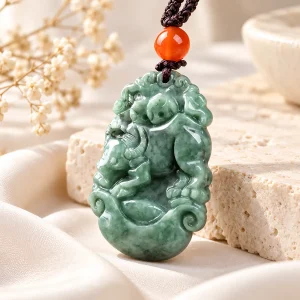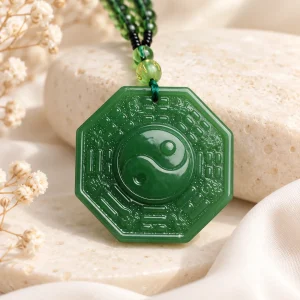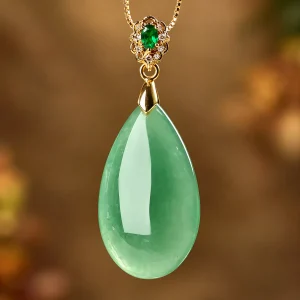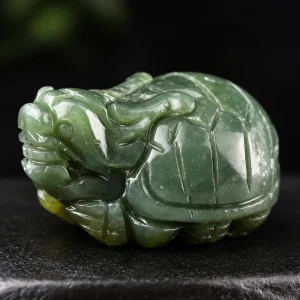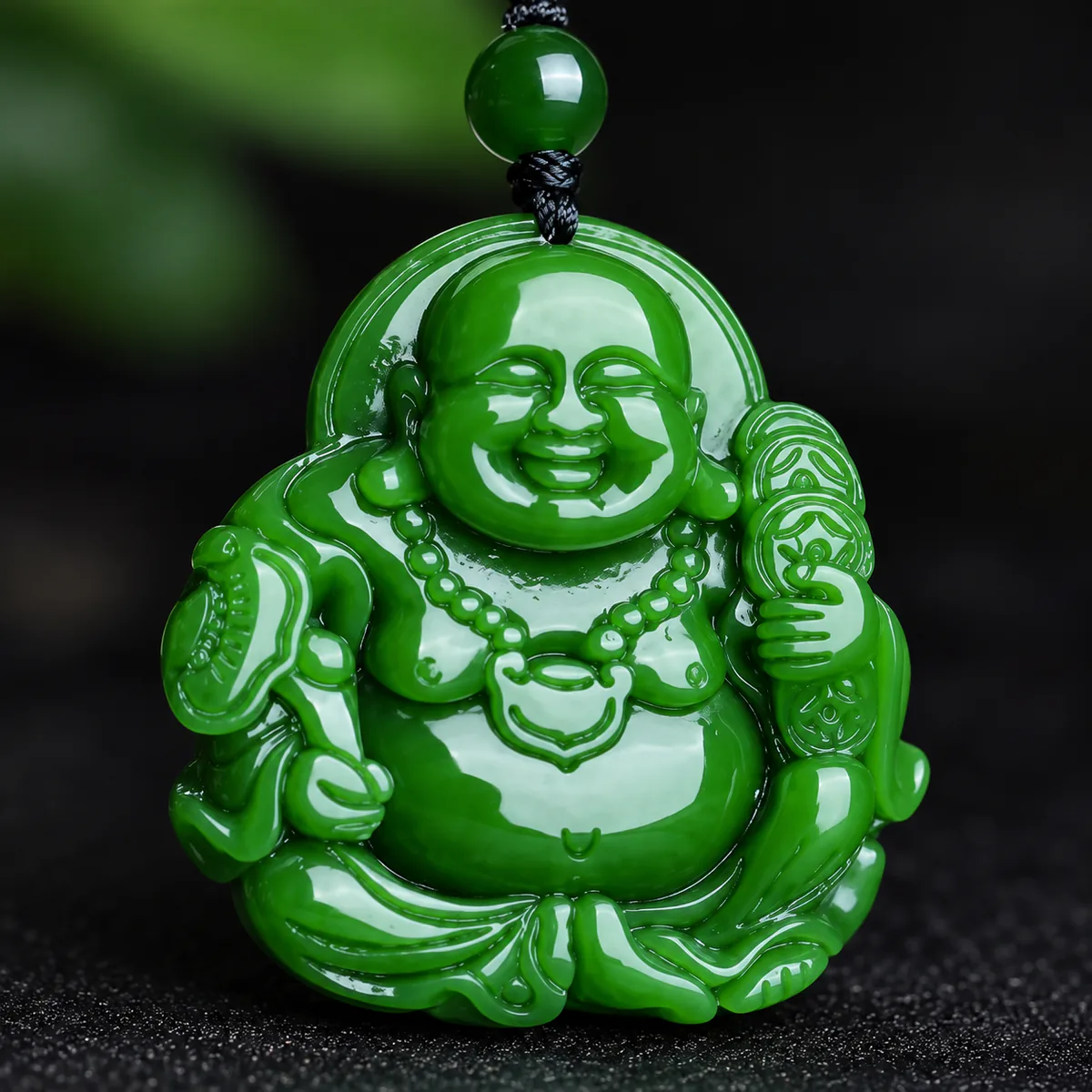
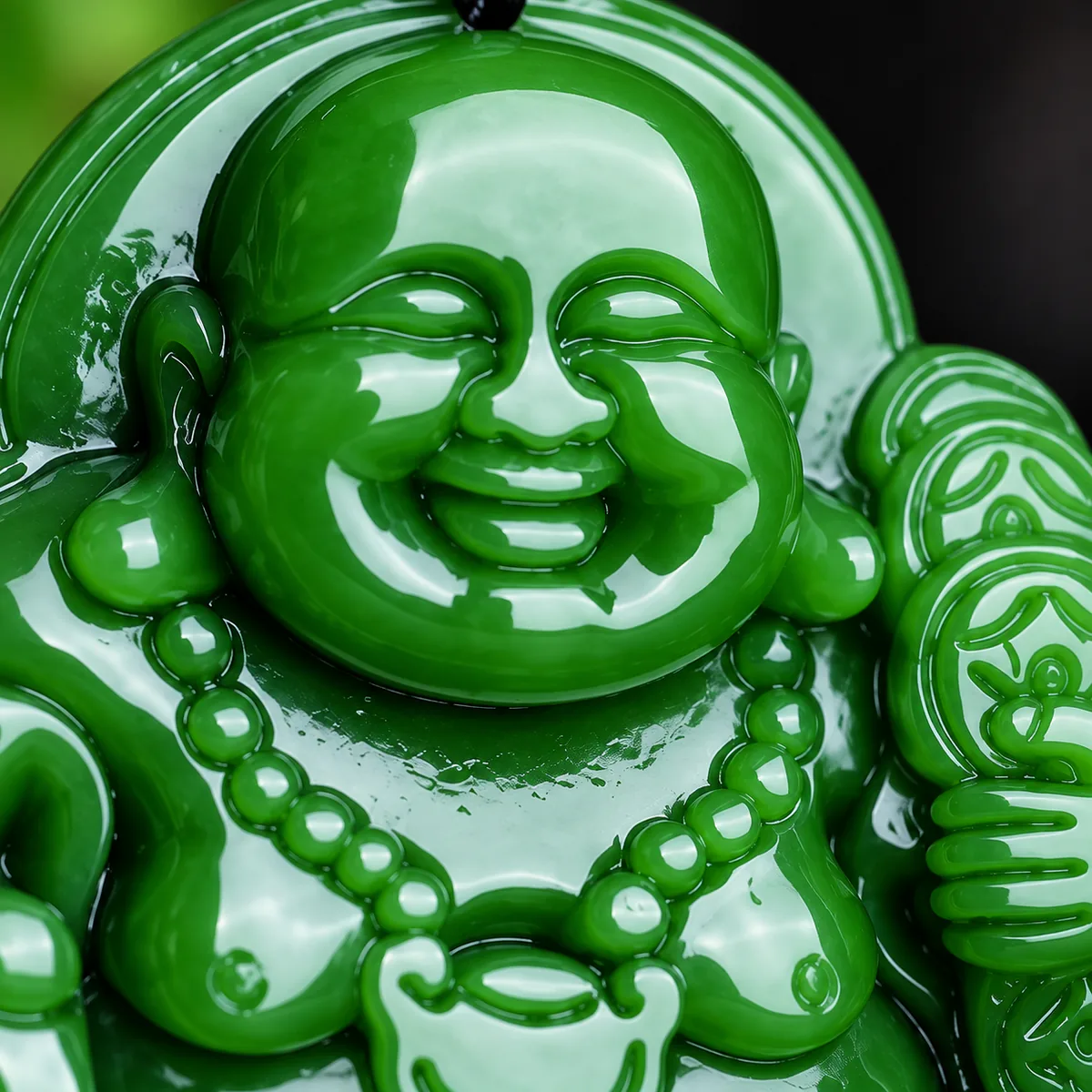
A jade Buddha pendant carved in relief: the figure is seated, laughing, belly bare, a sack in one hand and a cabochon of the tree of life in the other, a string of beads and a longevity lock engraved on the chest. It is drilled right through and strung on a black braided cord.
In four lines
- Relief carving, drilled, strung on a braided cord. No metal.
- The laughing figure is Budai, a Chinese monk, not the historical Buddha.
- Bare stone, therefore weighable: the figure will be published here, with its date.
- A deep, even green, whose evenness this page discusses further down.
This figure is not the Buddha
The laughing round-bellied figure everyone calls “Buddha” is Budai, a Chinese monk of the tenth century, a wandering beggar, later associated with the Buddha to come, Maitreya. He is not Siddhartha Gautama, the historical Buddha, who is shown slender, in meditation, eyes lowered.
The word “Buddha” has stuck in the trade, and I use it in the title of this page because that is the word people search for this piece with. But I am not going to let anyone believe that the sack, the belly and the laugh are the Buddha’s: they are Budai’s, and the attribution was made in China, not in India. The whole story of the figure.
It is a religious figure. Given as a gift, it does not suit everyone, and it is better to know that beforehand: giving a piece of jade jewellery.
A deep, even green, and what I can say about it
The carving is a clear, deep green, almost uniform, lighter on the raised parts and darker in the hollows. That contrast is optics, not a clue: on any carved and polished stone, the bumps return the light and the hollows stay in shadow.
What would deserve attention is different: a colour that follows a network of cracks rather than the shape, or that concentrates around the drill hole. On a carved piece, the chisel hollows are where a dye lodges best, and a jeweller’s loupe is enough to see whether it is there. I assert nothing about this piece, whose treatment status is not determined, like that of the whole catalogue. The checks that need no equipment.
The carving, and what it demands of the material
A relief like this one cannot be cut in just any stone: it takes a material that accepts deep hollows without splitting along a plane. Jade allows it thanks to its toughness, a structure of interlocking crystals that stops a crack from spreading. Its hardness, on the other hand, stays ordinary, 6.5 to 7 for jadeite. The difference between hardness and toughness.
The practical consequence: it is the fine edges of the relief that suffer, not the mass. A knock will not open the piece, it will chip the edge of a sleeve or an ear. And the quartz in the ambient dust, which rates 7, dulls the domed surfaces far more surely than an accident. A very soft brush for the hollows, warm water, a mild soap. Care in detail.
Why I write jade Buddha pendant, and not simply green stone
Because the word jade on its own does not say much, and because the laughing figure is precisely the motif most often carved in something else. What is sold under this name is very often serpentine, labelled “new jade” or “Korean jade”, or dyed quartzite, sold as “Malaysia jade”. None of those names designates jade.
The difference is physical and it can be measured: the four markers in the record are separated by far more than the uncertainty of a kitchen scale. Here the stone is bare, so the figure will come. That is what licences the word genuine on this site, and nothing else: never the untreated set against the treated. I weigh, I do not certify.