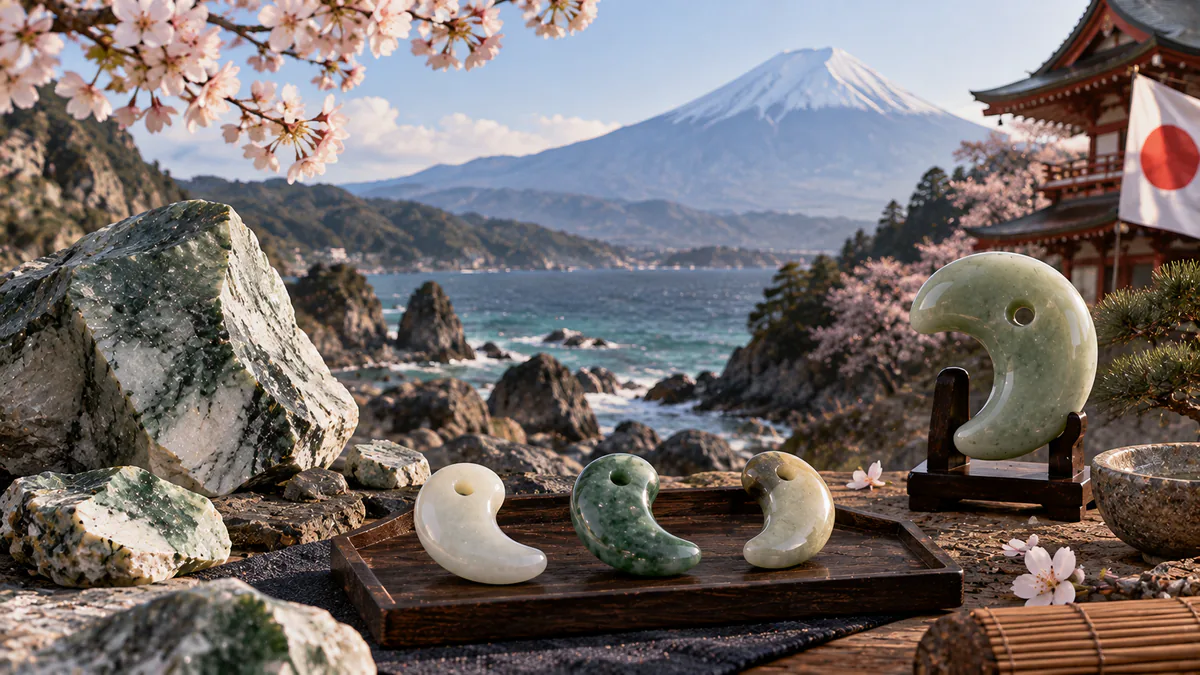
Jade in Japan: Itoigawa, the magatama and the national stone
This page tells the story of the third centre of ancient jade, the one almost never covered in French: a jadeite deposit on the Sea of Japan, beads carved thousands of years ago, a national stone designated in 2016, and what a closed deposit means for anyone buying jade in France.
Japanese jade is jadeite, its centre is Itoigawa, in Niigata Prefecture, where it has been gathered and worked for about seven thousand years, and it hardly feeds the trade at all: the deposits are protected and collecting there is prohibited.
| Milestone | What it establishes |
|---|---|
| About 7,000 years ago | Jade is gathered and worked at Itoigawa |
| About 5,500 years ago | The first jadeite beads |
| 1939 | Jadeite is identified in Japan itself |
| September 2016 | Jadeite designated Japan’s national stone |
My name is Jade, and I run a jade jewellery workshop: I choose the pieces, have them set, and weigh one example of each reference before it goes on sale. I am neither an archaeologist nor a gemmologist, I have never been to Itoigawa, and everything that follows comes from my reading: I say which at the end.
Itoigawa, a deposit on the Sea of Japan
Japan has several jadeite deposits, but the one that supplied the ancient objects is Itoigawa, a coastal city in Niigata Prefecture, on the Sea of Japan. It sits at the western end of the Fossa Magna, the great depression that cuts the archipelago in two, along the Itoigawa-Shizuoka tectonic line. This is not scenery: jadeite only forms in ancient subduction zones, where one plate dives beneath another.
On the ground, this means blocks of jadeite scattered in riverbeds, notably in the Kotakigawa gorge, at the foot of Mount Myojo. The mechanism is the same everywhere: how jade stone forms, and the map of the other sources is in where jade comes from.
The whole area has been a UNESCO Global Geopark since 2015, covering 74,624 hectares. It is recognition of geological heritage, not a commercial label: it protects a territory, it puts nothing up for sale.
1939, the year Japan found its own jade
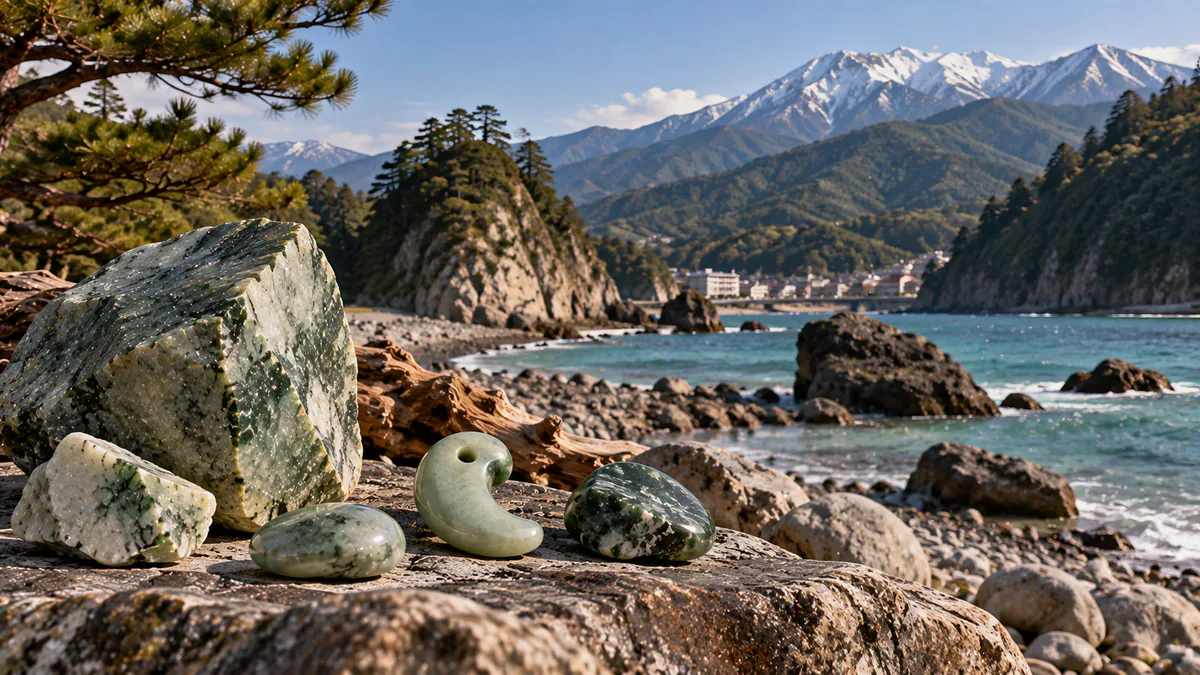
Here is the fact that made me decide to write this page. Until 1939, jade objects from Japanese archaeological sites were attributed to China: they were thought to be imports, since no local source was known. That year, jadeite was identified in Japan itself, in the Itoigawa area, and the interpretation flipped.
Millennia of local production then changed hands, without a single object moving from its display case. This is exactly what had happened in Europe eighty years earlier, when Alexis Damour recognized jadeite in Neolithic axes thought to have come from Asia: jade in Europe. The same mistake twice, at the same point in the reasoning: a distant origin had been assumed for lack of looking for a nearby one.
The jade bracelets available now
The magatama, and the object that came before them
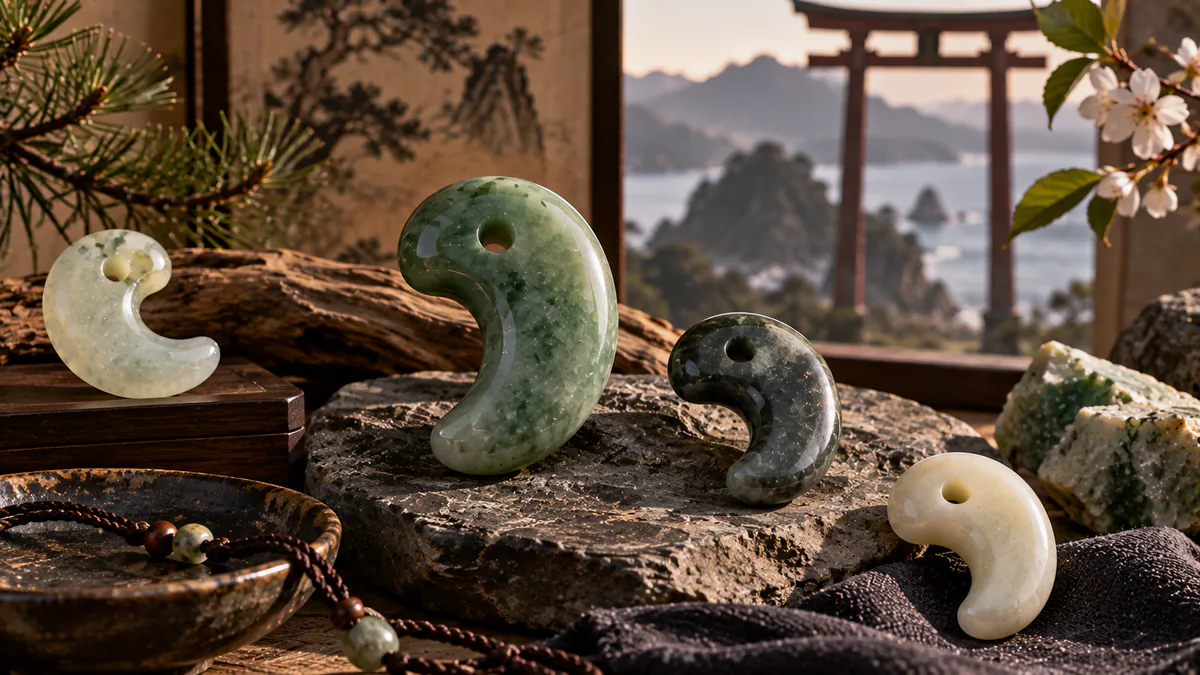
The magatama is that curved bead, drilled through its head, whose comma-shaped outline now serves as a Japanese symbol almost everywhere. It is found throughout the archipelago, in jade but also in rock crystal, glass or talc.
What you rarely read: it is not the first form. The oldest jadeite ornaments from Itoigawa are large pierced pendants, the taishu. The curved bead took over later, and it is the one that runs through the following periods, Yayoi then Kofun, when it accompanied the dead and marked rank.
The motif everyone associates with Japanese jade is therefore an end point, not a starting point. The other meaningful forms are covered in jade motifs.
Seven thousand years, and what that number actually says
You often read that Itoigawa is home to the oldest jade culture in the world. The phrase blends two sentences that do not carry the same weight.
What is solid: jadeite was worked at Itoigawa thousands of years before it was in China. Neolithic China worked nephrite, and jadeite only reached China very late, imported from Burma, its imperial vogue dating from the 18th century (jade jewellery in China).
What is less so: saying Japan worked jade before China. That is not the same sentence, since the word covers two unrelated minerals, and Chinese nephrite has an antiquity of the same order. The distinction is the whole subject of jadeite or nephrite, and the core of what I explain about this stone.
As for the number itself, it varies with what is being counted: about seven thousand years if you start from the first jade object, about five thousand five hundred for the first beads. Both appear in the same authors, and they do not contradict each other.
A hammer before a jewel
Among the ancient pieces from Itoigawa is a jadeite hammer about seven thousand years old, and it is not a curiosity: it is the material’s reason for being. Jade was not chosen for its hardness, which is moderate, but for its toughness, its resistance to breaking, which is exceptional in both minerals.
That toughness produced the polished tools of the Neolithic, in nephrite in China, in jadeite in the Alps and in Japan. The jewel came after the tool: why jade almost never breaks.
A national stone designated by a scientific society
In September 2016, jadeite was designated Japan’s national stone by the Japan Association of Mineralogical Sciences.
This point needs a clarification that the French pages I opened skip over: the decision came from a scientific society, not from the Japanese state. The choice fits the country’s geology, since jadeite is a subduction-zone stone and the archipelago is one.
This takes nothing away, it only says who spoke: I prefer to name who decides rather than write “official”, as in how jade is named.
A magatama among the three imperial regalia
The Japanese imperial tradition has three regalia: a mirror, a sword, and a magatama, the Yasakani no Magatama. They are never shown. During ceremonies, the bead and the sword appear only in their sealed boxes.
The direct consequence, and this is where I stop: the material of this object has not been established. It is described as a jade jewel, no public observation has confirmed it, and I prefer the gap to a plausible value, here as on a product page.
Why this jade cannot be bought
The Itoigawa sites are protected and extraction is prohibited there: the Kotakigawa gorge is a national natural monument, where collecting stones is forbidden. So there is no mining, and the amount of Japanese jadeite that reaches the market is negligible. What does circulate comes from rolled pebbles, picked up along rivers and on the coast.
I write this because the consequence for you is clear: no piece in my shop claims to be Japanese, and I will never write that word on a product page. What I buy and where from is set out in where my jade comes from.
In turn, be wary of labels that play on this prestige. “New jade”, “Korean jade” and “Malaysian jade” refer neither to jadeite nor to nephrite but to serpentine or dyed quartzite, and the full list is in stones sold as jade. The only check I can do in my workshop is the scale: weighing, and the tests you can try yourself are in how to recognise genuine jade.
Pendants whose density I publish
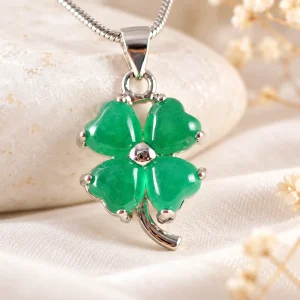
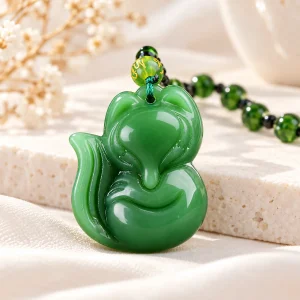
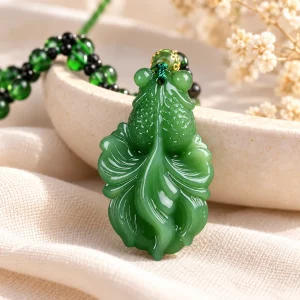
What tradition attributes to this stone
What follows changes register, and I flag it rather than blending it into the rest. Nothing in it is proven: it is what traditions have attributed to this stone.
Japanese jade is described as a sacred stone, associated with shrines and burial deposits. The curved bead is said to have served as a sign of belonging and as protection, and contemporary authors reportedly attribute balance and longevity to it: reported attributions, never established, gathered in what tradition attributes to jade stone.
What I will not write: that a magatama protects, heals or brings luck to whoever wears one today.
Questions I get asked
Is Japanese jade jadeite or nephrite?
Jadeite. That is what makes Itoigawa remarkable: most ancient East Asian jades are nephrite, and jadeite requires much rarer pressure conditions. The two minerals are told apart on a scale, between 3.25 and 3.36 for jadeite, 2.90 and 3.03 for nephrite.
What exactly is a magatama?
A curved, comma-shaped bead, drilled through its rounded end so it can hang. Some are jadeite, but others are rock crystal, glass or talc. The shape is Japanese; the material is not necessarily jade.
Can you buy jade from Itoigawa?
Hardly. The deposits are protected and extraction is prohibited, so nothing comes out on a commercial scale. The little that is worked comes from pebbles picked up by the water, and it stays local. A piece sold in France as Japanese jade deserves a request to see a number.
Did Japan work jade before China?
It worked jadeite thousands of years before China, which only imported it very late, from Burma. But China has worked nephrite for a comparable length of time. Both statements hold because a single word covers two minerals.
Can you pick up jade on the beaches of Itoigawa?
On the beaches, the geopark’s documentation allows small stones to be picked up, in very small quantities. In the protected sites, including the Kotakigawa gorge, collecting is prohibited. Check the rule in force on site rather than relying on this page.
Where can you see Japanese jade in France?
I have not verified that any Japanese piece is on display in a French museum, so I will not claim it. What I have checked are the displays of Chinese jade and Alpine jade: that is the subject of jade in French museums.
Where I checked
What comes from a named source. The identification of jadeite in Japan in 1939, the earlier attribution of Japanese jade to China, and the designation of jadeite as the national stone by the Japan Association of Mineralogical Sciences come from the article “Jadeitite (jadeite jade) from Japan: history, characteristics, and perspectives”, Journal of Mineralogical and Petrological Sciences, volume 112, 2017. The month of September 2016, the protection of the sites, the absence of extraction and the names taishu and magatama come from the Spring 2017 issue of Gems and Gemmology, the GIA’s journal. The UNESCO Global Geopark status since 2015, the 74,624 hectares, the Fossa Magna, the Kotakigawa gorge and the jadeite hammer about seven thousand years old come from the Itoigawa page of UNESCO’s International Geoscience and Geoparks Programme. The dates of seven thousand and five thousand five hundred years, and the rule on collecting from beaches, come from the geopark’s own pages.
What I do not write, because I have not read it. The year the Kotakigawa gorge was listed: two of the sources I opened give two different years, probably because they refer to two separate decisions, and I have read neither. The exact day of the designation: both my sources give the month of September 2016, and neither gives the date. And the material of the Yasakani no Magatama, which no one has measured.
What is a dated market observation. On 8 September 2026, I looked at the nine French competitors on the first page of results: none has a page on Japanese jade, and none states the mineral of its pieces. The same day, my supplier confirmed that they cannot say whether their goods are treated, and I publish that on every product page.
What is my own reasoning. The distinction between “the oldest worked jadeite” and “the oldest worked jade”, pointing out that a scientific society is not the state, and the decision to have no Japanese piece in the catalogue: these are choices, not established facts. If you find an error here, write to me: I will correct it and note the change.
In one sentence
Japan is the third centre of ancient jade, its jadeite has been worked for about seven thousand years on the Sea of Japan, and today it is so well protected that it is hardly sold at all: what you are offered under that name almost always comes from elsewhere, and the only way I have of knowing in my workshop is to weigh it (weighing, the shop).