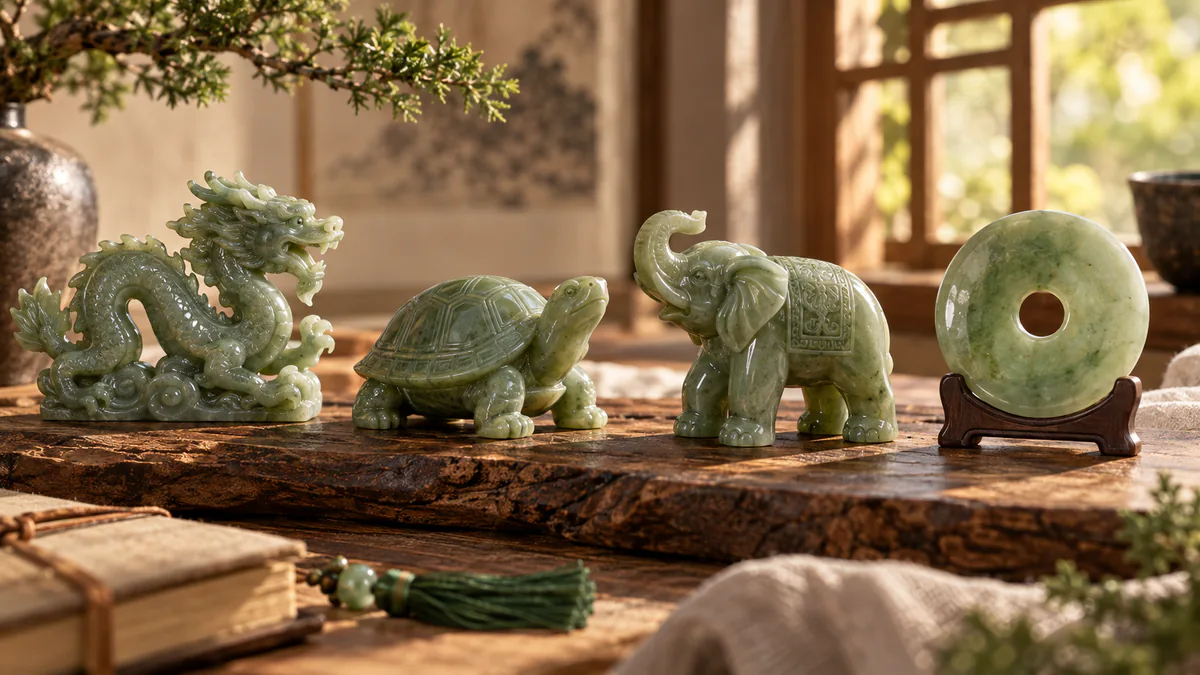
Jade motifs: dragon, turtle, elephant and Bi disc
This page goes through jade motifs: what Chinese tradition attaches to the dragon, the turtle and the pierced disc, where the elephant and the heart come from (they do not share an origin), and what a carved figure changes about how you read a stone.
A jade motif is something you read, not something that makes a promise: the dragon, the turtle, the elephant, the Bi disc and the heart each carry a story, and none of them tells you anything about the mineral or the treatment of the stone it is carved from.
My name is Jade, and I run a jade jewellery workshop where pieces are set or chosen one by one, and I weigh one example of each reference before it goes on sale. I do not carve anything, and I am neither a gemmologist nor a sinologist: here the mineralogy is stated as fact, and everything else is attributed.
What a motif says, and what it does not do
When someone asks me what a dragon pendant “means”, three questions have already been mixed together.
- What a tradition has attached to the figure, over centuries. This is documented, and it is the core of this page.
- What a seller writes on a label, which fits in three words and a promise.
- What you expect from the stone by wearing it. A legitimate question, and one I will not answer: nothing here heals or protects.
And these motifs do not form a consistent set: the pierced disc and the animal figures belong to the ancient Chinese repertoire, the elephant arrived by another route, and the heart has nothing Chinese about it. Lining them up in the same display does not make them contemporaries.
What follows changes register, and I flag it rather than blending it into the rest. Nothing in it is proven: it is what traditions have attributed to this stone.
The dragon, which is not there to be fought
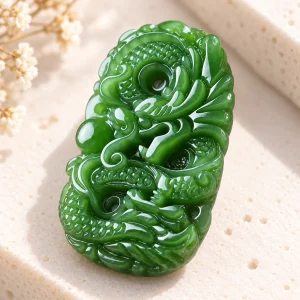
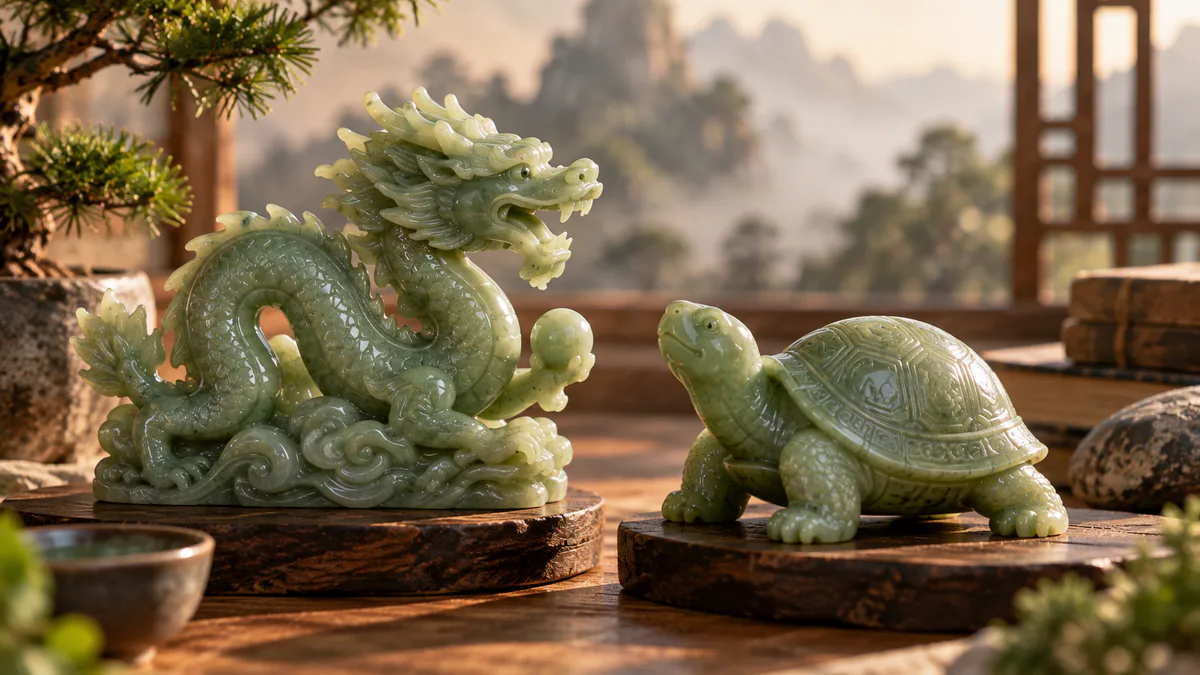
The Chinese dragon is a composite animal: the long body of a snake, scales, horns, claws. It is said to have been linked first to water and rain, before becoming the emblem of imperial power, and the court regulations of the last dynasties reportedly reserved the five-clawed version for the emperor alone.
The gap with the European figure changes how you read a pendant: this dragon is not a monster slain by a hero, it has no adversary, and there is nothing warlike about wearing one. My piece is jadeite, and I know that because I weighed it, not because it bears a dragon: the jade dragon pendant.
The jade pendants available now
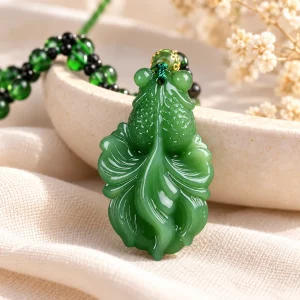
The turtle, longevity and divination
The turtle is said to be the figure of long life, and it is one of the most consistent associations in the repertoire. Yet its oldest documented use in China is not decorative: under the Shang, turtle plastrons were used for divination, heated until they cracked, and the answer was read in the fissures. The turtle was not a good-luck charm there, it was an instrument.
A later reading compares the domed shell to the vault of the sky and the flat plastron to the earth. I report it because it circulates everywhere; I do not know whether the carvers had it in mind. My turtle is nephrite: the jade turtle pendant.
The elephant and the heart, with no product behind them
These two motifs are searched for regularly, I see it in search data, and there is no piece from my catalogue behind this paragraph. I write about them because people have a real question about them, not because there is something to sell at the end.
The elephant does not belong to the Neolithic repertoire of Chinese jade: it entered through Buddhist iconography that came from India. Its reputation as an auspicious sign is said to rest on a play on sounds, the word for the animal and the word for good fortune being pronounced almost the same way. I report this as a commonly given explanation, and I do not read Chinese.
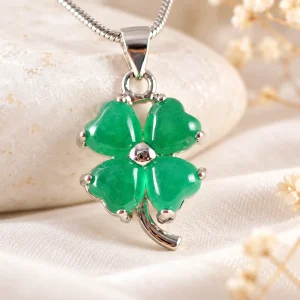
The heart, for its part, has no Chinese meaning to look for: this stylized shape is European and does not belong to the ancient jade repertoire. A jade heart is therefore what it looks like, a Western shape carved in an Asian material, which is perfectly legitimate as long as no one invents a Chinese antiquity for it. The rest depends on the person giving it (giving a jade piece as a gift).
Pendants whose density I publish
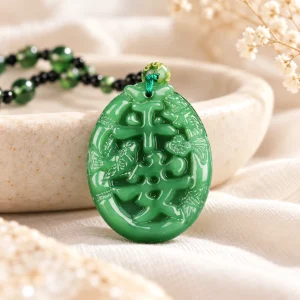
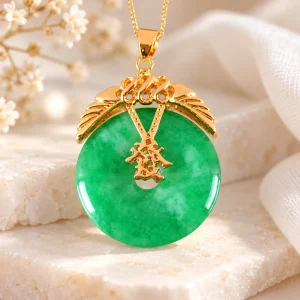
The Bi disc, a pierced form that spans the centuries
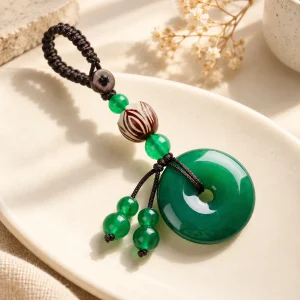
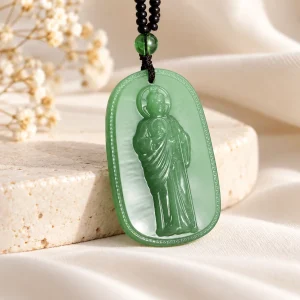
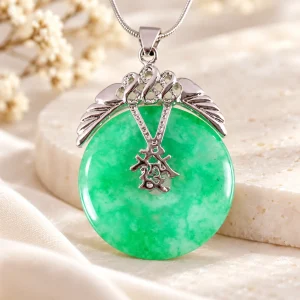
The Bi disc is a flat ring pierced at its centre, cut from a single block. It is one of the oldest forms of worked Chinese jade, in nephrite, present from the Neolithic and abundant in the burials of the Liangzhu culture, where discs were stacked on and around the body.
What it meant to those who carved it has not been established. The reading that makes it an image of the sky comes from ritual treatises compiled very long after the objects: applying it to Neolithic discs means explaining a piece with a commentary written several millennia later. I have also read technical readings of the central hole, related to the way the stone was ground down by rotation. I cannot settle the question.
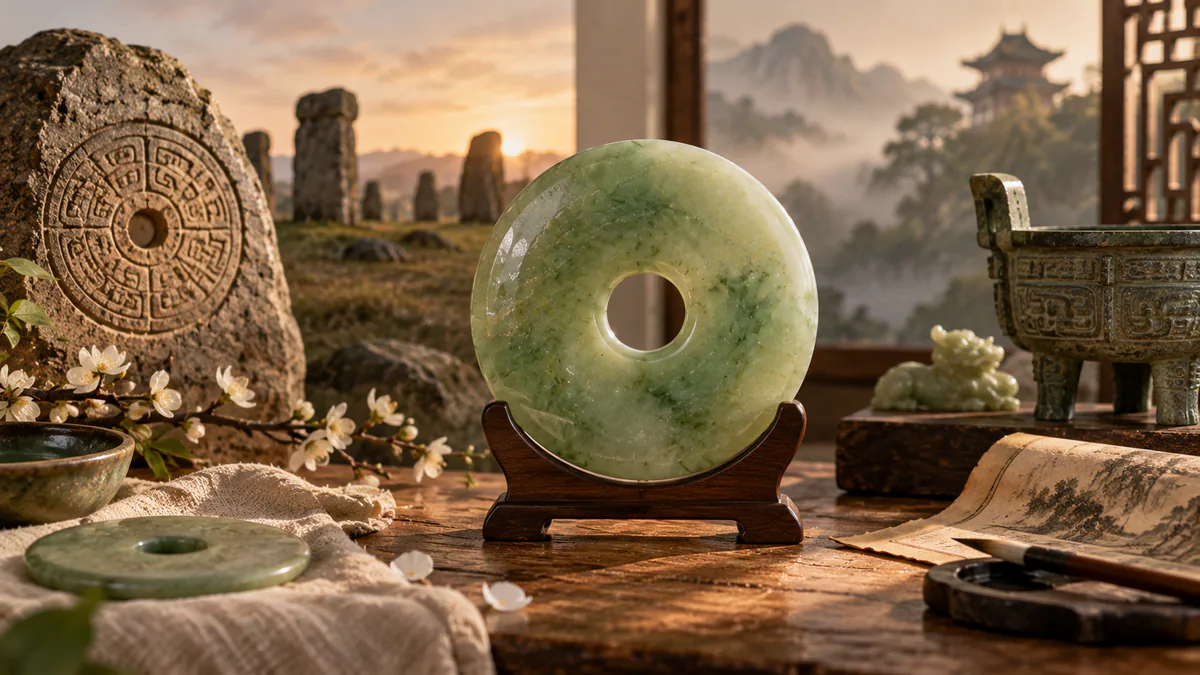
The form has survived into today’s round pendants (the round jade pendant), it left behind the most famous jade story in China (the He disc), and its funerary role belongs to another article (jade in Chinese tombs).
The other figures you come across
Four other motifs come up often enough to be named, and each takes a single line because it has its own page.
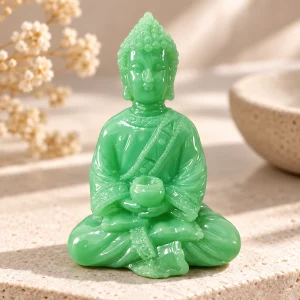
- The laughing, round-bellied figure, commonly called a Buddha, is not the historical Buddha: who he really is.
- The Pi Xiu, a creature from the Chinese repertoire that I offer as a carved object, and whose associated belief is covered elsewhere, in the conditional (the jade Pi Xiu, where the good-luck idea comes from).
- The gourd, whose double swelling catches the light twice: the jade gourd.
- The carved subject with no fixed figure, which I only name once I have received the example: the jade statuette.
What the motif changes about the stone
Here I go back to plain fact. A carved figure changes three concrete things, and none of them has anything to do with its meaning.
It creates hollows, and hollows hold dust. Ordinary dust contains quartz, which rates 7 on the Mohs scale, while nephrite sits between 6 and 6.5 and jadeite between 6.5 and 7. A dry cloth wiped over a dusty carved piece dulls the reliefs, and it shows first on the edges of the motif (how to clean jade stone, storing a jade piece).
It creates thin parts. Jade is not very hard but remarkably tough, which allows cuts that few stones would accept (why jade almost never breaks). Toughness is not infinite, though, and a dragon’s horn is still the place that breaks. No ultrasonic cleaners, no steam: as long as treatment has not been determined, you have to assume resin, which cannot withstand them (type A, B and C jade, the treatment information sheet).
It proves nothing. A dragon can be carved just as well in serpentine sold under a jade name, and the work can even be finer there, since the material is softer. I add one suspicion that is my own reading and not a fact: very heavy relief can sit exactly where the stone had a crack to cover (buying a jade piece). The only thing that separates these materials in my workshop is their density.
| Material | Density |
|---|---|
| Jadeite | 3.25 to 3.36 |
| Nephrite | 2.90 to 3.03 |
| Quartzite, dyed or not | about 2.65 |
| Serpentine | about 2.6 |
A stone weighed in air, then suspended underwater, gives this ratio in a few minutes: that is the whole of the weighing protocol. On a carved piece, the measurement is taken on the bare stone, without bail or cord, otherwise the metal ends up on the scale. It establishes the mineral (jadeite or nephrite, stones sold as jade), and says nothing about resin impregnation, which only infrared spectroscopy would settle.
The forms I do not have carved
Two repertoires are closed to me. Māori forms first: the hei-tiki and the koru belong to New Zealand pounamu, ownership of which a 1997 law vested in the Ngāi Tahu iwi on its territory. This is not a matter of courtesy, it is a legal status (Māori pounamu). Japanese magatama next, the curved bead of a third centre of jade, which I treat as a subject and not as a catalogue (jade in Japan).
And one rule that applies to all the others: I describe a motif, I do not attach a function to it. What Chinese tradition attributed to the stone itself is a whole subject, and it is moral rather than therapeutic (the moral virtues of jade, what tradition attributes to jade stone).
Questions I get asked
What does the dragon mean on a jade pendant?
Chinese tradition is said to associate it with water and rain, then with imperial power. It is a figure of authority, not a monster to be defeated as in Europe, and nothing suggests that wearing one does anything at all.
What does a jade turtle mean?
Longevity is the most consistent association in the repertoire. Yet its oldest documented use in China is not decorative: turtle plastrons were used for divination under the Shang.
Is the jade elephant a Chinese motif?
Not originally: it entered the repertoire through Buddhist iconography from India, and its reputation as an auspicious sign is said to rest on a similarity in sound between the word for it and the word for good fortune. I report this, and I have no elephant piece to offer.
Does a jade heart have a meaning in China?
No. The stylized heart shape is European and does not belong to the ancient jade repertoire. It is a Western shape carved in an Asian material, which is perfectly legitimate as long as no one invents a Chinese antiquity for it.
What is a Bi disc?
A flat ring pierced at its centre, cut from a single block, found in nephrite from the Chinese Neolithic and abundant in Liangzhu burials. What it meant has not been established: the cosmological readings come from texts written long after the objects.
Should you choose a motif based on what you expect from it?
I cannot help you on that ground, since no carved figure produces an effect. Choose on what can be checked, the mineral and its density, the cleanness of the drilling, the evenness of the polish, and then on what you like (how to recognise genuine jade).
Where I checked
What comes from a named source. The Chinese Neolithic, the Liangzhu culture and the abundance of discs in its burials are the standard chronology of Chinese archaeology, as it reads in museum notes: I have not read any excavation report, so I give no date more precise than the period. The status of pounamu comes from the 1997 New Zealand law named in the text. The density and hardness ranges come from the mineralogical literature: I cite them without having measured them, and I do not attribute them to any organization.
What I pass on without having checked it. Three points on this page are secondhand explanations: the homophony that would turn the elephant into a rebus, the court rule on the five-clawed dragon, and the shell read as the vault of heaven. I have only found them in popular books, I do not read Chinese, and I write them in the conditional rather than leave them out.
What is a dated market observation. On 8 September 2026, I noted the motifs offered by the French shops I opened: the Pi Xiu at two of them, the gourd at three, carved subjects at two. The same day, of the nine competitors on the first page of French results, one was offline and none of those I could open stated the mineral of its pieces. My supplier, for their part, confirmed that they cannot say whether their goods are treated.
What is my own reasoning. The rule that a motif tells you nothing about the mineral or the treatment, the suspicion of very heavy relief, the refusal of Māori forms, and the decision to write about the elephant and the heart when no piece carries them: these are choices, not established facts. If you find an error here, write to me: I will correct it and note the change.
In one sentence
Jade motifs come from different places and periods, from the Chinese Neolithic repertoire to a European shape of yesterday, and not one of them tells you what is in the stone: for that, you have to weigh it (jade stone, the shop).