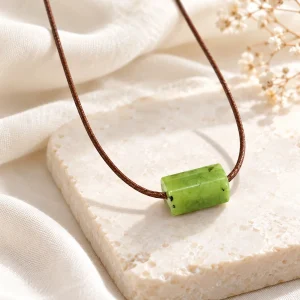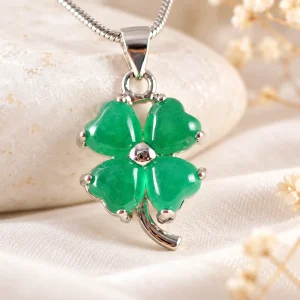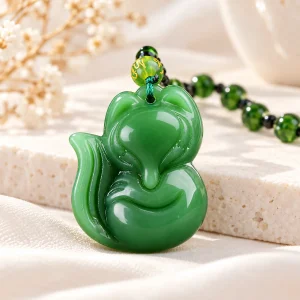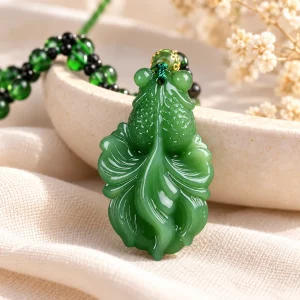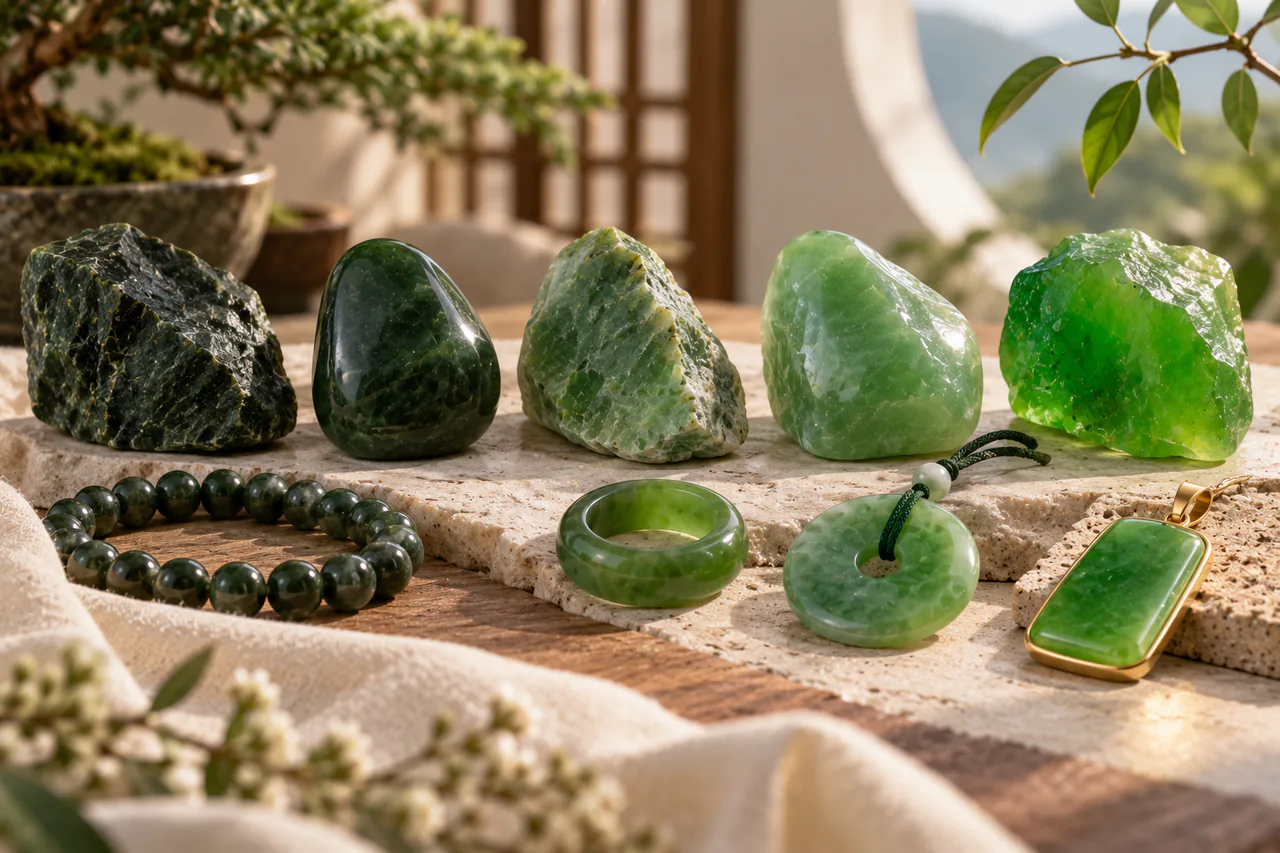
Green jade stone, from spinach green to bright green
A search for “green jade stone” covers two minerals and two chemistries. This page explains what creates the green in a jadeite and in a nephrite, what translucency changes when the hue is the same, and what stays green without being jade.
The green of a jade does not come from the jade: it comes from chromium in jadeite and iron in nephrite, and it is this difference in chemistry, far more than the hue itself, that separates a milky spinach green from a translucent bright green.
| Mineral | Coloring element | Resulting green |
|---|---|---|
| Jadeite | Chromium | Bright, saturated green, up to grass green |
| Jadeite | Iron | Grayer, duller green, the most widespread |
| Nephrite | Iron | Spinach green, then bottle green as the iron rises |
My name is Jade and I run a jade jewellery workshop: I choose the pieces, have them set, and weigh one example of each reference before it goes on sale. I am neither a gemmologist nor a therapist: I describe what produces a green, I do not certify what a stone has undergone.
Green is not the mineral’s own colour
A pure jadeite is white, and so is a pure nephrite. Green is an accident of composition: a few foreign atoms lodged in place of the ones that should be there, in quantities too small to change the species or its name.
Jadeite is a sodium aluminum pyroxene, NaAlSi2O6, and it is its aluminum that other ions replace: chromium gives a bright, saturated green, iron a more muted green, leaning toward grey or khaki. Nephrite is an amphibole of the tremolite-actinolite series: white at the magnesium end, it turns green and then darkens as iron takes the place of magnesium. Two levers on one side, only one on the other: that is why nephrite never reaches bright green.
The split between the two species is the subject of the pillar page, their chemistry is detailed in jadeite or nephrite, and the rest of the palette in the colours of jade stone.
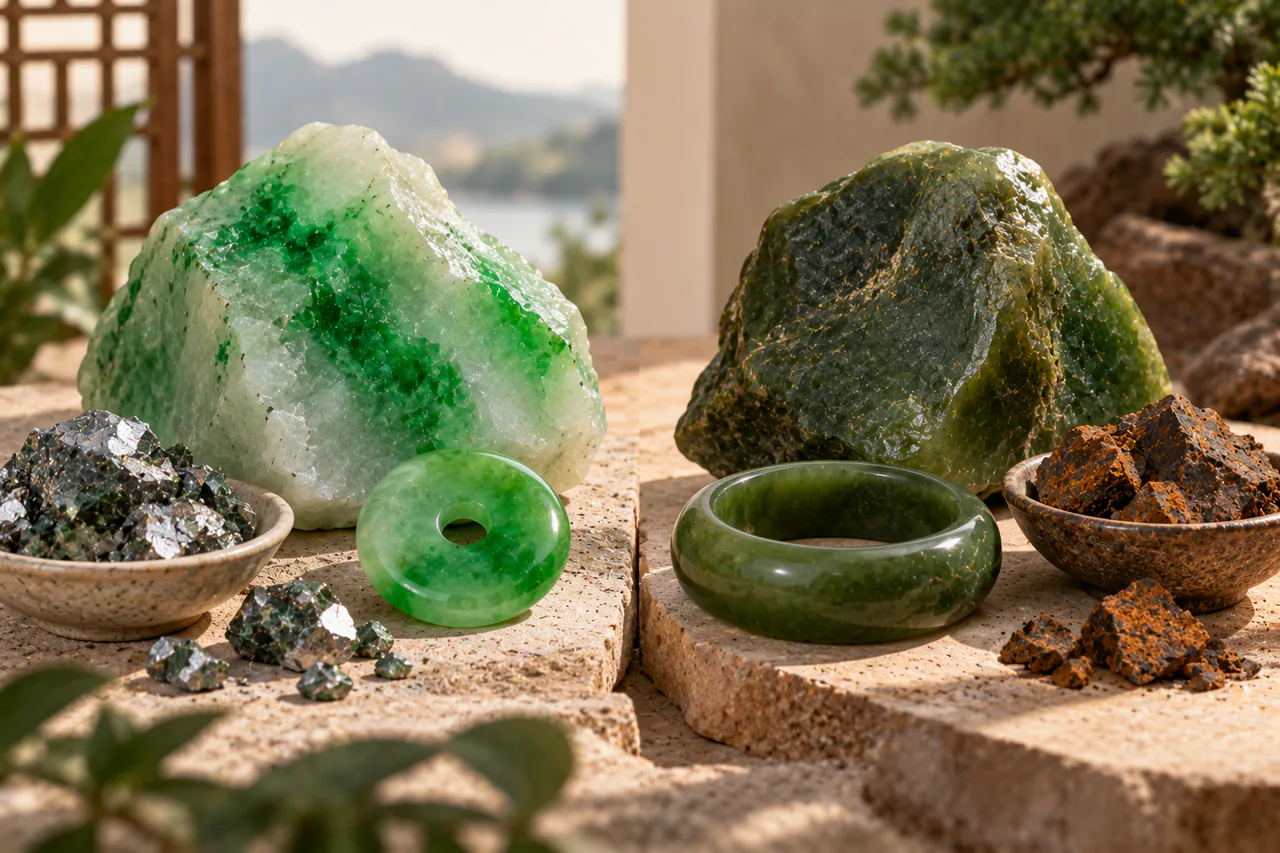
Spinach green, the green of nephrite
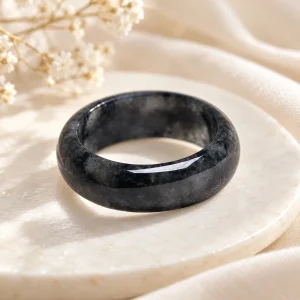
Nephrite supplies a good share of the green jewellery on the market, and its green is the one you are most likely to have already held. The word spinach is a trader’s term, not a mineralogist’s, and describes a medium to dark green, slightly bluish, often uniform on a bead and cloudy on a plaque.
Its look comes from its structure, a felt of microscopic fibers that scatter light, hence that milky, closed, almost greasy air. Its iron content, for its part, shows in the hue, from light green to a bottle green that is almost black.
Its density, 2.90 to 3.03, does not overlap with that of jadeite, 3.25 to 3.36: that is what lets me name the mineral of a reference before putting it online, following the protocol I publish. Its hardness, 6 to 6.5, puts it below the quartz in ordinary dust, so a nephrite green loses its polish faster than a jadeite green (why jade almost never breaks).
These greens come mainly from Russia, Canada, Taiwan and China, and New Zealand pounamu is one of them too: where jade comes from. In my shop, a spinach green nephrite bangle and a green jade necklace carry that shade.
Jade rings available now
Bright green, chromium in jadeite
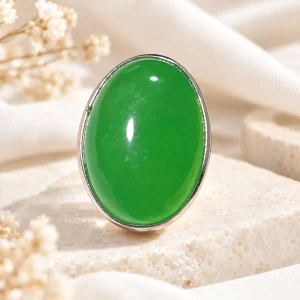
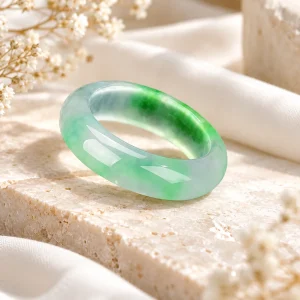
The most sought-after green, and the most expensive, is a chromium green, and it is jadeite that carries it. A few tenths of a percent are enough, and it is the same element that makes emerald green. The resulting colour is not just darker than an iron green: it is more saturated, without drifting toward grey or khaki.
Jadeite adds a favorable structure, fine interlocking grains rather than fibers, which lets light in instead of bouncing it back. It is the combination of the two that produces the sought-after pieces, not the hue alone.
At high chromium contents, mineralogy no longer speaks of jadeite but of kosmochlor, a neighboring pyroxene almost always mixed with it (how jade is named). And imperial jade is neither a label nor a controlled quality grade: in practise the term designates a translucent, gem-quality green jadeite, mostly Burmese, and I explain it rather than use it (what the term covers).
These bright greens come overwhelmingly from Burma, a source I refuse for a legal reason before an ethical one: Burmese jade bracelet. My green jadeites, this bangle or this cabochon ring, do not come from there: that is a condition I set when buying, not an analysis I publish, and my scale could not verify it.
Translucency, what separates two greens that look identical
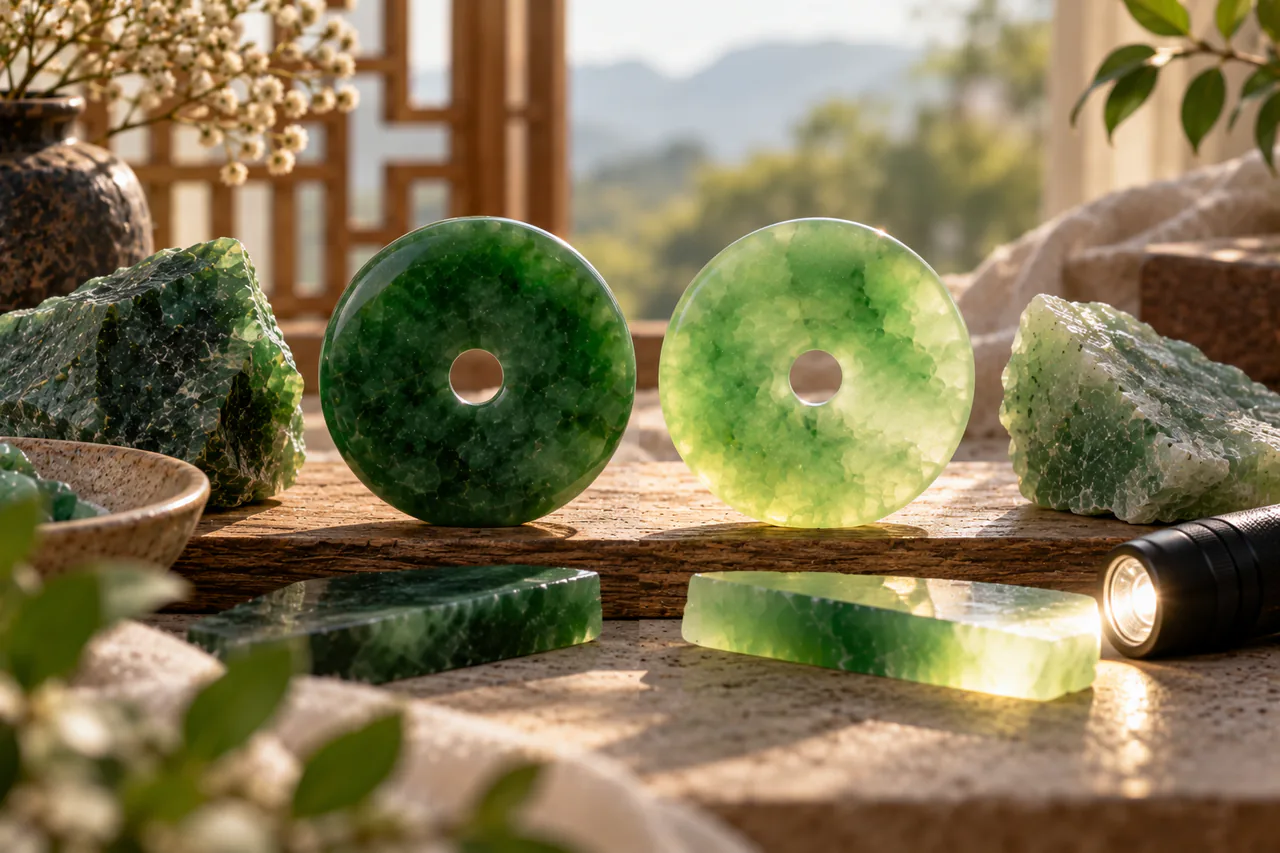
Two stones of the same green set on a table look alike; a lamp placed behind their edge separates them at once. Translucency is the distance light travels into the material before being absorbed or sent back, and it is what widens the gap between two greens of the same hue.
It depends on the fineness of the grain, so on the mineral as much as on the specimen: a nephrite rarely goes beyond translucency at an edge, while a very fine-grained jadeite lets you make out a finger behind a thin cabochon. The trade calls this the water of a stone, a word in common use that has never been defined (the jade glossary).
Two caveats when buying. Thickness skews the comparison: a thin plaque will look more translucent than a solid bangle of the same material. And a closed-back setting prevents you from looking through, which also allows a painted backing to fake depth (spotting added colour).
Why two greens do not sell at the same price
The gap between two stones of the same green is often counted in multiples rather than percentages, and colour explains only part of it. Also in the mix are the mineral, the saturation of the hue rather than its depth, its distribution across the piece, the translucency, the fineness of the grain and the treatment.
Distribution can be seen without equipment: a green in veins, concentrated in spots on a pale background or stopping abruptly at an edge, is worth less than an even green across the whole piece. The criteria are detailed in judging the quality of a jade, and the orders of magnitude in the price of jade stone.
That leaves treatment, the only one of these variables I cannot establish. A jadeite bleached and then impregnated with resin can be green and beautiful, but it has neither the same price nor the same future. My scale gives the mineral, not what it has undergone: so I never write that a piece is untreated, and I publish the A, B, C classification and the treatment information sheet rather than a silence that would read as a guarantee. The A, AA, AAA scale found on green jade product pages has no normative existence at all.
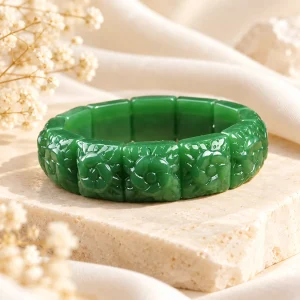
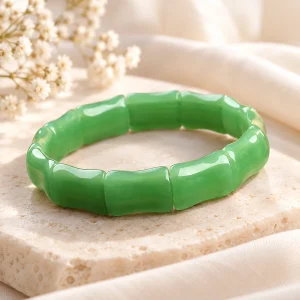
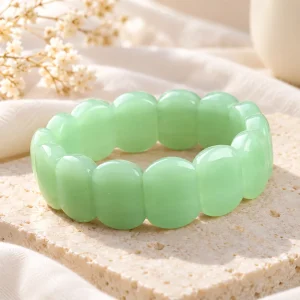
Green jade bracelets, with the density of each reference
The greens that are not jade
Green is the colour imitation focuses on, and it rarely works through an outright lie: rather through a compound name containing the word jade. The list of those names, and the stones they cover, is in stones sold as jade. What is worth saying here is shorter: sorting is not done by hue. A serpentine green, around 2.6, and a dyed quartzite green, around 2.65, can be indistinguishable to the eye from a nephrite green, even though those two figures fall far from the jade ranges. The scale settles it (how to tell if jade is real), and French law adds a line: selling a stone under another name is prohibited, and so is the term “semi-précieux” (semi-precious), for all the gems covered by the decree (jade and the 2002 decree).
Which green for which piece of jewellery
The shape of the piece changes what the green shows, and that is the reasoning I follow when I have a reference set.
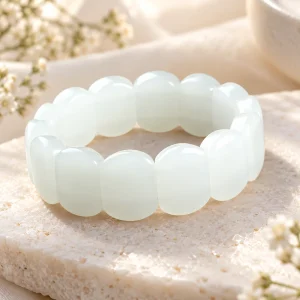
- A bangle worn every day. Thickness eats up translucency, so a dense nephrite green often looks better there than a pale jadeite: jade bracelets, which you can filter by colour.
- A cabochon for a ring or pendant. This is where translucency pays off, with light entering the stone through its edge: rings, pendants, including this jadeite cabochon.
- A strand of beads. Evenness matters more than intensity here: necklaces.
- Earrings. Two stones have to match, which is harder than one: earrings, including these green jade earrings.
These pieces are set or chosen one by one, and each product page publishes the mass in air, the immersed mass, the resulting density, the date of the measurement and the mineral it points to: what I publish on each product page.
What people look for behind the word meaning
The word meaning often comes attached to “green jade stone”, and it does not call for the same answer as the rest of this page. On the mineralogy side, the answer is short: green means iron, or chromium. What cultures have placed on this colour is another question, which has its own pages.
What follows changes register, and I flag it rather than blending it into the rest. Nothing in it is proven: it is what traditions have attributed to this stone.
The reported attributions are gathered in what tradition attributes to jade stone, the history of the word in the meaning of jade stone, and the moral reading of the Chinese literati, which is not crystal healing, in the moral virtues of jade. What I will never write is that a green heals or protects.
The questions I get asked
Is jade always green?
No. Green is the most common and most requested colour, but white, honey yellow, reddish brown, black and lavender are jade colours just as much.
Is the darkest green the best?
No, and it is the most widespread mistake on the pages I opened. What is sought after is a saturated, and therefore vivid, green: a very dark, opaque bottle green trades less well than a medium, bright, translucent green.
Jadeite or nephrite, for a green?
It depends on the piece. Jadeite reaches higher saturation and translucency, and resists scratching better, 6.5 to 7 against 6 to 6.5. Nephrite gives deep, even greens, generally for a more modest budget. Both are legitimately jade.
How can I tell if my green jade is dyed?
Three clues can be read with the naked eye, and none is proof: colour that collects in fissures, a hue too uniform for a material that never is, a green that bleeds onto the setting. Only a laboratory analysis settles it, and I do not have one.
Is a pale green jade of lower quality?
Not necessarily. A pale but translucent and even green is often worth more than a strong, spotty, opaque green. Colour is also the easiest criterion to fake, and so the least convincing on its own.
My green bracelet looks duller than when I bought it?
That is common, especially with nephrite: its hardness puts it below the quartz in ordinary dust, and a dusty cloth eventually dulls the surface (a jade that changes colour).
Where I checked
What comes from a named source. The separation of jadeite and nephrite, and the word jadeite itself, come from Alexis Damour’s note in the Comptes rendus hebdomadaires de l’Académie des sciences, volume 56, 1863; I do not give the page numbers, as I have not read it. The role of chromium and iron, the formula of jadeite, the tremolite-actinolite series, the density and hardness ranges and the comparison with emerald come from the mineralogical literature: I repeat them without having measured them, their bounds vary from one database to another, and I attribute them to no particular body.
What is a market observation, dated. On 8 September 2026, I looked at the nine French competitors on the first page of results. None states the mineral of its pieces, so none says whether the green it sells comes from chromium or iron, and one of them uses an A, AA, AAA scale. The same day, my supplier confirmed to me that they cannot say whether their goods are treated.
What is my own reasoning. The weight I give translucency over hue, the rule of comparing two greens at comparable thickness, the advice to prefer a dense nephrite for a thick bangle and a translucent jadeite for a cabochon, and the refusal to write “untreated” without an analysis: these are decisions, not established facts. If you find a mistake here, write to me: I will correct it and note that I did.
In one sentence
A green jade stone owes its colour to a few atoms of chromium or iron depending on the mineral that carries it, and it is translucency, the distribution of the hue and treatment, not the intensity of the green, that decide its value. The method is on the weighing page, and the pieces are in the shop.
Jade pendants, from spinach green to bright green