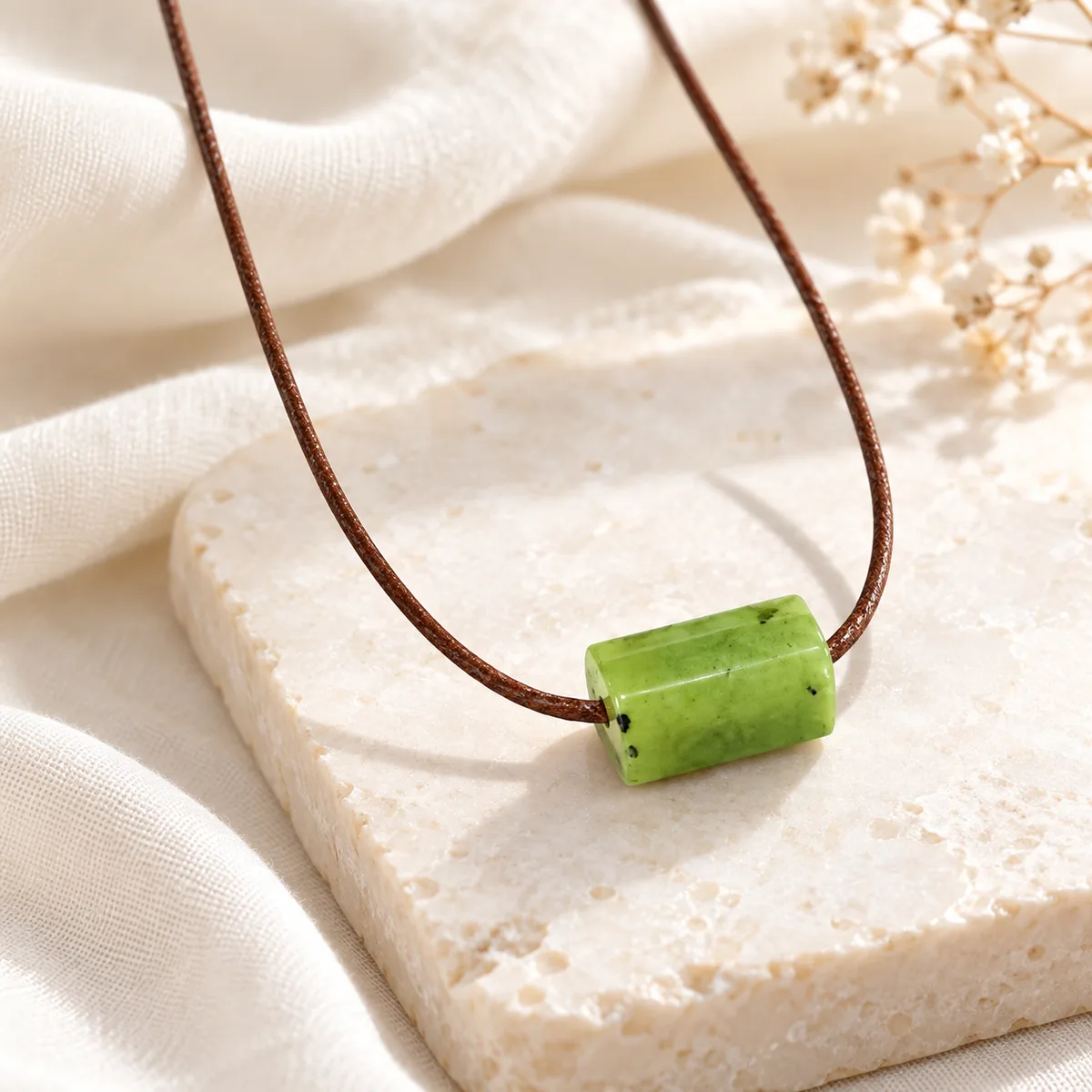
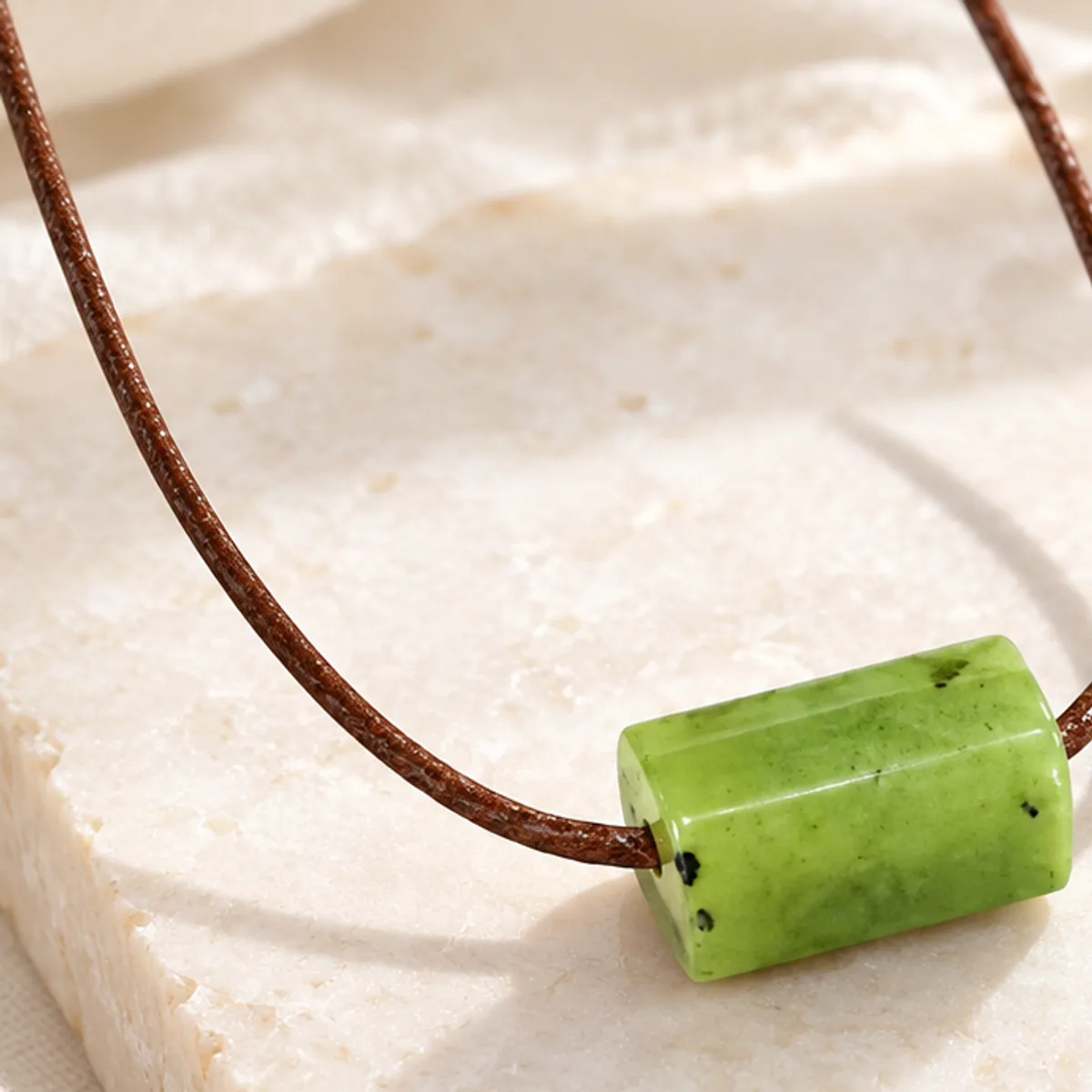
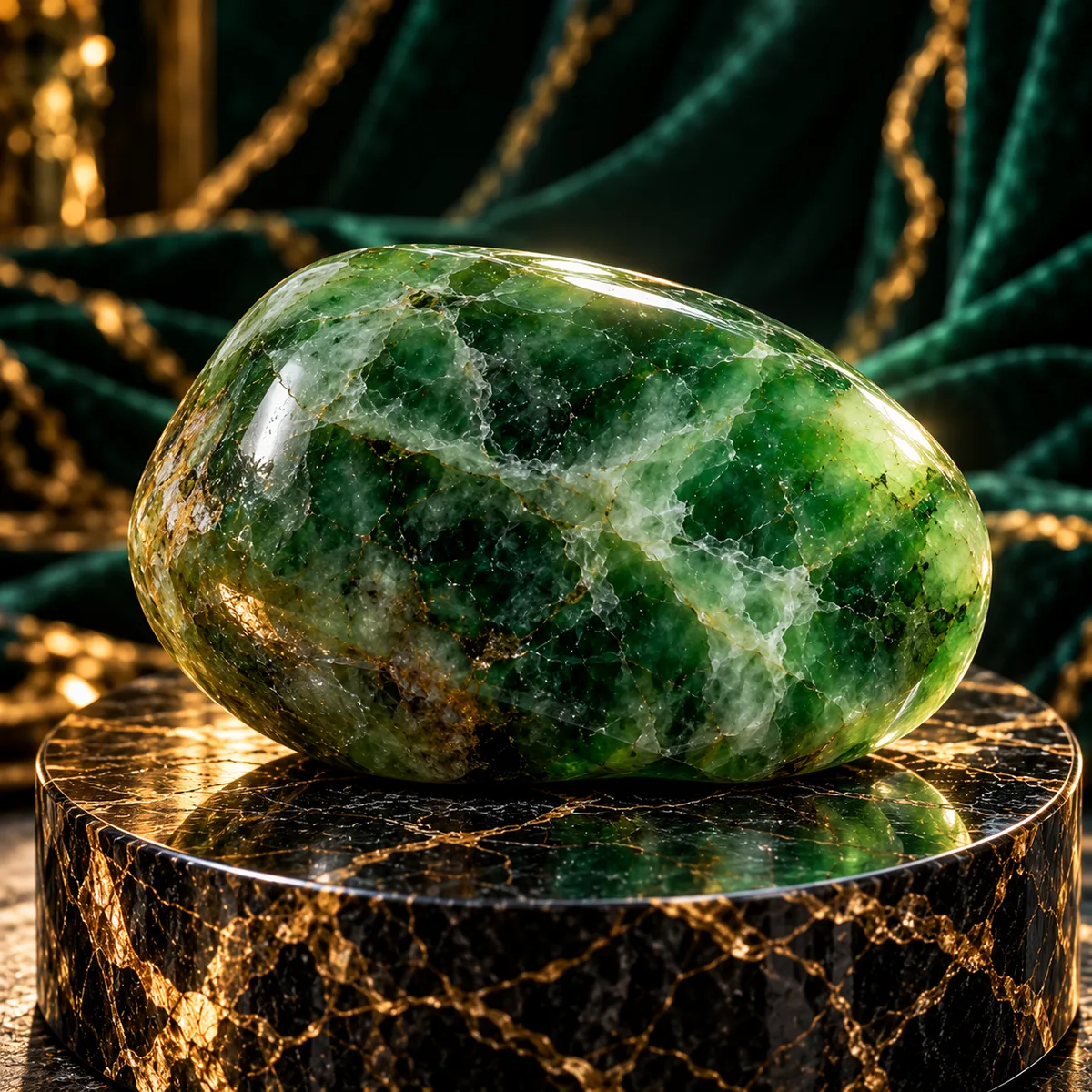
A jade tube pendant: a short cylinder of deep olive green, polished all over, drilled lengthwise and threaded on a fine brown cord. No mount, no decorative clasp, nothing but the stone and the thread.
In four lines
A polished cylinder, drilled lengthwise, threaded on a cord.
Deep olive green, with small black specks in the mass.
No mount, no metal: nothing to tarnish, nothing to maintain.
The record will be published: the stone slides off, so it weighs.
The black specks are good news
The stone carries a few black flecks, sharp, about the size of a pinhead. I have not erased them from the photographs, and I am not going to apologise for them either: on a nephrite, these dark inclusions are common and they argue in the stone’s favour.
The reason is simple. They are grains of another mineral trapped while the rock formed, most often a chromium or iron oxide. A glass paste has none, a dyed quartzite would have masked them, and a perfectly even colour is more suspect than a broken one.
That does not make a proof, and the page will never say so. It is one more clue, to set beside the weighing when it is done. How to judge the quality of a jade.
The plainest pendant in the shop
There is nothing more to say about the shape, and that is precisely the point of the piece. A cylinder, a hole, a cord. No carved subject, no deity, no sign to explain, nothing that commits the wearer to anything.
The cord is fine and brown, with no visible metal clasp. If it breaks it is replaced for a few euros at any haberdasher: the stone, for its part, does not wear out. The thread and the cord of a jade piece.
What the stone is, and what remains to be established
The green is olive, fairly dark, and it is a colour to look at closely: a muted olive green is the type colour of serpentine, which circulates more than any other stone under the name jade. I say so here rather than leave it to be guessed.
The gap in density is fortunately wide: serpentine sits around 2.6, nephrite starts at 2.90. This is the kind of case the weighing settles without discussion, and on this reference it is immediate since the stone slides off the cord.
Outside Burma, country of extraction not confirmed
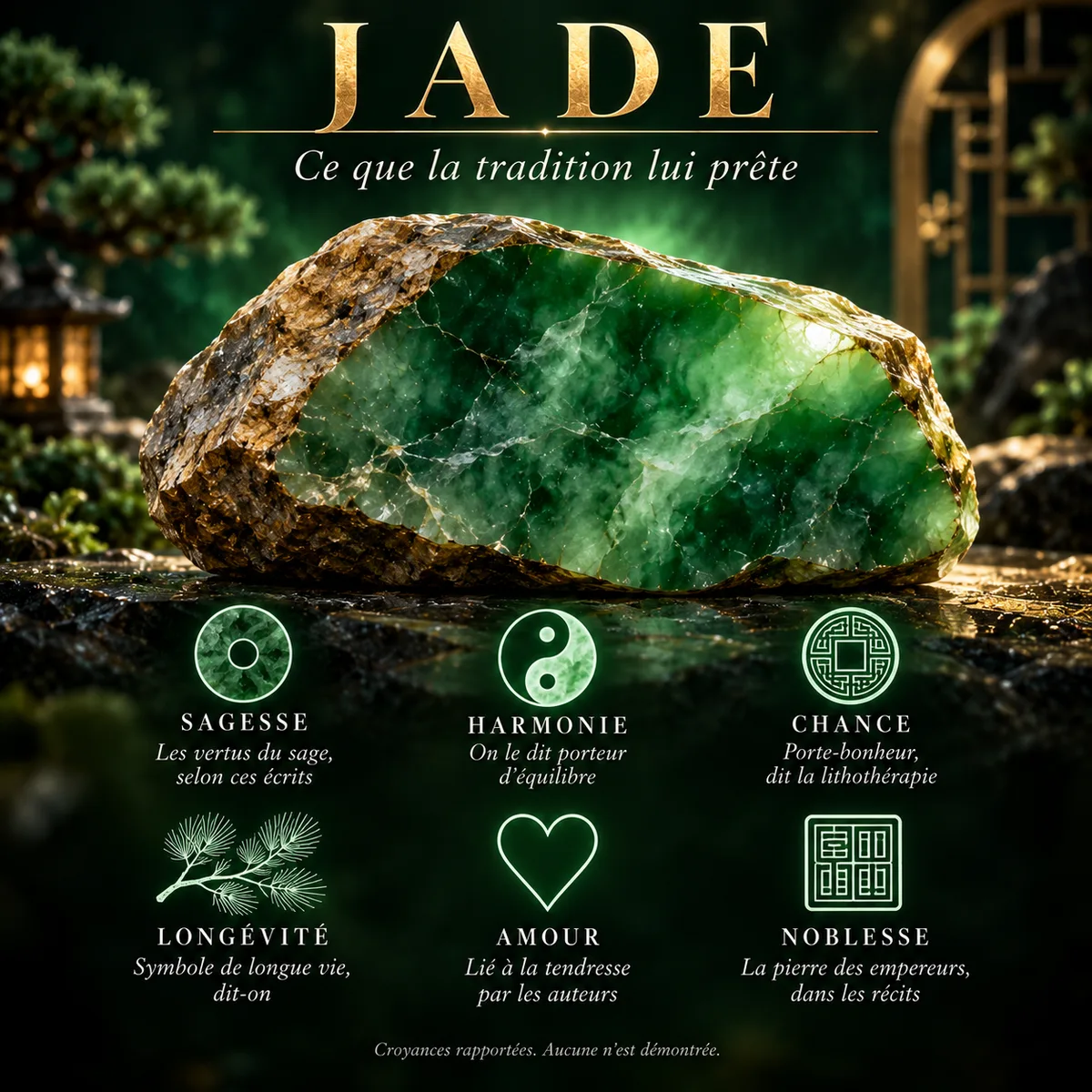
What tradition attributes to jade
What follows changes register, and I flag it rather than blending it into the rest of the page. Nothing here is demonstrated. These are customs and beliefs, which I report because they are part of the history of this stone. No piece in this shop is sold as a remedy, and I claim no effect for this one.
A man's stone, and long has beenJade is nothing like a feminine ornament in ancient China: belt plaques, archer's thumb rings and rank pendants were men's objects. The present division is recent, and largely Western.
The tube and the discBeside the round disc, ancient tombs yield jade tubes, often square outside and round inside. A late reading makes them the image of the earth against the heaven of the disc. This tube is round, and it is a form of jewellery, not of ritual.
What you do not seeIn the scholar's taste, a jade without decoration was worth more than a carved one: the quality of the material had to be enough. The plainest pieces were often the dearest, and a bare object leaves nothing to hide behind.
A stone of moral virtueIn Confucian thought, jade is associated with qualities of character rather than effects on the body: uprightness, constancy, restraint. It is the best documented meaning of them all.
Dispatched within 48 hours of your order being confirmed, for delivery within 14 days from dispatch. I keep no buffer stock, and I won’t promise a timeframe I couldn’t meet.
Postage charges
€6.99 to any destination, free on orders of €47 or more to France, Belgium, Switzerland and Luxembourg. The exact amount appears in the cart before you pay.
The packaging, and why it matters
Every piece ships in its own pouch, kept apart from the others. This isn’t about presentation: the hardness of jade is ordinary, between 6 and 6.5 for nephrite and 6.5 to 7 for jadeite, and the quartz in everyday dust sits at 7. Two pieces of jewellery that travel together end up scratching each other.
Fourteen days to change your mind
With no need to explain yourself. An email is enough to open a return, there is no form to fill in. Return postage is at your expense, unless the piece doesn’t match its listing or arrives damaged.
Warm water, mild soap, a soft cloth. A very soft brush for the hollows of a carving. That’s all, and it’s enough.
What you must never do, and why
No ultrasonic cleaner, no steam, no solvent, no heat source. This isn’t a token precaution: the treatment status of my pieces is not established. My supplier doesn’t know, and weighing establishes the mineral without saying anything about a possible resin impregnation. Resin tolerates neither heat nor solvents, so every piece is handled as though it might contain some. The information sheet on treatments.
Scratches, and where they come from
Jade is tough, meaning very hard to break: its interlocking crystal structure resists fracturing, and that is why axes could be shaped from it in the Neolithic. Its hardness, on the other hand, is ordinary, 6 to 6.5 for nephrite and 6.5 to 7 for jadeite. The quartz in everyday dust sits at 7: that is what dulls jade, not knocks. The difference between the two.
Day to day
Put the piece on after perfume and cream, never before. Take it off for housework, gardening and sport, where the knocks against corners happen. Store each piece on its own, in its pouch. On a strand of beads, the thread wears out before the stone: it gets restrung, and there is nothing abnormal about that.
My name is Jade. I’m French, from Morbihan, and based in Tallinn. I choose the pieces and have them set: I mine nothing, I cut nothing, and I don’t do the metalwork myself. The work I do is the sorting, and with this material that is what decides everything.
I am neither a gemmologist, nor a lapidary, nor a therapist, and I don’t claim to be.
I weigh, I don’t certify
Before putting a reference online, I order one example of it for myself. When it reaches me unset, I weigh it in air, then suspended from a thread in a glass of water: the ratio of the two masses gives the density, and that figure separates jadeite, nephrite, serpentine and dyed quartzite without ambiguity.
One example per reference, not every piece. I don’t handle the piece that goes out to you, and I would rather say so than let you believe otherwise. The method, with its three limits.
What I can’t know
The treatment status of my pieces. My supplier doesn’t know, and the scales say nothing about it: they establish the mineral, not the resin impregnation. Only infrared spectroscopy in a laboratory would settle it, and I don’t have that done. So you will never read “jadeite A”, “type A” or “untreated” on this site. The information sheet.
Where my jade comes from
No Burmese jadeite, and the first reason is a legal one. Not the reason you read everywhere: the JADE Act of 2008 did indeed ban these stones in the United States, but that ban was lifted on 7 October 2016. What applies today dates from 8 April 2021: the US Treasury sanctioned Myanma Gems Enterprise, the state-owned company that controls the Burmese gem trade. So there is no general ban, but an American is not allowed to trade with that entity, and a stone never tells you where it has passed through. One single supply chain for ten markets: it has to hold up for the most demanding of them. When an origin isn’t confirmed to me in writing, the listing doesn’t state it. My sourcing policy.