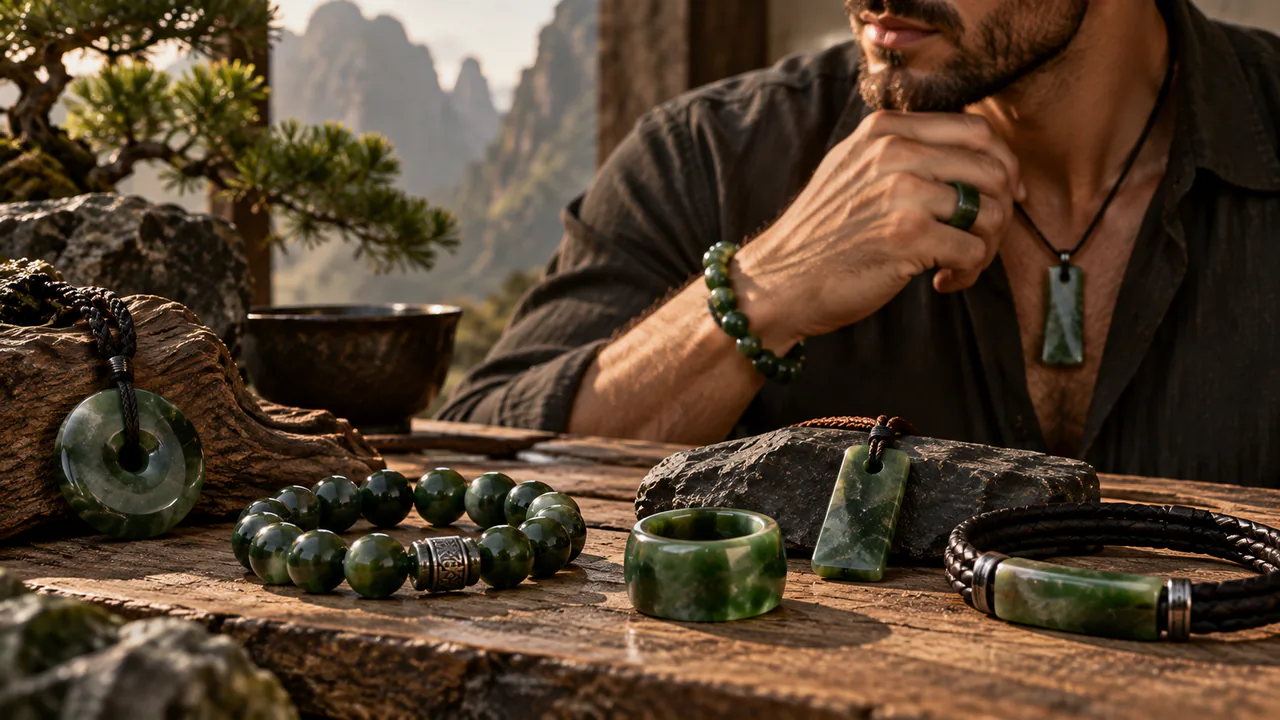
Men’s jade jewellery
This page covers men’s jade jewellery through what actually changes from one piece to the next: the format chosen, the width of a bangle, the length of a cord, the setting and the clasp, and why the mineral itself does not depend on who wears the piece.
What separates a man’s jade piece from a woman’s is neither the stone nor its quality: it comes down to three variables of shape, the format, its width or length, and the setting that goes with it; the mineral, and the density that proves it, are identical on both sides.
My name is Jade, I run a jade jewellery workshop, with pieces set or chosen one by one, and I weigh one sample of each reference before putting it on sale. I am neither a gemmologist nor a therapist: what is established is stated here as fact, what is believed is attributed.
One point governs this whole page: I give no millimetre figures here. The dimensions of a reference only go on its product page once I have received the sample I order. What follows describes constraints and choices, not numbers.
The formats men choose most
Four families account for most of the demand from men, and their constraints are not the same at all.
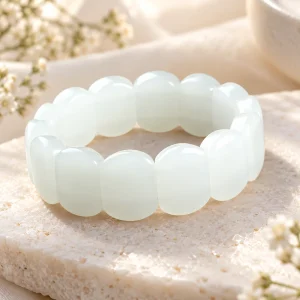
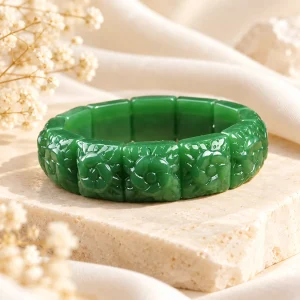
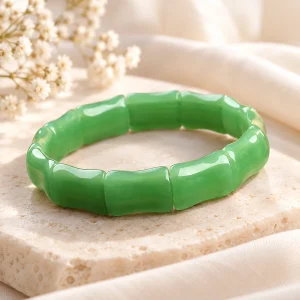
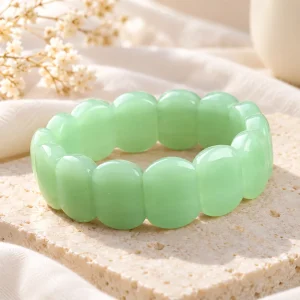
- The bracelet, first by number of query variants, either as a rigid bangle cut from a single block or as a strand of threaded beads: two objects that share neither the same measurement nor the same fragility. See a dark green nephrite bracelet and the other jade bracelets.
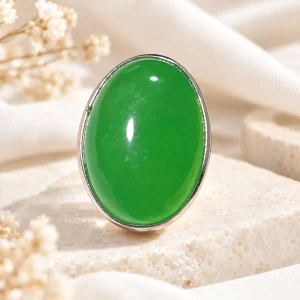
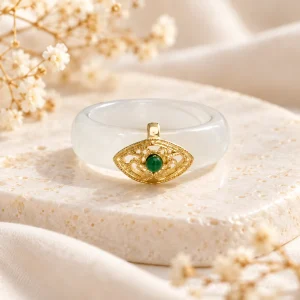
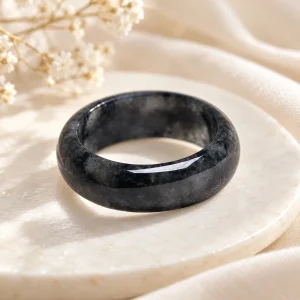
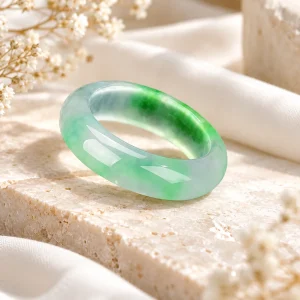
- The ring, which I offer as a wide band with a low-set cabochon: a jade and 925 silver ring, and the others among the jade rings.
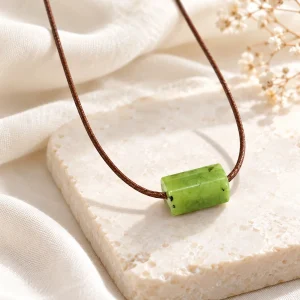
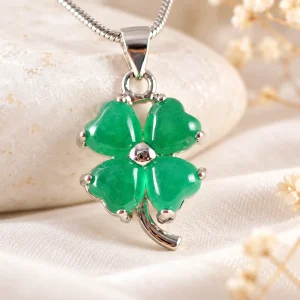
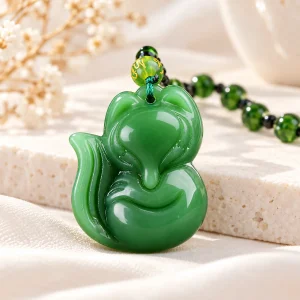
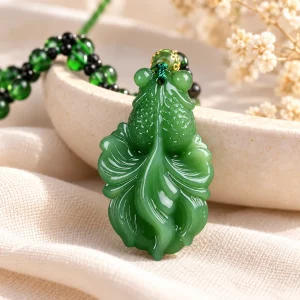
- The pendant, mounted on a braided cord rather than a chain: a pendant on a cord, and the others among the jade pendants.
- The necklace, which is most often a flat pendant on a cord: a men’s jade necklace, and the others among the jade necklaces.
There is no “men” section on this site, and that is deliberate. When I surveyed French searches for this stone, generic demand turned out to be ten times lighter than demand family by family: people look for a bracelet, a ring or a pendant far more often than for men’s jewellery as a whole. The pieces therefore live in the collections of their family, and this article plays the role of the section.

The width of a bangle, and the millimetre I don’t write
The bangle is the easiest format to get wrong, because it does not adjust: it is a closed ring cut from a single piece of stone, with no clasp or hinge, and it is sized by its inner diameter, not by wrist circumference. If this shape exists at all, it is not because jade is hard, it is only moderately so, but because it is tough, difficult to break: why jade almost never breaks. Converting one measurement into the other is explained in measuring your wrist, and the other formats in the size guide.
That leaves the width of the band, which is what makes a bangle read as masculine or not. I can say three things about it without inventing a figure. A wider band needs more material, so it costs more at equal quality and weighs more on the wrist. It also catches the edge of a desk where a narrow band slips past. And it never makes up for a diameter mistake: these are two independent measurements.
The only two sized query variants I found on this subject, in French searches, have zero volume: the question almost never comes up in millimetres, and my answer would be an unmeasured number.
Bracelets whose density I publish
Silver, gold, and what the setting does to the scale
Two metals recur. 925 silver is the one on my men’s references: understated, it tarnishes slowly and can be polished again. Gold does not tarnish, costs more and changes how a green stone reads: that is the subject of jade and gold jewellery.
The setting also affects my method. My check is a hydrostatic weighing: the stone is weighed in air, then suspended in a glass of water, and the ratio gives its density. On a set piece or a threaded strand, the metal and the thread enter the measurement and skew it. So I weigh the bare stone of the sample I order, not every ring that ships. The protocol and its limits are on the weighing page.
The colours that recur on men’s pieces
The men’s references in my catalogue revolve around dark green, and that reflects my selection rather than a survey: I have not measured demand by colour. The chemistry, however, is established and differs by mineral: in jadeite, vivid green comes from chromium and ordinary green from iron; in nephrite, from iron alone, hence the so-called spinach green, which is the green of the dark pieces. The range of greens is covered in green jade stone, the rest of the palette in jade stone colours, and white, which is not a second-rate jade, in white jade stone.
One caution belongs here, and it mostly affects dark pieces: a perfectly even bottle green across an entire strand of cheap beads is a signal, not proof. What dye does and what it leaves visible is in dyed jade.
The cord, the chain and the clasp
On a pendant, the stone is only half the object: what carries it decides how low it hangs, and what gives way first. The braided cord, which I use on men’s pieces, holds up for practical reasons as much as for looks: it does not deform like a fine chain, it costs next to nothing to replace, and it does not turn skin green. On the other hand, it soaks up sweat and snaps cleanly if it catches. A silver chain lasts longer but needs a clasp, which is the weak point of a necklace worn every day. The details of thread, knot and replacement are in thread and cord for jade jewellery.
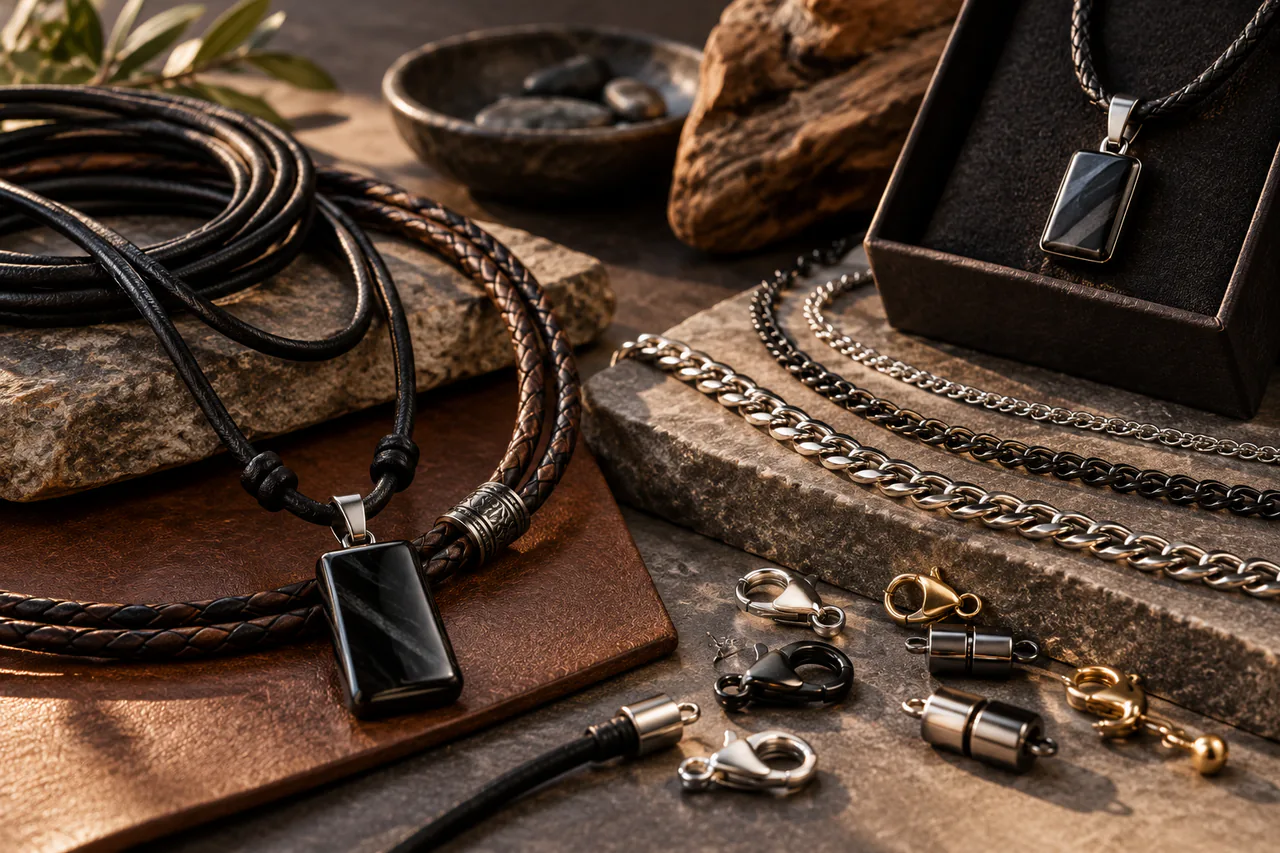
On length, the same rule applies: I describe, I do not give figures. A pendant worn high shows at the open collar of a shirt, a pendant worn low bumps against a belt buckle. I publish the length measured on the sample I receive, reference by reference.
Jade rings, chosen one by one
The mineral does not depend on the wearer
This is the point this page exists to make. The word jade covers two unrelated minerals, jadeite and nephrite, separated in 1863 by the French mineralogist Alexis Damour, and their densities do not overlap: jadeite sits between 3.25 and 3.36, nephrite between 2.90 and 3.03, while serpentine is around 2.6 and dyed quartzite around 2.65. None of these numbers changes depending on whether the piece is sold to a man or a woman. The full overview is on jade stone, and checking at home in how to recognise real jade stone.
Two consequences for a piece often worn every day. Scratching first: nephrite sits around 6 to 6.5 on the Mohs scale and jadeite around 6.5 to 7, while quartz, which makes up a good share of ordinary dust, rates 7. A dusty cloth dulls nephrite faster than jadeite. Treatment next: I cannot determine it, my supplier does not know it, and my scale does not reveal it, since a resin does not change the mass enough. That prevents me from writing “untreated”, and it rules out ultrasonic cleaners and steam for you, which an impregnation does not withstand. The actual classification is in jade A, B, C, and what I know so far in the treatment information sheet.
The missing format, and why I say so
There is no men’s reference among the jade earrings, and it is not an oversight. On 8 September 2026, surveying French search queries for this stone, I counted 79 query variants pairing men with bracelets against 4 for earrings, all four with zero volume. Demand of that size does not justify a reference, and I would rather say so than suggest a complete catalogue.
The reverse asymmetry is worth noting, because it runs against intuition in a jewellery market: on the bracelet side, the men’s field counts 79 variants against 47 in the women’s field. The companion to this page is jade jewellery for women.
What traditions attribute to men’s pieces
What follows changes register, and I flag it rather than blending it into the rest. Nothing in it is proven: it is what traditions have attributed to this stone.
Classical Chinese thought is said to have associated jade with moral qualities rather than a power, and it was the scholar, so a man, whom it described through the material: the moral virtues of jade. The motifs on men’s pieces come from the same repertoire, the dragon first among them: jade motifs, the Buddha pendant. Contemporary authors also link jade to luck, an attribution that is reported and never established: the lucky charm idea. What I will never write, for a man or for anyone: that a piece of jewellery protects or heals.
The questions I get asked
What bangle width should a man choose?
I do not give a millimetre figure, and no one should give you one without having the piece in hand. What can be reasoned through: a wide band weighs more, costs more at equal quality and catches on corners more often. It never makes up for a mistake in inner diameter, which is the decisive measurement.
What cord length for a man’s jade pendant?
It is a choice, not a standard, and you make it on your own body: a shoelace knotted at the length you have in mind and worn for a day settles it better than a number read online. The only fixed constraint is that a cord without a clasp must fit over the head.
Is jade men’s jewellery?
Historically, yes, and widely so. Chinese ritual objects in nephrite, discs and tubes, belong to a world of courts and scholars. The idea that it is first and foremost women’s jewellery does not come from there.
Can a man wear a jade bangle?
Yes, with one constraint that has nothing symbolic about it: a bangle is a closed ring that has to pass over the hand, and a broad hand requires a larger inner diameter, so a larger stone. It is the only format in the catalogue that cannot be adjusted afterward.
Which jade for a man who works with his hands?
A pendant rather than a bangle, and jadeite rather than nephrite if the choice comes up, since its hardness ranks higher. Jade absorbs impacts but scratches: take the piece off for work and sports, and store it on its own.
Silver or gold with jade, for a man?
No rule, only consequences: 925 silver darkens slowly and can be polished again, gold does not change and warms up a dark green. In both cases the setting skews my weighing, which is why it is done on the bare stone of the sample.
Where I checked
What comes from a named source. The separation of jadeite and nephrite comes from Alexis Damour’s note in the Comptes rendus hebdomadaires de l’Académie des sciences, volume 56, 1863; I do not give its page numbers, because I have not read it. The density and hardness ranges are those of the mineralogical literature: I repeat them, I did not measure them, and their limits vary by a few hundredths from one database to another, which prevents me from attributing them to any one organization.
What is an observation, dated. On 8 September 2026, I surveyed French search queries for this stone: that is where the count of 79 bracelet variants against 4 for earrings and 47 on the women’s side comes from, along with the one-to-ten ratio between generic demand and family-by-family demand, and the fact that the only sized query variants on this subject have zero volume. The same day, my supplier confirmed that they cannot tell whether their stock is treated.
What is my own reasoning. The refusal to publish a width, a length or a diameter before receiving the sample, the decision not to open a men’s section, the link between hardness and wear from dust, and the idea that a cord gives way before the stone: these are choices and deductions, not established facts. The dark tone of the men’s pieces is a catalogue selection, not a preference I have measured, and I state it that way rather than as a statistic. If you find a mistake here, write to me: I will correct it and note the correction.
In one sentence
Men’s jade jewellery is chosen by format, width, length and setting, not by some quality of stone that would be masculine; the mineral is the same on both sides, it is proven on the scale, and the numbers come when I have the piece in hand, not before. The method is on the weighing page, the pieces in the shop.
Pendants whose mineral and density I publish