Judging jade quality: the six criteria
This page explains how I examine a piece of jade before putting it online: what each criterion is checked with, the order I take them in, which ones survive a photograph, and the two things none of them tells you.
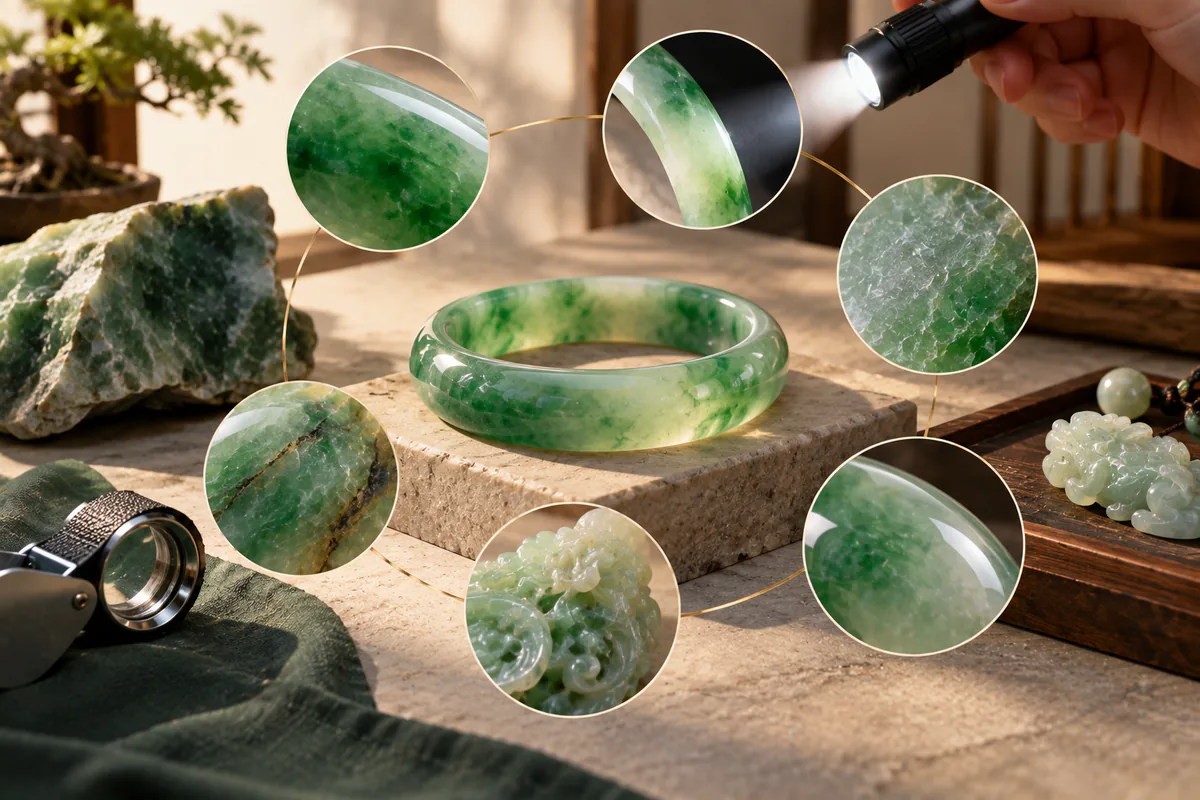
Jade quality is read through six criteria that cannot be reduced to a single grade: colour and its evenness, translucency, grain texture, polish quality, fractures and inclusions, and finally the cut and symmetry of the piece.
These six criteria do not offset one another. A translucent stone with a fracture is not the equivalent of a sound but dull stone: they are two different objects, and nothing requires ranking one above the other.
My name is Jade, I run a jade jewellery workshop: I choose the pieces, have them set, and weigh one sample of each reference before it goes on sale. I am neither a gemmologist nor a lapidary: I describe what I look at, I do not issue any grading.
The material comes before quality
Judging the quality of a stone that is not jade means examining the wrong object. The word covers two unrelated minerals, jadeite and nephrite, and the trade sells other stones under that name: serpentine sits around 2.6 and dyed quartzite around 2.65, while jadeite runs from 3.25 to 3.36 and nephrite from 2.90 to 3.03. These four ranges are my working tool, and the protocol that measures them is published on the weighing page. The split itself is the subject of this site’s main guide, the most common substitutions that of stones sold as jade, and the checks you can do at home that of how to recognise real jade stone.
Once the material is known, a second precaution: the six criteria are read within a single species. Nephrite and jadeite have neither the same grain, nor the same possible translucency, nor the same deposits, and comparing them on a single grid turns a difference in nature into a difference in quality (what separates the two minerals).
Colour, and above all its evenness
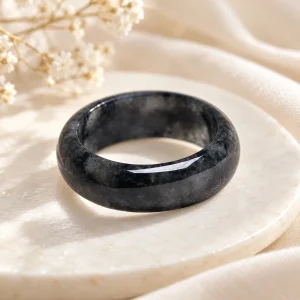
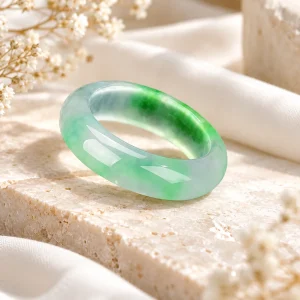
Colour is the criterion people look at first, and the one they judge fastest, because they stop at the hue. What is really being judged is how evenly that hue is spread across the whole piece: a colour distributed with no clouding, no streaks and no paler patches is found less often than an intense colour, and all the less so as the object gets bigger.
What I do, concretely. On a bangle, I turn the piece around and look at the entire circumference, because the green of jade is rarely spread evenly and a bracelet can have a good side and a pale side. On a strand of beads, I compare the beads with each other rather than each one on its own. On a set cabochon, I look at the hue in daylight and then under a lamp: a yellow light source brings out warm greens and erases greys.
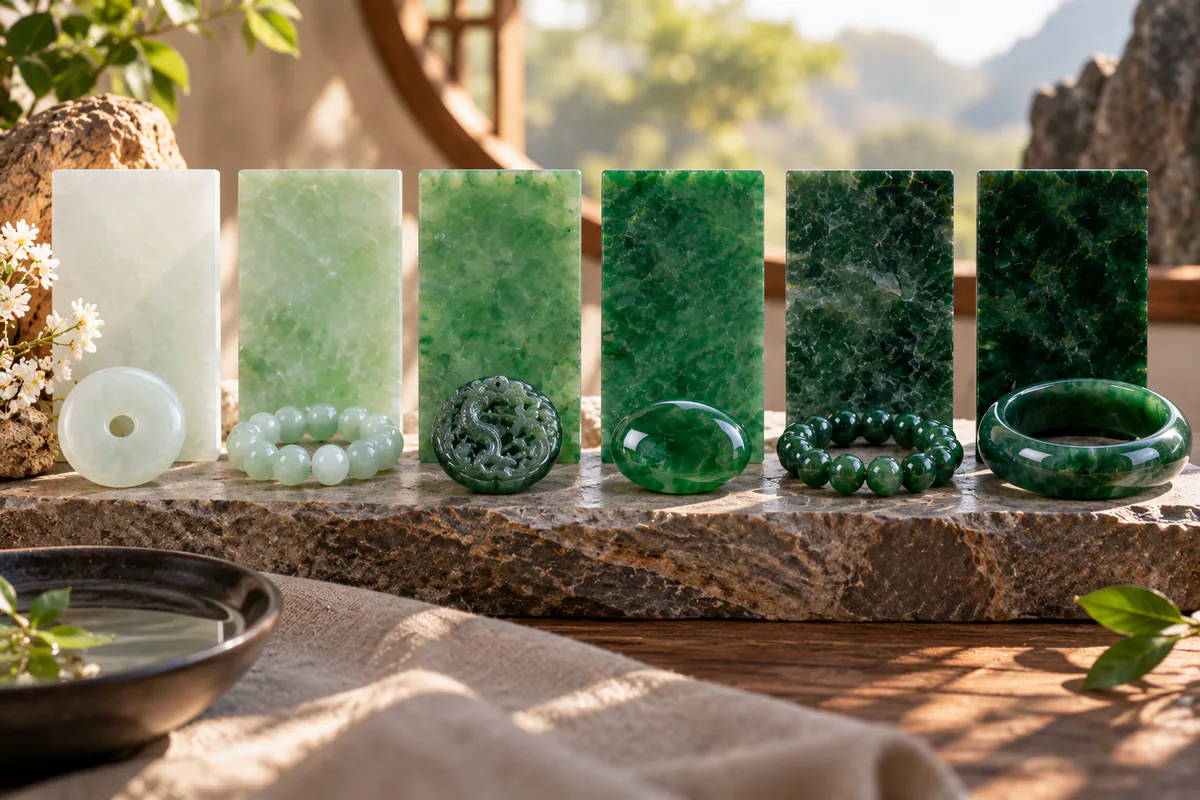
Where the green comes from is not the subject of this page: chromium in jadeite, iron in nephrite, which is explained in green jade stone, with the rest of the palette in jade stone colours. Two warning signs, however, belong to this criterion. A colour that is too even and too saturated on an ordinary piece deserves a look at the fractures, where dye settles (spotting added colour). And “imperial jade” names the top of the scale for jadeite, a saturated, translucent green, not an origin or a label: what the term really means.
Jade rings right now
Translucency, which is not transparency
The two words are often confused, and they do not say the same thing. A transparent stone lets you read through it; a translucent stone lets light in, where it diffuses and comes back out softened. Jade is almost never transparent, and a listing that says so has the wrong vocabulary or the wrong stone.
Translucency is judged through the edge, never from the front, and against a diffuse light source rather than a spotlight: a bare bulb placed behind a stone makes anything glow. Three caveats, in this order. Thickness distorts the comparison, so two pieces can only be compared at similar thickness. Translucency varies within the same piece: a bangle can let light through along part of its circumference and stay opaque elsewhere, and that is common. And a closed setting makes the examination impossible.
The trade calls this a stone’s water, a word in common use that nobody defines (the jade glossary). It is also the criterion that accounts for part of the price gap noted in the price of jade stone and the price of set jewellery without being able to break it down. I give no grade, no percentage and no scale: I have no way of measuring translucency at home, and an invented scale would be exactly the flaw I criticize in others.
Grain texture
Grain is the size of the crystals or fibers that make up the stone, and it governs two of the other criteria. A fine grain lets light travel further, so it supports translucency, and it takes a more even polish, because the crystals at the surface are smaller and wear down together under the wheel.
Jadeite is made of interlocking grains, nephrite of microscopic fibers tangled like felt: two textures, not two degrees of the same texture (why jade almost never breaks). On a polished piece, I look for the grain in raking light, tilting the surface until it returns an elongated reflection. A coarse-grained surface then shows a slight wavy relief, because crystals with different orientations have not worn down at the same rate. A fine-grained surface returns a clean, continuous reflection.
Two limits to this observation, and I state them because they matter. It needs the stone in hand; it cannot be done on a screen. And it is easily confused with a mediocre polish, which produces a similar flaw for a different reason: that is the next section.
Polish quality
Polish is, along with the cut, the one of the six criteria that owes most to the workshop’s work. It is judged by what the surface does to a reflection, not by its shine: a very shiny surface can be poorly leveled.
My method fits in one sentence: I watch the reflection of a straight line, the edge of a table or a window frame, move across the surface. If it wavers, the surface is not flat and the polish followed rough leveling. Then I look for the places the wheel reaches poorly, around a drill hole, at the bottom of a groove, in the hollow of a carving, inside a bangle: that is where matte areas show up when the work was rushed, and that is where nobody thinks to look.
Two caveats. On nephrite, a slightly satiny polish can come from the material as much as from the workshop, and I cannot always tell. And a very glassy shine on an otherwise ordinary piece may come from a surface coating rather than polishing: I have no way to check that on the piece I receive.
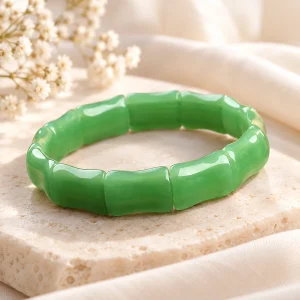
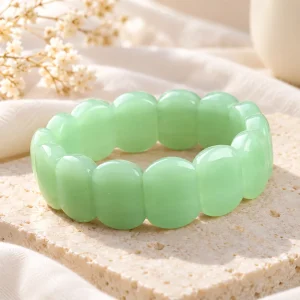
Bracelets whose density I publish
What time does to a polish
Jade is moderately hard and remarkably tough, and the confusion between those two notions shows on most of the pages I opened. Hardness measures resistance to scratching: nephrite sits around 6 to 6.5 on the Mohs scale, jadeite around 6.5 to 7. Quartz rates 7 and makes up a large share of ordinary dust. In other words, dust is harder than nephrite and as hard as jadeite, and a cloth loaded with it slowly dulls a surface instead of cleaning it. Toughness, on the other hand, measures resistance to breaking, and while the polish softens, the piece does not break because of it: why jade almost never breaks.
The practical consequence is this: an old piece does not look like a catalogue photo, and that is not a manufacturing defect. A bracelet worn for a long time has a softer, more satiny surface, sometimes marked with micro-scratches that only show in raking light. It is a frequent source of doubt for people comparing an inherited piece with a shop’s images. What protects that surface is storage more than cleaning: storing jade jewellery. And if it is the hue, rather than the shine, that seems to have shifted, that question is covered in jade that changes colour.
I give no duration and no timeframe here. I only sell new pieces, I do not comment on a piece I have not received, and I know of no rule linking a number of years to a surface condition.
Veins, inclusions and fractures
This is the criterion I most often see misunderstood, because it mixes two unrelated things: what has run through the material since it formed, and what has opened it since.
- Veins and colour clouds belong to the stone. They are zones of different composition, formed along with it. They are not openings, and I do not count them as flaws.
- Inclusions are crystals or spots of another mineral, often dark. They are part of the material and cannot be removed.
- A fracture is an opening. It is both a possible breaking point and an entry path for dye or resin, and it is the one of the three that weighs most on a piece’s value.
Telling them apart is done with a fingernail and light. A vein stops at the surface without interrupting it; a fracture catches a fingernail drawn across it, and sends back a line of light when you tilt the piece, because its two edges reflect separately. Under a lamp placed behind the stone, dye shows in fractures as a darker streak, more concentrated than the background colour: that is the subject of dyed jade. What jade’s toughness forgives in a fractured piece is covered in hardness and toughness, and what happens when it does not in a jade bracelet that breaks.
No piece in my catalogue is advertised as inclusion-free, and none of my product pages promises a clean stone. I describe what I received, I do not sell it as a guarantee: a vein photographed up close on a product page is a vein, not a manufacturing accident, and it is the first doubt that comes up after delivery in this market. What each product page carries is detailed in what I publish on each jade product page.
Cut and symmetry
The last criterion says nothing about the stone, which is probably why people skip it. Yet all it asks for is a methodical look.
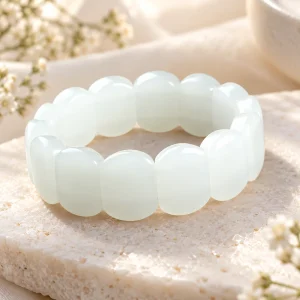
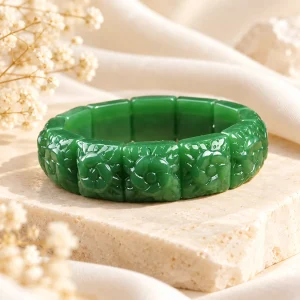
On a bangle, I check that the thickness stays constant all the way around, that the inner opening is truly circular and not oval, and that both edges have the same rounding. On a cabochon, I look at it in profile, not from above: the dome should be centered on its base and its outline regular. On a carved figure, a Buddha or a disc, I compare the two halves and look at the depth of the carving, which reveals the time spent on the piece. On a strand of beads, I look for off-centre drill holes, which make the beads sit crooked once strung.
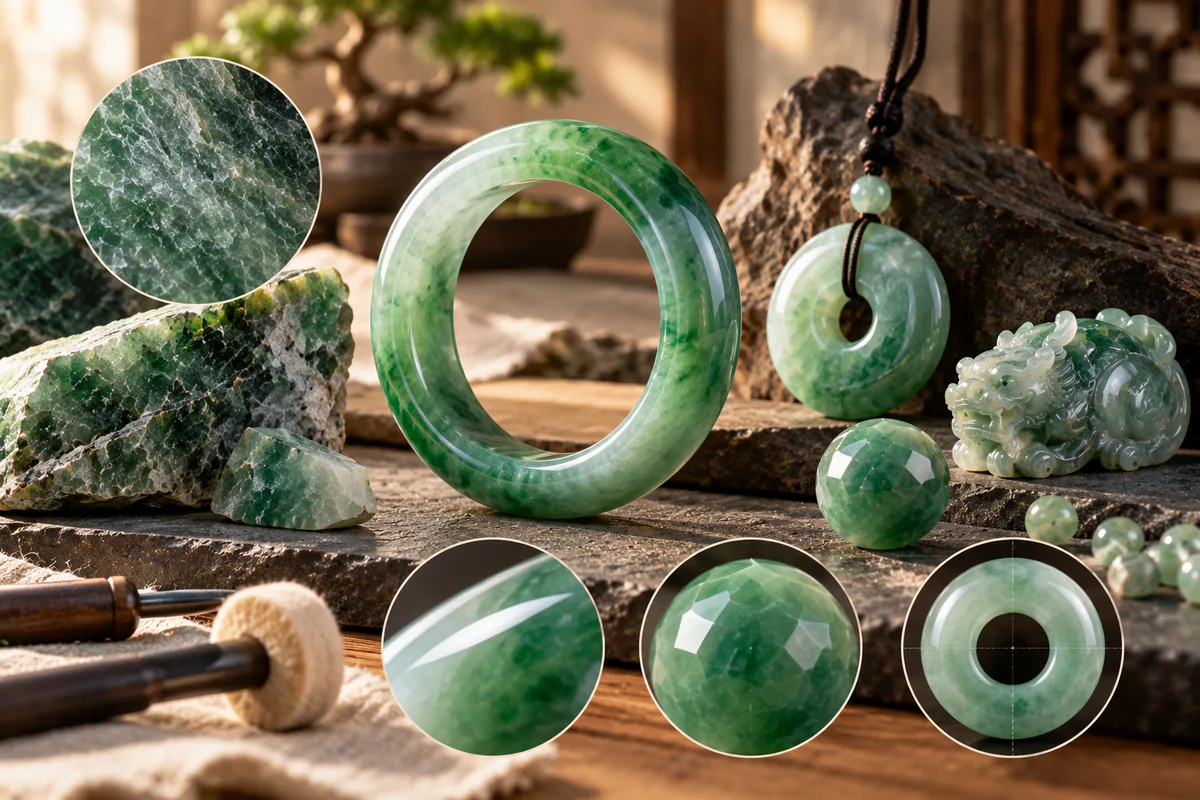
One point is worth knowing before comparing two objects. A bangle carved from a single block requires hollowing out the centre and demands a stone that is sound all the way around: one badly placed flaw ruins the piece, whereas the same block cut into beads works around its flaws. These two objects require neither the same work nor the same starting material, and what that means for the price is covered in the price of jade stone. My jewellery is set or chosen one piece at a time, and the bracelet and pendant collections are best browsed with these six criteria in hand.
The seventh criterion, the one I refuse
A seventh criterion circulates widely in this market: the A, AA, AAA grading, sometimes stretched to five letters. I use it on none of my pieces, for three reasons.
It refers to no standard I have been able to find, neither from gemological organizations nor in any regulatory text (how jade is named). It borrows its letters from the real classification, the one for treatments, A, B and C, and it is this borrowing that makes it both credible and misleading: a letter meant to express quality looks like a letter that says something else entirely (jade A, B, C).
Finally, the six criteria on this page resist it on their own: none of them is a number, none is weighted against the others, and I do not see how a single letter could summarize six independent judgments without losing five of them. Of the nine French competitors I opened on 8 September 2026, one uses this scale.
What cannot be judged from a photo or by eye
Some of these six criteria survive a photograph and some do not, and it is better to know which before buying remotely.
These come through more or less: fractures and inclusions, if the shot is sharp and lit from the side; symmetry, if the object is photographed from the front and in profile; colour, provided you are wary of white balance, which shifts a green from one shot to the next. These do not: translucency, because backlighting can be staged; grain, which needs the stone in hand; and polish, which retouching erases. That is why I photograph my pieces from the side and without backlighting, and why I prefer a slightly dull image to a flattering one.
What remains is what none of the six tells you, and it is the heaviest: treatment. A resin impregnation does not shift density enough for my scale to see it; only infrared spectroscopy would settle it, and I do not have that equipment. My supplier does not know the status of their stock either, as they confirmed to me on 8 September 2026, and I say so rather than keep quiet, even though Article 2 of French Decree No. 2002-65 requires the name to be completed with the treatment undergone: my treatment information sheet explains what that changes. What I publish instead can be checked, on one sample of each reference: the mass in air, the immersed mass, the density and the date of the measurement. The questions to ask a seller are gathered in buying jade jewellery.
The questions I get asked
What are the quality criteria for jade?
Six: colour and its evenness, translucency, grain texture, polish quality, fractures and inclusions, cut and symmetry. They do not offset one another and cannot be summed up in a grade. A seventh, the A, AA, AAA scale, circulates widely and refers to no standard.
Is greener jade better-quality jade?
Not necessarily. What is judged is not the intensity of the hue but its evenness across the whole piece, and a very saturated but blotchy colour ranks behind a softer, even one. A hue that is too perfect on an ordinary piece, on the contrary, calls for a look at the fractures.
How can you judge jade from a photo?
Fractures, inclusions and symmetry show if the photo is sharp and lit from the side. Colour shows, allowing for white balance. Translucency, grain and polish cannot be judged on a screen: ask for a profile view, without backlighting, in which the piece has not been retouched.
Is a vein or spot in my jade a flaw?
No. A vein or a colour cloud has belonged to the stone since it formed and does not weaken it. What matters is an open fracture, which catches a fingernail and sends back a line of light when you tilt the piece. None of my product pages promises a clean stone.
My jade bracelet is less shiny than before; is that normal?
It is common. Ordinary dust contains quartz, which rates 7 on the Mohs scale, while nephrite is 6 to 6.5 and jadeite 6.5 to 7: a dusty cloth dulls a surface instead of cleaning it. The polish softens, but the stone does not break because of it.
What is a shop’s A, AA, AAA grading worth?
Nothing verifiable. I have not found this scale in any standard or regulatory text, and it borrows its letters from the A, B, C classification of treatments, which does exist. A single letter cannot summarize six independent criteria.
Where I checked
What comes from a named source. The density ranges and the Mohs hardness values come from the mineralogical literature: I repeat them, I did not measure them, and their limits vary by a few hundredths or tenths from one database to another. I therefore attribute them to no particular organization, because I did not take them from any single one. French Decree No. 2002-65 of 14 January 2002 is cited for its Article 2, which requires the name to be completed with the treatment undergone. The A, B, C classification of jadeite treatments is a trade classification, described on its dedicated page.
What is a market observation, dated. On 8 September 2026, I opened the nine French competitors on the first page of results. Only one publishes a list of jade quality criteria, and it is shorter than this one; none states the mineral of its pieces; one uses the A, AA, AAA scale. The same day, my supplier confirmed that they cannot tell whether their stock has been bleached, impregnated or dyed.
What is my own reasoning. The order in which I place the six criteria, the refusal of any grade or numbered scale, the link between jade’s hardness and the wear of its polish by dust, the way of telling a vein from a fracture with a fingernail and light, and the decision to describe a piece rather than promise a clean stone: these are positions and working methods, not established facts. If you find a mistake here, write to me: I will correct it and note the correction.
In one sentence
Judging jade quality first means knowing which material you are talking about, then looking at six separate things, none of which can be replaced by a letter: it takes time, it does not boil down, and that is precisely why the market invented a scale that says nothing. The measurement method is on the weighing page, the pieces in the shop.