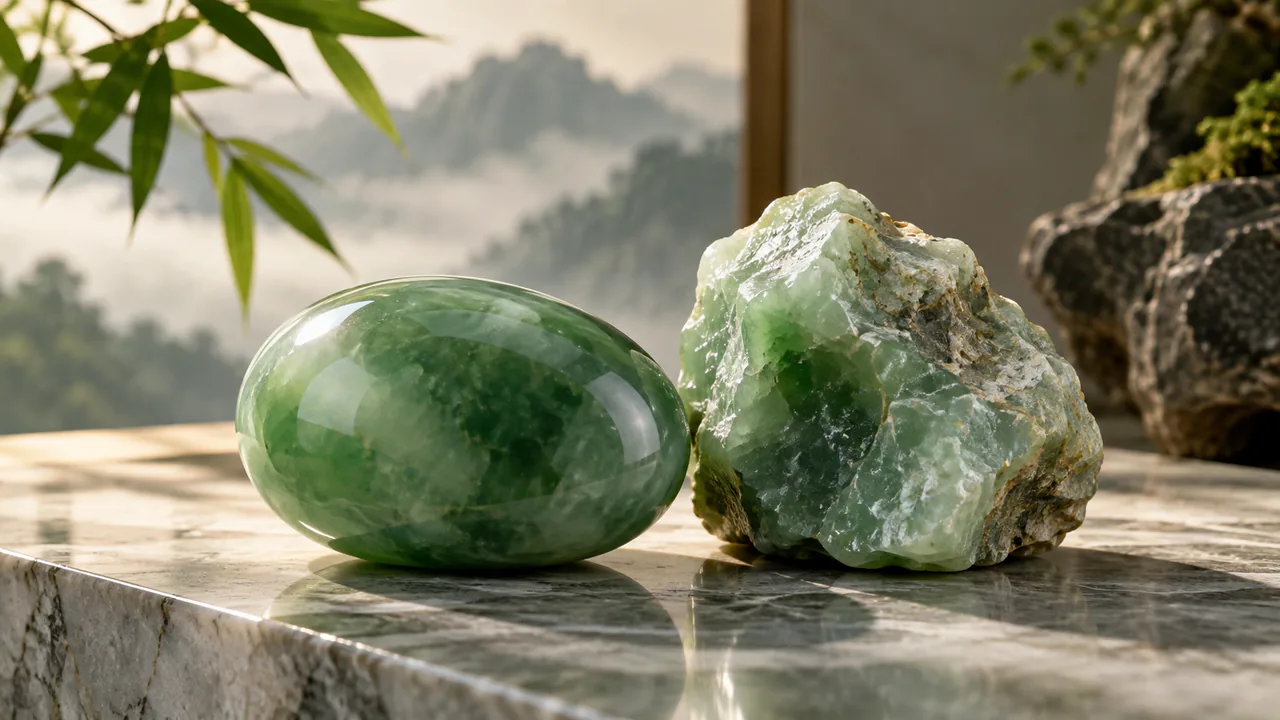
Jade Stone: Two Minerals Under One Name
This page covers jade stone from end to end: what separates jadeite from nephrite, what the market sells in their place, where their colour comes from, how I tell them apart on a scale, and what history, tradition and care add to a piece of jewellery.
Jade stone does not exist as a single mineral species: the word covers two minerals unrelated to each other, jadeite and nephrite, which their density separates without ambiguity, and that is the only reliable method I have at home.
| Mineral | Density |
|---|---|
| Jadeite | 3.25 to 3.36 |
| Nephrite | 2.90 to 3.03 |
Jadeite is a pyroxene, nephrite an amphibole: two mineral species with no kinship, which trade brought together under one word. They look alike to the eye, they separate on a scale, and it was a French mineralogist who told them apart, in 1863.
These two ranges are my working tool, and the protocol that measures them is published.
My name is Jade, and I run a jade jewellery workshop: I choose the pieces, have them set, and weigh one example of every piece before it goes on sale. I am neither a gemmologist nor a therapist: here, mineralogy is stated as fact, and everything else is attributed.
What a jade stone is: jadeite and nephrite
For centuries, any green, hard stone that was difficult to break was called jade, without anyone asking whether Chinese objects, European axes and Mesoamerican masks were made of the same material. They were not.
In 1863, the mineralogist Alexis Damour (1808-1902) analyzed green jades brought back from the looting of the Summer Palace in Beijing and established that the name covered two distinct species. He coined the word jadeite. The dividing line has not moved since.
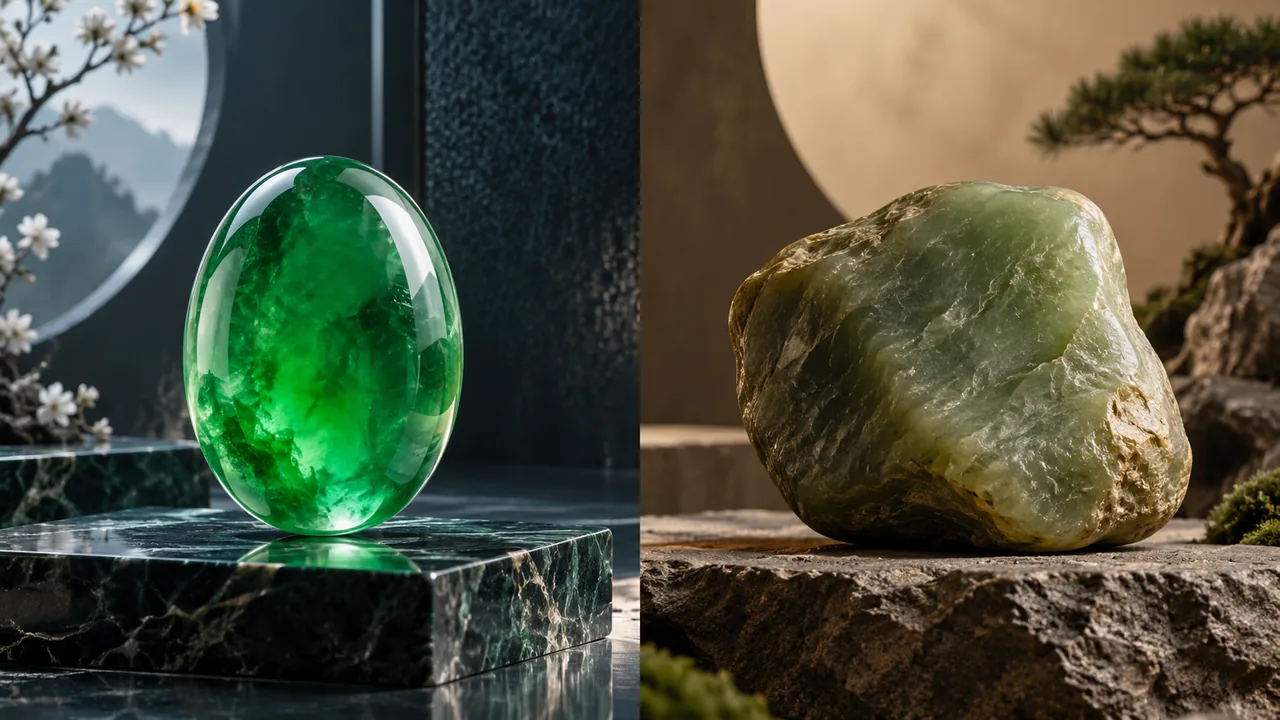
- Jadeite is a sodium aluminum pyroxene, with the formula NaAlSi2O6. Fine interlocking grains, and a translucency that can go as far as almost transparent.
- Nephrite is a calcium amphibole of the tremolite-actinolite series. It is not granular but fibrous: microscopic fibers matted together like felt.
Single chains in the pyroxene, double hydroxylated chains in the amphibole: that is where nephrite’s felted structure comes from, and its toughness with it. The detail is in jadeite or nephrite, and how they form in how jade stone forms.
A third name the trade does not count
The market talks about two jades, mineralogy knows more. Kosmochlor is a chromium-bearing pyroxene of the jadeite family, rare and almost always mixed with it: it is not sold under its own name.
I mention it because it marks the limit of my method: these mixtures sit around 3.3, like jadeite, and my scale does not separate them. It tells me the family, not the mineral. Nomenclatures admit one more, omphacite: how jade is named.
Hard, no. Tough, yes
Hardness measures resistance to scratching, toughness resistance to breaking. A diamond is very hard and splits under a hammer; jade is the opposite, and the confusion shows up on most of the pages I have opened.
Nephrite sits at around 6 to 6.5 on the Mohs scale, jadeite at 6.5 to 7: the first falls below quartz, which rates 7 and makes up a good share of ordinary dust, and the second almost matches it. Toughness, on the other hand, is exceptional in both, and it is what made the polished axes of the Neolithic, in nephrite in China and in jadeite in the Alps: why jade almost never breaks.
What I measure, and what I do not
A stone weighed in air, then hanging in a glass of water, gives its density by a simple ratio, which only needs comparing with the table at the top of the page. The limits of the method are on the weighing page.
Three clarifications. I weigh one example per piece, the one I order before it goes on sale, and not every order that ships. The measurement applies to the bare stone: on a set piece or a strung strand, the metal and the thread go onto the scale and skew it. And weighing tells the mineral, not the treatment: a jadeite impregnated with resin weighs about the same as any other, and only infrared spectroscopy, which I do not have, would settle it. My supplier does not know either, and I would rather write that than stay silent: jade A, B, C, and the treatment information sheet.
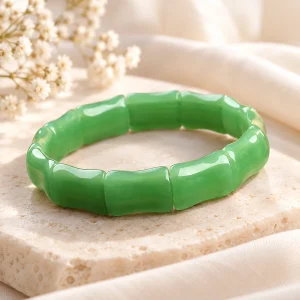
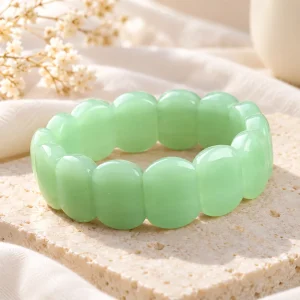
Bracelets whose density I publish
Care, and what really damages jade
Three habits and two prohibitions, and the prohibitions matter more.
- Lukewarm water, neutral soap, a soft cloth, then dry immediately. Nothing else, even on a piece worn every day.
- Never ultrasonic cleaners, never steam. As long as the treatment is not determined, you have to assume resin, which withstands neither cavitation nor thermal shock.
- The jewellery comes off before the pool, housework and sports: chlorine and cleaning products attack adhesives and metal.
What scratches jade is almost always another piece of jewellery: a separate soft pouch settles the matter (storing jade jewellery). The word “recharging” covers both a physical cleaning and a gesture of belief, which I keep apart in how to recharge a jade stone; the method setting by setting is in how to clean jade stone.
A history wider than China
In China, the material worked since the Neolithic is nephrite: bi discs, cong tubes, Liangzhu ornaments, the whole of ritual statuary. Jadeite arrived late, imported from Burma, and its imperial vogue dates from the 18th century. Confusing the two gives jadeite four thousand years that belong to nephrite: jade jewellery from China.
In Mesoamerica, the Olmecs and then the Maya worked jadeite from the Motagua valley, in Guatemala, and ranked it above gold. It was this tradition the Spanish encountered in the 16th century, and it is where the name of this page comes from.
In Europe, finally, and almost nobody writes about it in France. Damour identified jadeite in the axes from Celtic monuments as early as 1865. In June 2003, Pierre and Anne-Marie Pétrequin identified the Neolithic jadeite quarries of the Alps in the Monte Viso massif, in Piedmont, between 1,500 and 2,400 metres, and in the Beigua massif. In the 5th and 4th millennia BCE, they supplied polished axes spread over 3,300 kilometres, from Ireland to Bulgaria. The Museum of Prehistory in Carnac, in the Morbihan, displays some, and I grew up near those display cases: jade in Europe.
What traditions have attributed to the stone
What follows shifts register, and I say so rather than blending it into the rest. None of it is proven: it is what traditions have attributed to this stone.
Classical Chinese thought is said to associate jade with moral qualities rather than a power: the material served to describe the accomplished person. This is not crystal healing but philosophy, and I hold to the distinction: the moral virtues of jade.
Mesoamerican tradition is said to link the stone with water, maize and breath, hence the jadeite beads in burials. Contemporary crystal-healing authors associate jade with balance and luck: reported attributions, never established, gathered in what tradition attributes to jade stone and in where the lucky-stone idea comes from.
What I will never write: that a piece of jewellery heals, protects or promotes fertility.
Colours beyond green
Green is the colour people expect, but it is neither the only one nor the same chemistry from one mineral to the other. In jadeite, bright, vivid green comes from chromium and ordinary green from iron; in nephrite, from iron alone, hence the so-called spinach green: green jade stone.
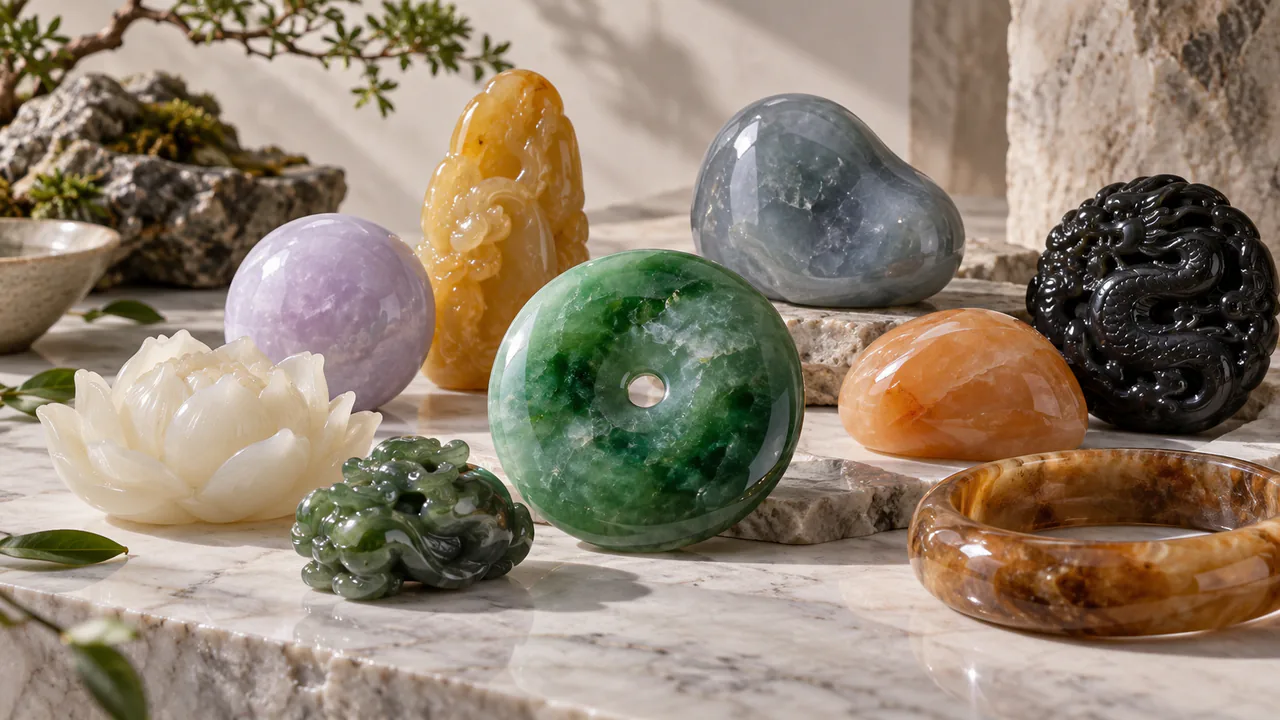
The rest of the palette is real and little known: the white of nephrite, called mutton fat in China, the lavender of jadeite, black, honey yellow, and the surface red caused by the oxidation of iron. The full tour is in the colours of jade stone and white jade stone.
Two colours call for suspicion: bright pink and clear blue sold as jade are almost always dyed quartzite or a coloured jadeite (pink, blue and red jade stone, dyed jade). And “imperial jade” refers to a quality of jadeite, not a place of origin: what it means.
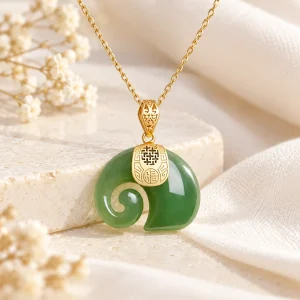
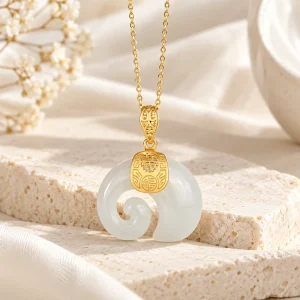
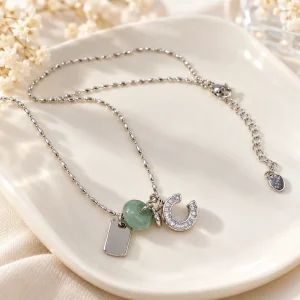
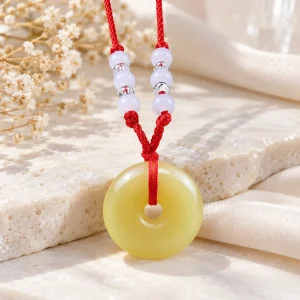
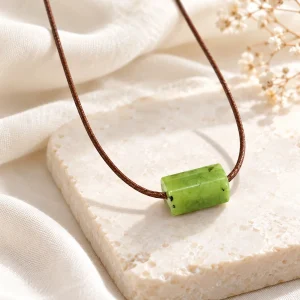
Pendants, one colour per piece
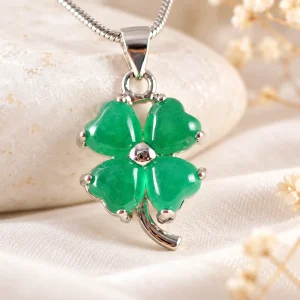
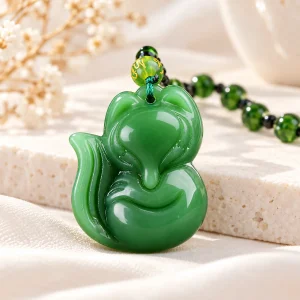
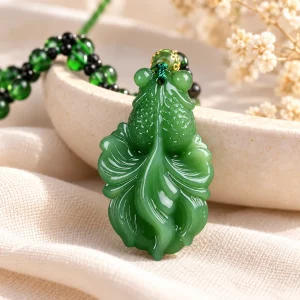
Where the jade in jewellery comes from
The two minerals do not come from the same places: jadeite requires very high pressures at moderate temperatures, which confines it to former subduction zones. Nephrite is more common.
- Burma: most of the gem-quality jadeite on the world market.
- Guatemala: the Motagua valley, the second source of gem jadeite, far behind Burma. Russia, Kazakhstan and Japan also produce some, marginally.
- New Zealand: pounamu nephrite, whose status is not only cultural, since a 1997 New Zealand law vested ownership of the pounamu on its territory in the Ngāi Tahu iwi. That is the subject of Māori pounamu, and the reason I imitate neither the hei-tiki nor the koru.
- Russia, Canada, Taiwan, China: the major nephrite deposits, where most jewellery on the market comes from.
The complete map is in where jade comes from. I refuse one origin, Burma. The American import ban introduced in 2008 was lifted in 2016, but the state-owned company that controls Burmese jade has been under United States sanctions since 8 April 2021 and European Union sanctions since 21 June 2021, and the ethical argument does the rest: Burmese jade bracelets, where my jade comes from.
Where the word jade comes from
The word has nothing Chinese about it. It comes from the Spanish piedra de la ijada, coined around 1565: the stone of the flank, because the Spanish had seen the conquered peoples wear it against kidney colic. The same object gives the Latin lapis nephriticus, hence nephrite, from the Greek nephros, kidney. French went through éjade, then a faulty word split gave le jade, a path traced by the Dictionary of the Académie française.
In other words, the two words I use every day were born from a promise of healing, which is exactly what I forbid myself to write on a product page. I carry that contrast rather than hide it: about, the meaning of jade stone.
What the trade sells under this name
A large part of what is sold as jade is not jade: the fraud works through a compound name rather than an outright lie.
- Serpentine, around 2.6, sold under the labels “new jade”, “olive jade” or “Korean jade”.
- Dyed quartzite, around 2.65, sold as “Malaysia jade”: the material of most pink and fuchsia bracelets.
- Aventurine, a green quartzite, often offered as jade in bead lots.
- Chrysoprase sold as “Australian jade”, and grossular as “African jade”.
None of them is bad: they have a name, and that name is not jade. The full list and their densities are in stones sold as jade, the checks you can do at home in how to recognise genuine jade stone, and the trade vocabulary in the jade glossary.
French law says two useful things without naming jade. Decree No. 2002-65 of 14 January 2002 mentions neither jade, jadeite nor nephrite, and carries no positive list; it does, however, prohibit selling a stone under another name, and it prohibits outright “semi-precious” and “semi-fine”, which most stone websites use anyway: jade and the 2002 decree, is jade a precious stone.
One last false benchmark: the A, AA, AAA scale has no normative existence, and it borrows its alphabet from the real classification, the one for treatments. What gives a piece its value is in judging the quality of jade, and the price gap in the price of jade stone.
The questions I get asked
What is the difference between jadeite and nephrite?
Two unrelated minerals. Jadeite is a fine-grained pyroxene, with a density of 3.25 to 3.36; nephrite is a fibrous amphibole, from 2.90 to 3.03. Both are legitimately called jade, and the density gap is enough to tell them apart.
How can I tell if my jade stone is real?
The only reliable method at home is hydrostatic weighing: weigh the bare stone in air, then hanging in water, and calculate the ratio. Around 2.6 or 2.65, it is serpentine or quartzite. The scratch, sound and cold tests prove almost nothing: the detail is on the weighing page.
Is jade a precious stone?
Not in the strict sense: usage reserves that term for diamond, ruby, sapphire and emerald. Beware of the next reflex: in France, “semi-precious” is prohibited by Article 5 of Decree No. 2002-65. The right terms are a fine stone, or a gemstone.
Does jade stone scratch easily?
More than people think, especially nephrite: its hardness of 6 to 6.5 puts it below quartz, which is very common in household dust, and a dusty cloth dulls it. Jadeite, at 6.5 to 7, holds up better. Toughness, for its part, absorbs knocks.
Can I wear my jade jewellery every day?
Yes, and it is one of the few stones people dare to carve into a bangle from a single block. Take it off before the pool, housework and sports, dry it after contact with water, and store it on its own. No ultrasonic cleaner, no steam.
Why don’t two jades of the same colour cost the same?
Because colour is only one variable: the mineral, translucency, evenness of colour, fineness of grain, weight and treatment all count too. A translucent jadeite and an opaque nephrite of the same shade do not belong to the same market.
Where I checked
What comes from a named source. The separation of the two minerals and the word jadeite come from Alexis Damour’s note in the Comptes rendus hebdomadaires de l’Académie des sciences, volume 56, 1863; I do not give the page numbers, because I have not read it. Monte Viso, Beigua, the altitudes, the 3,300 kilometres and the Morbihan deposits come from the Pétrequin research, the CNRS JADE project, June 2003. The legal texts are named in the body: Decree No. 2002-65, the 2008 JADE Act and its lifting by Executive Order 13742 of 7 October 2016, the American sanctions of 8 April 2021 and the European sanctions of 21 June 2021, and the 1997 New Zealand law on pounamu. The density and hardness ranges are those of the mineralogical literature: I repeat them, I have not measured them, and their limits vary by a few hundredths from one database to another. I therefore attribute them to no organization in particular, because I did not take them from a single one.
What is a market observation, with a date. On 8 September 2026, I looked at the nine French competitors on the first page of results. One was offline and three sell almost no jade; among the others, none states the mineral of its pieces, one shows two contradictory origins on the same product page, and another uses the A, AA, AAA scale. The same day, my supplier confirmed that it cannot say whether its stock is treated.
What is my own reasoning. The link between hardness and wear from dust, the rule of never writing “untreated” or “natural” without spectroscopy, the refusal of Burmese jadeite on grounds of American law: these are decisions, not established facts. If you find a mistake here, write to me: I will correct it and note that I did.
In one sentence
Jade stone is a trade word that covers two unrelated minerals, and everything that follows, the colour, the price, the imitations, comes down to the word not saying so. The method is on the weighing page, and the pieces are in the shop.