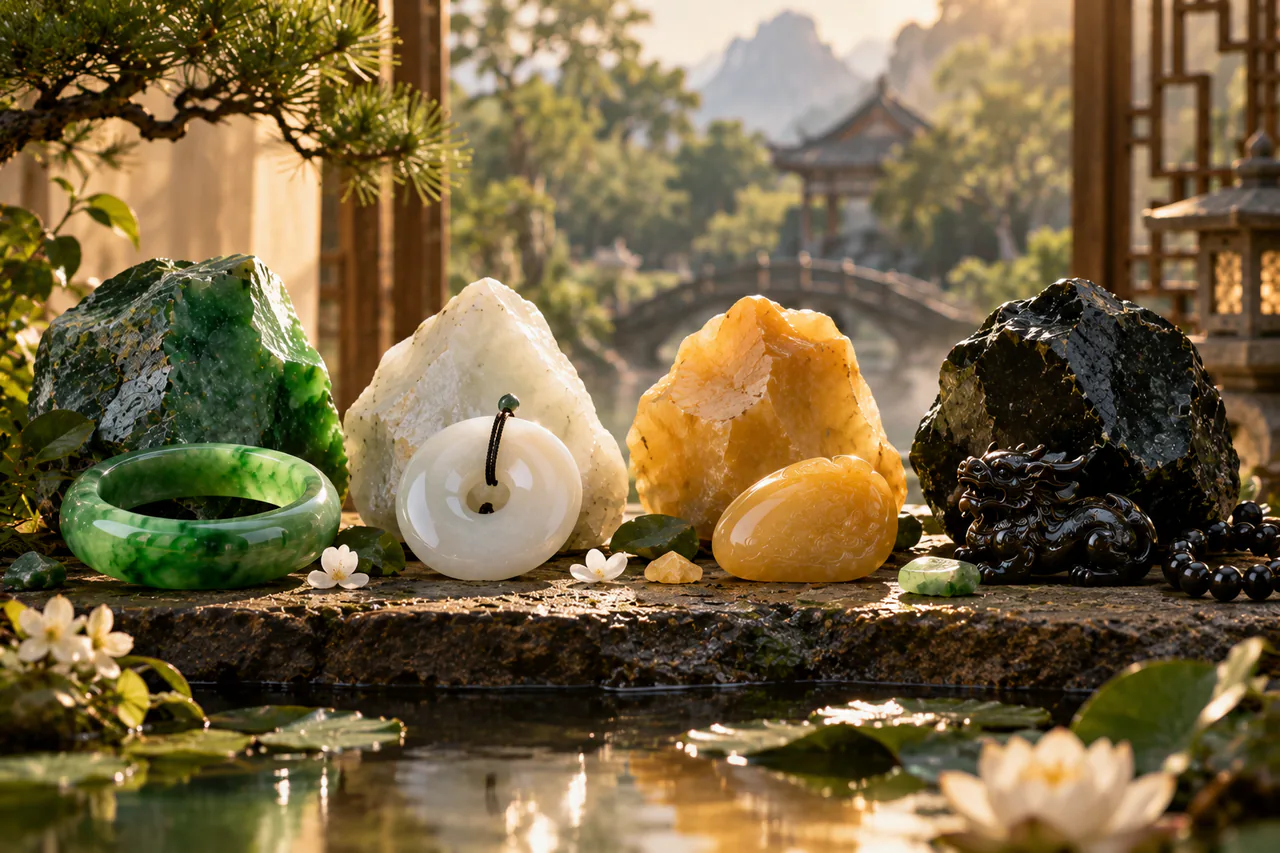
Jade Stone Colours: Green, White, Yellow, Black
This page takes jade stone colour by colour: what produces each shade in the mineral, what imitates it, what colour changes in the price, and when a shade should make you suspicious.
A jade can be green, white, honey yellow, reddish brown, black or lavender, and these six colours are not produced the same way: green and honey come from traces of iron or chromium, reddish brown from surface oxidation of iron, white from the absence of these traces, black from inclusions, and lavender from a cause I cannot settle.
Jadeite and nephrite do not produce the same palette, because they share neither the same formula nor the same structure. In its pure state, each of the two is white or colorless: colour is a chemical accident. Green is therefore just one colour among others, and on its own it says nothing about what a piece is worth.
My name is Jade, and I run a jade jewellery workshop: I choose the pieces, have them set, and weigh one example of every piece before it goes on sale. I am neither a gemmologist nor a therapist: I describe what produces a colour, I do not certify what a stone has undergone.
Where the colour of jade comes from
The colour of a jade is almost never that of the mineral itself: it comes from elements present in very small quantities, through three routes that have nothing to do with one another.
- Substitution. One ion takes the place of another in the crystal, without changing the mineral or its name: iron and chromium account for most jade colours.
- Inclusions. Grains of another material, scattered through the mass, darken the whole. That is where most dark pieces come from.
- Surface weathering. A block that has spent a long time in a river or in soil oxidizes through its cracks: the iron turns russet, then reddish brown. This colour is not in the mass, it sits in a thin layer, and the lapidary keeps it or cuts it away.
Then each species has its palette. Nephrite is an amphibole of the tremolite-actinolite series: at the magnesium end it is white, and the more iron replaces magnesium, the more it turns green, then dark green. Jadeite is a sodium aluminum pyroxene, and chromium replaces the aluminum: there, chromium gives a far more vivid green than iron. The divide between the two minerals is on the pillar page, and their chemistry in jadeite or nephrite.
Green, and what separates two greens
When people look up jade stone colours, green is almost always what they have in mind. Yet it covers a very wide range, and two greens of the same intensity have neither the same origin nor the same price.
In jadeite, the clear, saturated green comes from chromium; the duller, grayer green, which is also the most common, comes from iron. In nephrite there is only iron, hence the so-called spinach green and the bottle green of dark pieces. To the eye, what gives the species away is less the hue than the way light enters: jadeite can be distinctly translucent, while nephrite is more often milky.
The detail, shade by shade, is in green jade stone.
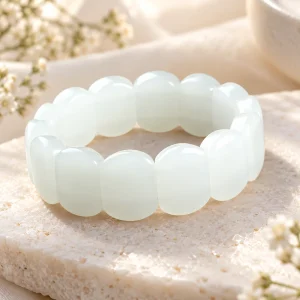
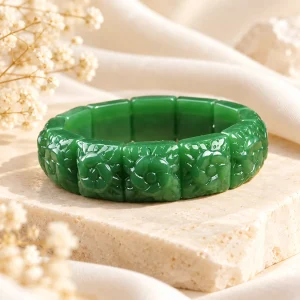
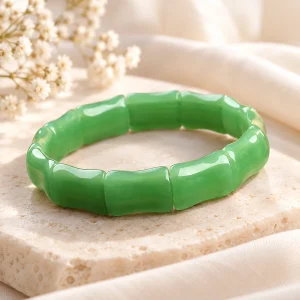
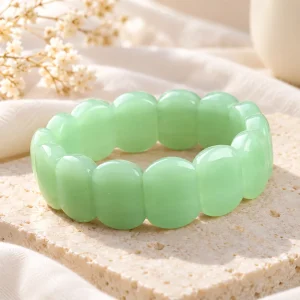
Jade bracelets, from light green to dark green
White, and the name mutton fat
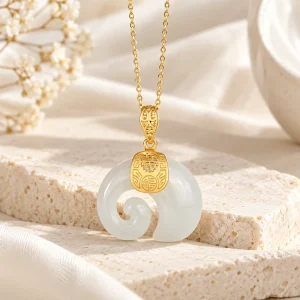
White is not a faded jade: it is nephrite when iron is lacking, so the starting point of the series rather than an exception. The trade name for the most sought-after white is mutton fat, and it describes the look as much as the hue: greasy, closed, almost without reflection.
It is also the most confused colour on the pages I have opened. A milky, uniform, slightly too regular white is very often quartzite or serpentine. The difference cannot be seen, it has to be weighed: 2.90 to 3.03 for nephrite, against about 2.65 for quartzite, with the protocol I publish. The full case is covered in white jade stone.
Honey yellow and reddish brown
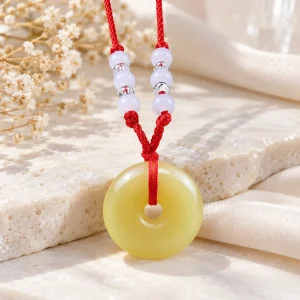
Yellow really exists, and it is most often a nephrite: a honey shade that again comes from iron, distributed differently than in a green. Red, however, does not come from the mass. It is the oxidation I mentioned above, taken from blocks left in alluvial deposits, and it gives russet browns rather than bright reds.
These are also the two most imitated colours after green: a dye reproduces them easily. A clear, uniform, bright red on inexpensive jewellery is an added red until proven otherwise. The sorting is done in pink, blue, red and yellow jade stone, and the origin of river blocks in where jade comes from.
Black, which is almost never black
Black jade exists, and it is the colour I was most wrong about before looking closely. Many so-called black nephrites stop being black as soon as you hold them up to a lamp: light passing through a thin edge comes out green, very dark, sometimes brown. The black comes from inclusions scattered through the felted structure of the stone, most often graphite from what I have read, and not from a pigment spread through the material.
There is also black jadeite, rarer in jewellery, often rich in omphacite, a neighboring mineral that nomenclatures attach to jade and that the trade does not name: how jade is named. And above all, there are many black stones sold under this name without being jade, from obsidian to dyed agate. Here again, the scale settles what the eye cannot.
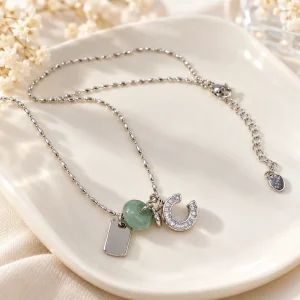
The black pieces I select are nephrites, and I only put a piece on sale after weighing its example: the rings include some, and so do the necklaces.
Lavender, the colour I do not carry
Lavender is a jadeite, and it is the colour whose cause is least well established on this page. The authors I have read do not agree: some attribute it to manganese, others to iron combined with titanium. I do not settle it, because I have nothing to settle it with, and I would rather write that than pick the version that sounds best.
What I can say is more down to earth. Lavender jadeite is pale, hazy and uneven, and its hue spreads through the grain. A deep, perfectly uniform, frankly purple lavender on a strand of beads sold for a few euros is almost always dyed quartzite or a coloured jadeite: recognizing an added colour.
It is not in the catalogue. Lavender is one of the two accent colours of this site: a place in the brand palette, none in the shop, and I would rather say so than let it pass for a choice.
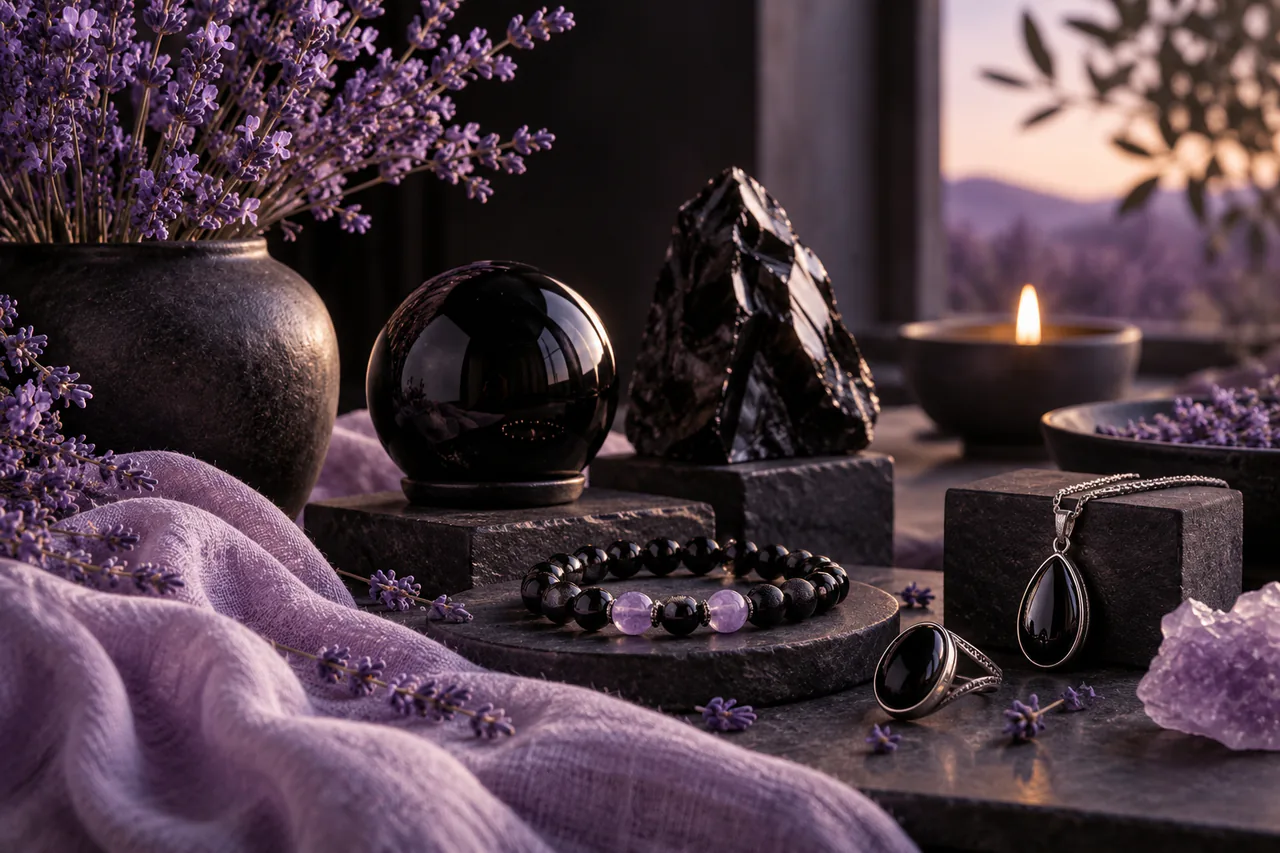
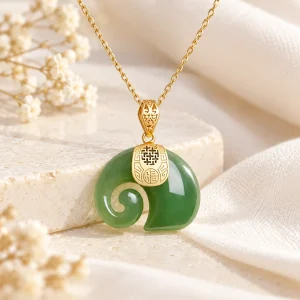
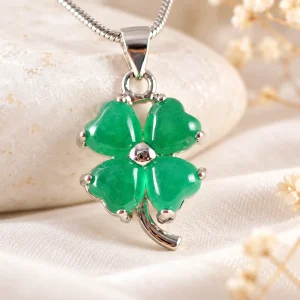
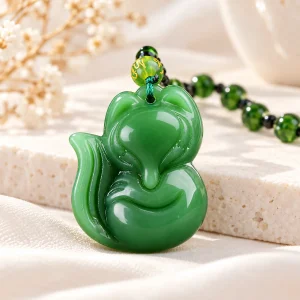
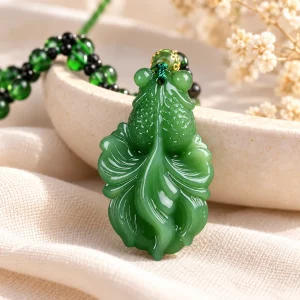
Jade pendants, chosen one by one
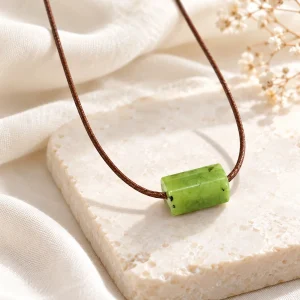
Colours that have been added
A colour can be manufactured, and that is why it proves nothing on its own. Three cases, of unequal seriousness.
- Another stone, dyed. Quartzite, around 2.65, or serpentine, around 2.6, sold under a compound name that contains the word jade. They are not jades, whatever the label: stones sold as jade.
- A real jade, dyed. A jadeite bleached with acid, impregnated with resin, then coloured. The A, B and C classification describes these states, and it is explained here.
- A colour built into the setting. A doublet, a coloured foil slipped under a translucent cabochon, a painted backing in a closed setting.
Three clues can be read with the naked eye, and none of them is proof: colour that collects in cracks instead of spreading through the grain, a hue too uniform for a material that rarely is, and a green that bleeds onto the setting or the thread.
My position is the same across the whole site: my scale tells the mineral, not the treatment. I therefore never write that a piece is untreated, and I publish the treatment information sheet rather than a silence that would read as a guarantee. What you can check at home is gathered in how to recognise genuine jade stone.
What colour changes in the price
It counts, and it does not count alone. For the same hue, translucency, evenness, fineness of grain, weight and treatment make a piece vary by larger amounts than the move from green to white. A vivid but opaque and spotted green therefore does not automatically rank above a dense, regular white.
The term “imperial jade” is no exception: it refers to a quality of translucent green jadeite, not a place of origin or a label, and the French 2002 decree does not regulate it (what it covers). The detail of the criteria is in judging the quality of jade, and that of the price gaps in the price of jade stone.
What traditions have attached to colours
What follows shifts register, and I say so rather than blending it into the rest. None of it is proven: it is what traditions have attributed to this stone.
In ancient China, the white of nephrite is said to have held first rank, and that would be the source of the prestige of mutton fat: a matter of ritual rather than a taste in colour. Contemporary crystal-healing authors, for their part, assign virtues by hue, green to balance, white to calm, lavender to soothing, and their lists change from one book to the next. The heart of the subject lies elsewhere: what tradition attributes to jade stone, and the meaning of jade stone. What I will never write is that a colour heals.
The questions I get asked
What colour is jade stone?
Most often green, but not only: white, honey yellow, reddish brown, black and lavender are jade colours just as much. A bright blue or vivid pink stone sold as jade, on the other hand, has almost always been given its colour.
Which jade colour is the most expensive?
In jadeite, the intense, translucent green the trade calls imperial. In nephrite, the white known as mutton fat. But for the same hue, translucency, grain and treatment weigh more.
Is black jade real jade?
It can be. Black nephrite exists and is set in jewellery; held up to a lamp, it often turns out to be very dark green. But many inexpensive black stones sold as jade are something else, and it is density that tells you, not the hue.
Is lavender jade dyed?
Not always. Lavender jadeite exists, pale and slightly hazy. A deep, perfectly uniform lavender on low-priced beads, however, is almost always dyed quartzite or a coloured jadeite. I have no lavender piece in the catalogue.
My jade has changed colour, is that normal?
It happens, and the causes are rarely mysterious: dirt settled into the grain, a resin turning yellow, a cord that bleeds colour. The subject has its own page, jade that changes colour.
Is colour enough to recognise real jade?
No. It is the easiest criterion to fake, and therefore the least conclusive. What separates jade from an imitation is its density: 3.25 to 3.36 for jadeite, 2.90 to 3.03 for nephrite, against about 2.6 and 2.65 for serpentine and quartzite, and the method is on the weighing page.
Where I checked
What comes from a named source. The separation of jadeite and nephrite, and the word jadeite itself, come from Alexis Damour’s note in the Comptes rendus hebdomadaires de l’Académie des sciences, volume 56, 1863; I do not give the page numbers, because I have not read it. The formulas, the tremolite-actinolite series and the role of chromium and iron are those of the mineralogical literature: I repeat them, I have not measured them, and I attribute them to no organization, since I did not take them from a single one. The density ranges cited here are those of the weighing page.
What is a market observation, with a date. On 8 September 2026, I looked at the nine French competitors on the first page of results: none states the mineral of its pieces, one shows two contradictory origins on the same product page, and another uses an A, AA, AAA scale that has no normative existence. The same day, my supplier confirmed that it cannot say whether its stock is treated, which applies to colour as to everything else.
What is my own reasoning. Refusing to settle the origin of lavender, choosing to cover black and lavender here rather than in pages of their own, the idea that a perfectly uniform hue should make you suspicious, and the rule of never writing “untreated” without spectroscopy: these are decisions, not established facts. If you find a mistake on this page, write to me: I will correct it and note that I did.
In one sentence
The colour of a jade comes down to a few atoms of iron and chromium, it can be manufactured as easily as it forms, and that is why, on its own, it does not tell you what you are holding. The method is on the weighing page, and the pieces are in the shop.