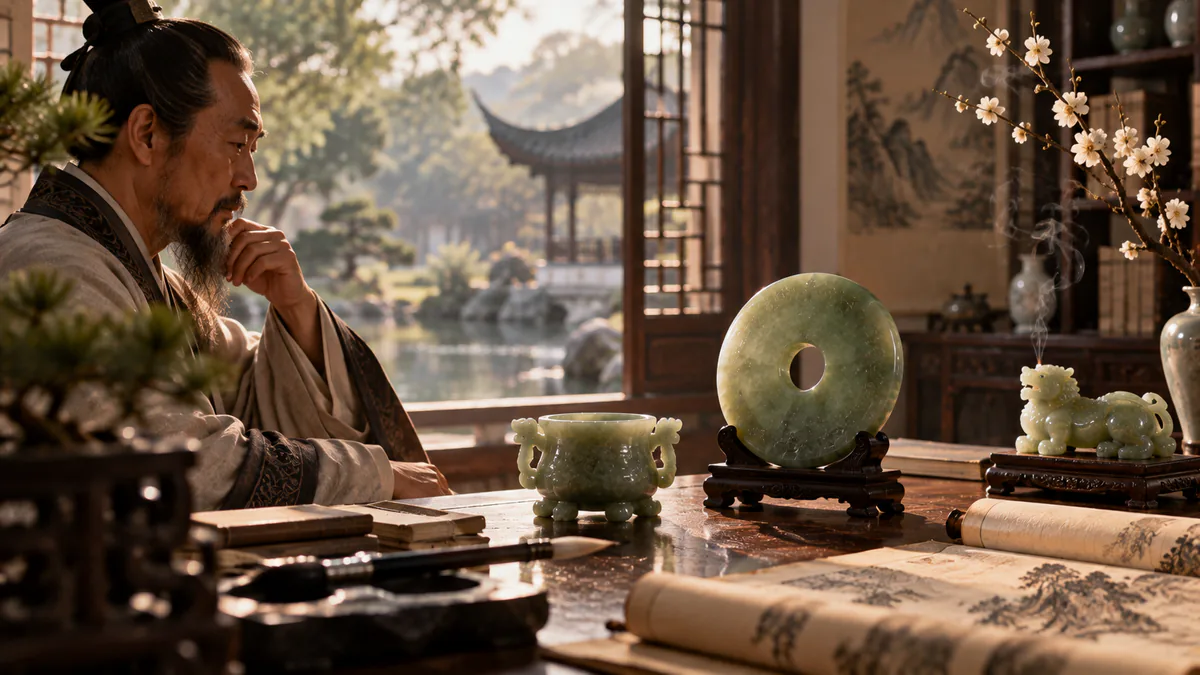
The moral virtues of jade in Chinese thought
This page gathers what ancient Chinese texts wrote about the virtues of jade, in the moral sense of the word: where the lists you see everywhere come from, what they actually say, and why they do not match.
In these texts, a virtue is a quality of character and never an effect on the body: jade serves to describe the accomplished person, and the number of virtues is not fixed, five in Xu Shen’s dictionary, nine in the Guanzi, eleven in the Liji.
My name is Jade, and I run a jade jewellery workshop: I choose the pieces, have them set, and weigh one example of each reference before it goes on sale. I am not a gemmologist, a sinologist or a therapist, and everything that follows comes through translations that I name.
One word for two different things
English, like French, uses the same word for the virtue of a person and the virtues of a medicinal herb, for courage and for the power to act. With jade, that economy of vocabulary does damage: a page promising the virtues of jade and an ancient treatise describing its virtues are not talking about the same thing, and nothing warns you of the switch.
Here the word is taken in its moral sense, and that is the whole subject. The jade in these texts does nothing to anyone: it serves as a point of comparison for describing what an accomplished character is made of. What contemporary crystal healing attributes to it is another subject, written elsewhere and in the conditional, in the virtues attributed to jade stone, and the full tour of its symbolism is in the meaning of jade stone.
Five, nine or eleven: the count depends on the text
The first thing I looked for was a number, and there is not just one. Three ancient texts compare jade to moral qualities, and none of them agrees with the others.
| Text | Number of virtues |
|---|---|
| Shuowen Jiezi, Xu Shen’s dictionary, around 100 CE | five |
| Guanzi, Shuidi chapter | nine |
| Liji, Pinyi chapter | eleven |
The count of nine is not a commentator’s reconstruction: the Shuidi chapter states it itself, and I read the passage in the Chinese text published by the Chinese Text Project. I do not give the nine names; I explain why below.
These three counts are not variants of a single list badly copied: they are three separate texts, from different periods and genres, making the same gesture in different ways. Writing “the five virtues of jade” without saying where the five comes from means picking one of the three without saying so.
The jade pendants available now
The eleven of the Liji, in Legge’s translation
This is the longest of the three lists. It comes from the Pinyi chapter of the Liji, the Book of Rites, in the English translation by James Legge published in 1885 in the Sacred Books of the East. The passage opens with a line I paraphrase from his English: in ancient times, superior men found the likeness of all excellent qualities in jade.
Eleven comparisons follow, each tied to a property of the stone.
- Benevolence, because it is soft and smooth to the touch.
- Intelligence, because it is dense and compact.
- Righteousness, because its edges do not cut.
- Propriety, because the pendant hangs down toward the ground.
- Music, because when struck it gives a clear, prolonged note that stops abruptly.
- Loyalty, because its flaws do not hide its beauty, nor its beauty its flaws.
- Good faith, because a brightness comes from it on every side.
- Heaven, earth, virtue and the Way, to finish, with no physical property attached.
Heaven, earth and the Way are not qualities of character, and neither is music: out of eleven entries, at least four are not moral virtues, and speaking of the eleven virtues of jade is already a copyist’s approximation.
That leaves the attribution. The passage presents itself as Confucius answering a disciple, and the list circulates under his name. But the Liji is a collection compiled under the Han, several centuries after his death: it is a list handed down under his name, which is not the same thing as a documented saying.
The five of Xu Shen’s dictionary
The Shuowen Jiezi by Xu Shen, completed around 100 CE, is the first Chinese dictionary to analyse characters by their components. Its entry for the character for jade does not just name the material: it defines it as the most beautiful of stones and attributes five virtues to it.
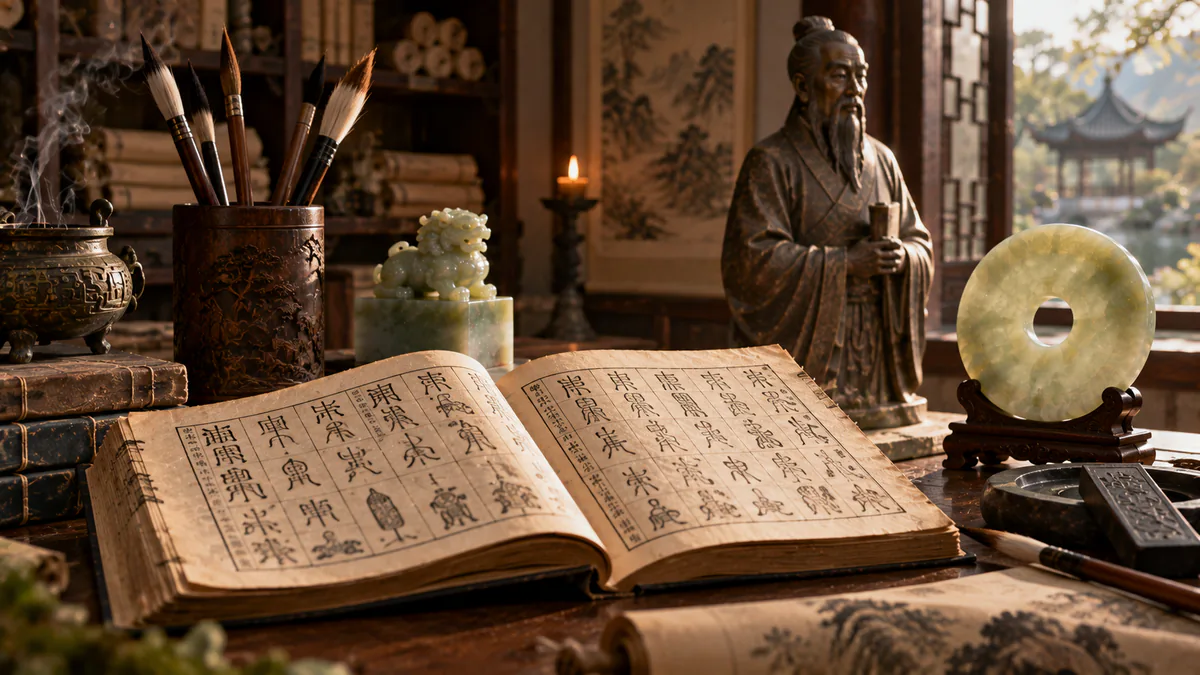
Each is tied to something you can check by holding the stone: the warm, greasy luster, the translucency that lets you see the inside from the outside, the clear note that carries far when struck, the fact that it breaks without bending, and the broken edge that does not cut the hand.
Breaking without bending is nothing specific to jade: stones generally break rather than deform. What truly sets this material apart, its toughness, its resistance to breaking, is not on the list. The text ties a moral quality to an ordinary characteristic and leaves out the remarkable one: that is my reading, and I flag it as such.
Why the lists you find do not match
On 10 September 2026, on the French pages the search engine offered me, three gave five virtues attributed to Confucius, in three lists that do not match: benevolence, justice, wisdom, propriety and sincerity on one; wisdom, courage, fairness, humanity and modesty on the second; benevolence, justice, wisdom, courage and purity on the third.
English does the same. The University of Pennsylvania Museum of Archaeology renders Xu Shen’s five as charity, rectitude, wisdom, courage and equity; other pages write benevolence, uprightness, intelligence, courage and purity.
These gaps do not come from carelessness: the Chinese terms of Confucian ethics have no exact equivalent in our languages, and each translator makes choices. That is why the previous section gives the physical properties rather than five English words. The properties stay stable from one version to another; the words do not.
Comparing one’s virtue to a stone
The gesture these texts make comes down to one phrase: comparing one’s virtue to jade. The subject of the sentence is the person, not the stone. The stone supplies a concrete vocabulary for talking about something that has none.
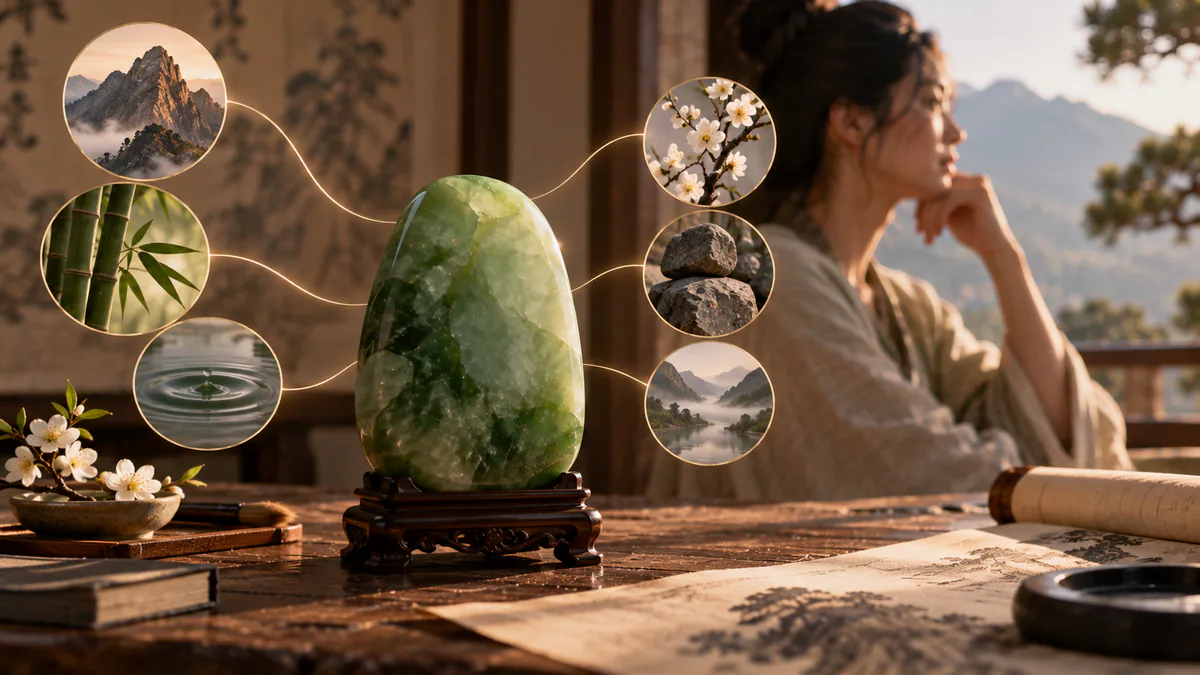
The difference is not a matter of style. In the direction the text goes, a reader learns what a loyal character looks like. In the reverse direction, an object acquires a power. That is also why jade served first as a sign of rank, in the ritual objects of power, and why the story that ties it to the empire is a tale of merit recognized late, that of the He disc.
The jade bracelets available now
Which jade these texts are talking about
This is the only point on this page that belongs to mineralogy, and it is stated as fact. The jade worked in China since prehistory is nephrite. Jadeite only arrived there in the 18th century, imported from Burma through Yunnan, as the University of Pennsylvania museum points out.
In other words, when the Liji and the Shuowen Jiezi describe the stone, they are describing nephrite: the greasy feel, the limited translucency, the note when struck. The so-called mutton-fat white, highly prized by Chinese scholars, is nephrite too: white jade stone.
It follows that presenting a jadeite bracelet as carrying the stone’s Confucian virtues means applying to a material a text written more than fifteen hundred years before it reached China. Both minerals are legitimately called jade, and they do not share this history: jadeite or nephrite, jade stone, jade jewellery in China.
What these texts do not say
A note on register, which I flag rather than blend into the rest. Everything above is a literary fact: ancient texts wrote this. Nothing in it is proven about the stone, and nothing in it concerns the body.
None of these three passages names an organ, an illness, a health benefit or an energy centre. None attributes any action to the stone: they are passages on ethics and ritual, in which the body has no place.
I say this because these passages are regularly used to open a page that goes on to promise something else entirely. The ancient endorsement is real; what it is made to guarantee is not.
What I do not write on a product page
These virtues interest me, and I put them on no product page. A list of moral qualities placed next to a price becomes a promise, and the promise is what the reader remembers.
What I publish instead comes down to a few numbers: the mass in air, the mass underwater, the resulting density, the date of the measurement and the mineral I conclude from it. The protocol is on the weighing page. It is less beautiful than a virtue, and at least it tells you whether the stone is the one these texts were talking about.
Questions I get asked
How many virtues does jade have in Chinese tradition?
It depends on the text. Xu Shen’s dictionary gives five, the Shuidi chapter of the Guanzi nine, the Pinyi chapter of the Liji eleven. None of these counts cancels the others, and a page that cites only one without saying which has chosen for you.
Are the five virtues of jade from Confucius?
No. The five come from Xu Shen’s Shuowen Jiezi, a dictionary completed around 100 CE, some six centuries after Confucius. It is the list of eleven, in the Liji, that the text puts in Confucius’s mouth, and the Liji itself is a Han compilation.
Are these virtues health benefits?
No, and English, like French, feeds the confusion by using the same word for a moral quality and for a power to act. These passages name no organ, illness or effect. What contemporary crystal healing attributes to jade is something else, and is covered on the disclaimer page.
Do these texts talk about jadeite or nephrite?
Nephrite. It is the jade worked in China since prehistory; jadeite only arrived from Burma in the 18th century. The properties the texts describe, the feel, the translucency, the note when struck, are those of nephrite.
Why don’t the lists I find match?
For two reasons that add up. Pages do not all cite the same source text, and the terms of Confucian ethics are translated differently by different translators. I found three incompatible lists of five on three French pages on the same day.
Does a jade piece carry these virtues?
Not in the sense of these texts. The stone there is a point of comparison used to describe a person, not an object that passes something on to whoever wears it. A piece of jewellery can remind the person who chose it of an idea, and that is reason enough to wear one.
Where I checked
What comes from a named source. The list of eleven comes from the Pinyi chapter of the Liji in James Legge’s English translation, Sacred Books of the East, 1885; I read it reproduced, not in the volume itself, so I give no page numbers. Xu Shen’s definition of jade, its five virtues, and the fact that China has worked nephrite since prehistory and only imported jadeite from Burma in the 18th century come from Expedition, the magazine of the University of Pennsylvania Museum of Archaeology and Anthropology. The count of nine is the one stated in the Shuidi chapter of the Guanzi, read on the Chinese Text Project.
What I could not pin down, and which is therefore missing here. I found no complete translation of the Shuowen Jiezi that I could open: the five virtues reach me through paraphrases, hence the physical properties rather than five English words. For the Guanzi, I publish the count, which the text states, and not the nine names, of which I have only seen diverging English renderings. Nor do I give the count from a fourth text, the Xunzi, which I could not find in a translation I could name. I do not read classical Chinese and I do not claim otherwise.
What is a dated observation. The three incompatible French lists in the fifth section were noted on 10 September 2026, on the pages the search engine offered me that day. In English, two renderings of the same five terms had only one word in common: courage.
What is my own reasoning. The remark about courage being tied to an ordinary property, the refusal to publish a count I could not source, and the decision to put none of these virtues on a product page: these are choices, not established facts. If you read classical Chinese and something here is wrong, write to me: I will correct it and note the change.
In one sentence
The moral virtues of jade are a literary fact, written in at least three texts that agree neither on their number nor on their names, and that describe a person using a stone rather than the other way round. The trade terms are in the jade glossary, and the pieces are in the shop.