Jade for good luck: where the idea comes from
“Jade good luck”: that is how the phrase tends to get typed, with no “for” in the middle. This page traces where the idea comes from, who said it before us, and why the belief almost always takes the form of a pendant. A history of a belief, and nothing that is promised.
The idea of jade as a lucky charm does not descend from a single tradition: it stacks up a 16th-century Spanish medical amulet, a Chinese philosophy that talked about morality and not luck, wish objects worn around the neck, and a recent Western crystal healing movement that gathered all of it under a word those traditions did not use.
My name is Jade, and I run a jade jewellery workshop: I choose the pieces, have them set, and weigh one example of every piece before it goes on sale. I am neither a gemmologist nor a therapist, and on this page I report beliefs without endorsing any of them.
What the words lucky charm lump together
In a display case, “lucky charm” covers three objects that do not do the same job. The amulet wards something off, an illness, an accident. The talisman draws something in, money, success. The heirloom does neither: it connects the person wearing it to the person who wore it before.
Jade has been all three, in different places and centuries apart, almost never at the same time. It is our modern vocabulary that put them in the same drawer, not the cultures whose authority gets invoked. I have not pinned down when the French word for lucky charm was first attested, and I would rather write down that gap than a plausible date.
The first documented amulet was aimed at the kidneys
The oldest European use I can date has nothing to do with luck. Around 1565, the Spanish of the conquest saw Mesoamerican peoples wearing this green stone and named it piedra de la ijada, the stone of the flank: they understood it was worn against kidney colic. The same object gives the Latin lapis nephriticus, from which comes nephrite, from the Greek nephros, kidney.
The first property Europe attached to this stone was therefore medical, and located in a single organ. That is not a lucky charm. And it is where the name of my shop comes from, which makes me the worst-placed person to sell luck: the contrast is written on my about page, and what each culture put into this word is in the meaning of the jade stone.
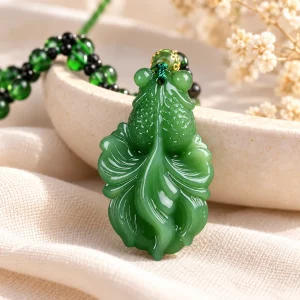
Jade pendants available now
In China, a stone of morality before a stone of luck
What follows changes register, and I flag it rather than blend it into the rest. Nothing in it is proven: it is what traditions have attributed to this stone.
A stone does not heal anything, and the full disclaimer is here.
The tradition most often invoked to justify jade as a lucky charm is Chinese, and it is the one that least says what people make it say. What classical thought is said to have put into it is a catalogue of moral qualities: the material would serve to describe the accomplished person, their constancy, the way they ring true. That is philosophy, not crystal healing (the moral virtues of jade).
Two details that are often missing. The material of this tradition is nephrite; jadeite arrived late from Burma, and its imperial vogue dates from the 18th century: giving it four thousand years of symbolism means getting the mineral wrong (jade stone). And the great ritual objects, discs and tubes, were not worn around the neck: they accompanied rank and death (jade in Chinese tombs).
The Chinese objects that carry a wish
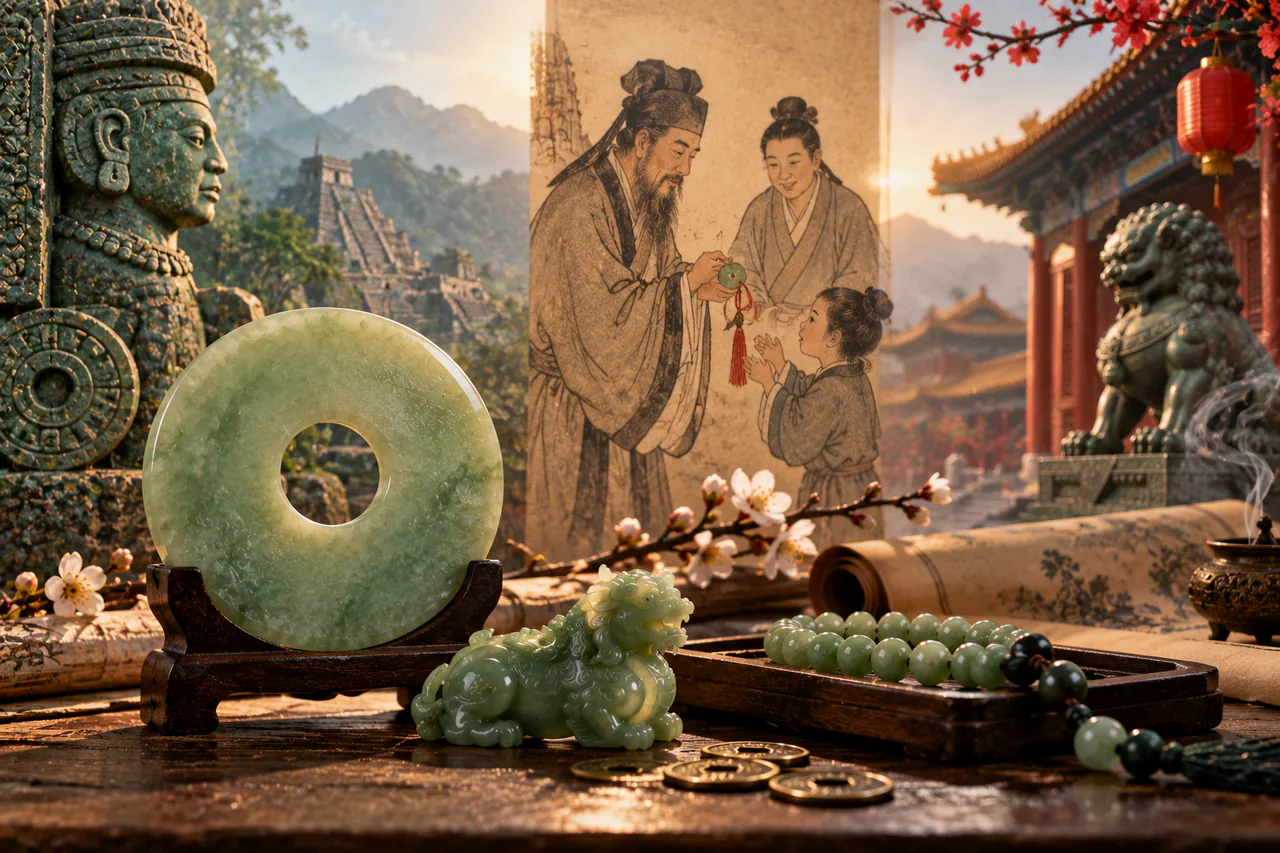
What looks most like a lucky charm in Chinese usage is a family of worn objects that state an explicit wish. The clearest is the longevity lock, a lock-shaped pendant hung around a child’s neck, meant to “lock” them to life. Its traditional material is more often silver than jade, which shops rarely mention. The case of very young children is in the jade necklace for babies.
Carved motifs work the same way. The gourd, the bat or the peach do not “contain” anything: they spell out a wish, often through wordplay, like a rebus you wear on your body (jade motifs). And the laughing figure sold as a lucky Buddha is not the historical Buddha but Budai: his story is worth a look.
The nuance changes everything: these objects state a wish, they do not claim to grant it. The shift from wish to attracted luck is a commercial one.
Mesoamerica, New Zealand, Europe: three times something else
In Mesoamerica, the Olmecs and then the Maya ranked jadeite above gold and placed a bead in the mouths of the dead. Tradition is said to link it to water, maize and breath: a cosmology of the living, not a talisman for success.
In New Zealand, pounamu, the local nephrite, is a taonga: its value lies in the handing down and the genealogy of the piece. Its status is not only cultural, since a 1997 New Zealand law vested ownership of the pounamu in its territory in the Ngāi Tahu iwi, and that is why I imitate neither the hei-tiki nor the koru (Māori pounamu).
In Europe, the polished axes of Alpine jadeite from Monte Viso, spread over 3,300 kilometres, were objects of prestige and deposit (jade in Europe).
In what I have read of these three traditions, none files jade under a notion that matches our lucky charm: they speak of rank, lineage and death.
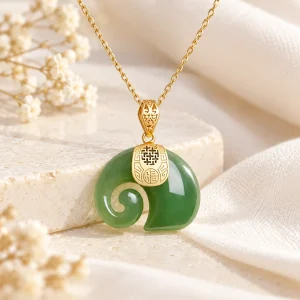
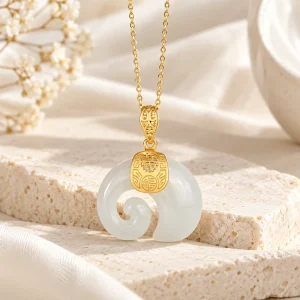
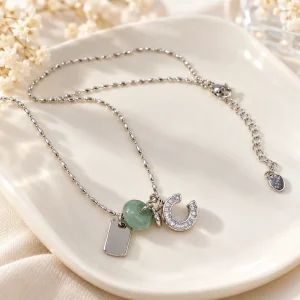
Why it is almost always a pendant
Of the French phrasings that lead here, only one names a type of jewellery: the pendant. That is no accident of vocabulary, and three reasons hold up, one of which can be checked through wear.
- An amulet is worn against the body. The pendant is the piece that rests on the breastbone, under the fabric, against the skin: it is the form amulets take almost everywhere.
- A wish needs a surface. A bead or a bangle carries nothing to read; a pendant offers a small flat face that can be carved, where the motif can be written.
- Jade scratches more than people think. Nephrite sits around 6 to 6.5 on the Mohs scale, jadeite at 6.5 to 7, below or level with quartz, and quartz makes up a good share of ordinary dust. A pendant rubs against less than a ring: jade hardness and toughness.
On such a pendant, what I can establish is not what it brings, it is what it is: one example of every piece is weighed in air and then suspended in water, jadeite at 3.25 to 3.36, nephrite at 2.90 to 3.03 (the protocol and its limits). The scale says nothing about treatment, and I write that rather than stay silent (the information sheet).
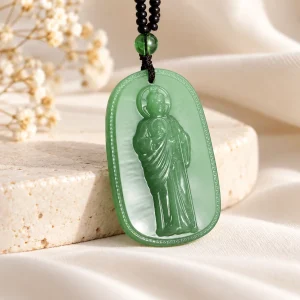
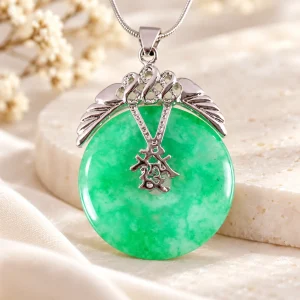
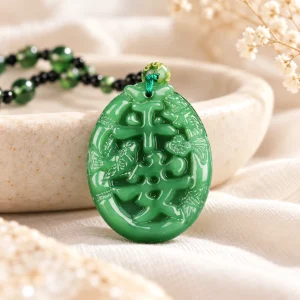
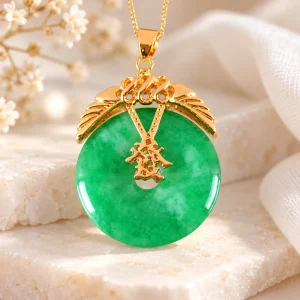
Pendants whose mineral and density I publish
What contemporary crystal healing added
Contemporary authors are said to associate jade with abundance, prosperity, serenity and, precisely, with attracting luck. These lists look alike from one book to the next and from one website to the next, and I have not managed to trace the one that served as the template: they are copied more than sourced (what tradition attributes to jade stone).
I add a correction I did not see on any of the pages I opened that day: these lists rarely say which mineral they are talking about. A property attributed to a serpentine sold as jade is a property attributed to something else (stones sold as jade). The wrist side of the subject is in jade bracelet meaning.
Giving jade without promising anything
You can give jade as a good luck gift without a single untrue word, and it is the only use of the term I find solid: what you give is an object, the wish belongs to the person giving it. It commits the material to no property at all (giving jade jewellery).
What I will never write, here or on a product page: that a stone protects, heals, promotes fertility or brings in money. That is not careful wording, it is that I cannot show it, and this site only stands on what I show, number by number (what I publish on each product page).
The questions I get asked
Does jade bring good luck?
I have no idea, and I know no one who could establish it. The belief, on the other hand, exists and can be documented: it is simply younger and more composite than people say. I sell a piece of jewellery whose mineral I publish, not luck.
Since when has jade been a lucky charm?
The question mixes two things. Jade has carried meaning since the Neolithic in China, but that meaning is moral and ritual. The current form, a pendant that would attract luck, came together much later and in the West.
Which jade colour is for luck?
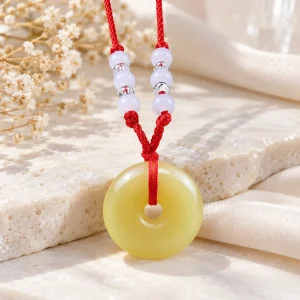
No tradition I have read attributes luck to one colour over another. Green dominates because it dominates the deposits and market taste: white, lavender and honey come out of the same mines.
Should jade be worn against the skin?
On the belief side, that is the logic of the amulet, and it is up to you. On the material side, it is rather a good idea: under clothing, the stone meets fewer hard surfaces and loses its polish more slowly.
Is jade received as a gift better than jade you buy?
That is what the handed-down version of the belief says, and I have nothing to tell it apart from a convenient sales argument. What is true is that a piece you receive carries a story that a piece you buy does not have yet.
Is the laughing jade Buddha a lucky charm?
It is sold as one, and the figure is not who people think: this round-bellied, smiling character is Budai, a legendary monk, not the historical Buddha. The contentment attributed to him belongs to that figure.
Where I checked
What comes from a named source. The etymology piedra de la ijada and lapis nephriticus comes from the entry for jade in the Dictionnaire de l’Académie française, ninth edition. Monte Viso and the 3,300 kilometres come from the work of Pierre and Anne-Marie Pétrequin, the CNRS JADE project. The vesting of pounamu in the Ngāi Tahu iwi is that of the 1997 New Zealand law. The catalogue of moral qualities is attributed to the classical Chinese ritual texts, cited everywhere, which I have not read in a critical edition. The density and hardness ranges are those of the mineralogical literature; I repeat them without attributing them to an organization, since I did not take them from a single one.
What is a market observation, with a date. On 9 September 2026, I opened the French pages that rank for this idea. On the ones I read, the word is used as a selling point without any of them saying which mineral they mean, or where the meanings they announce come from; several attribute to jadeite a Chinese antiquity that belongs to nephrite.
What is my own reasoning. The split into amulet, talisman and heirloom is a framework I propose to see clearly, not a scholarly classification. The physical explanation for the dominance of the pendant, less friction than a ring, is deduced from hardness, not recorded. If you find a mistake here, write to me: I will correct it and note that I did.
In one sentence
Jade for good luck is a recent, composite idea, assembled in the West from a Spanish kidney amulet, a Chinese philosophy that spoke of character, and wish objects worn around the neck: it is worth knowing, it is worth no promise, and what I can say about a piece remains its mineral (the shop, weighing).