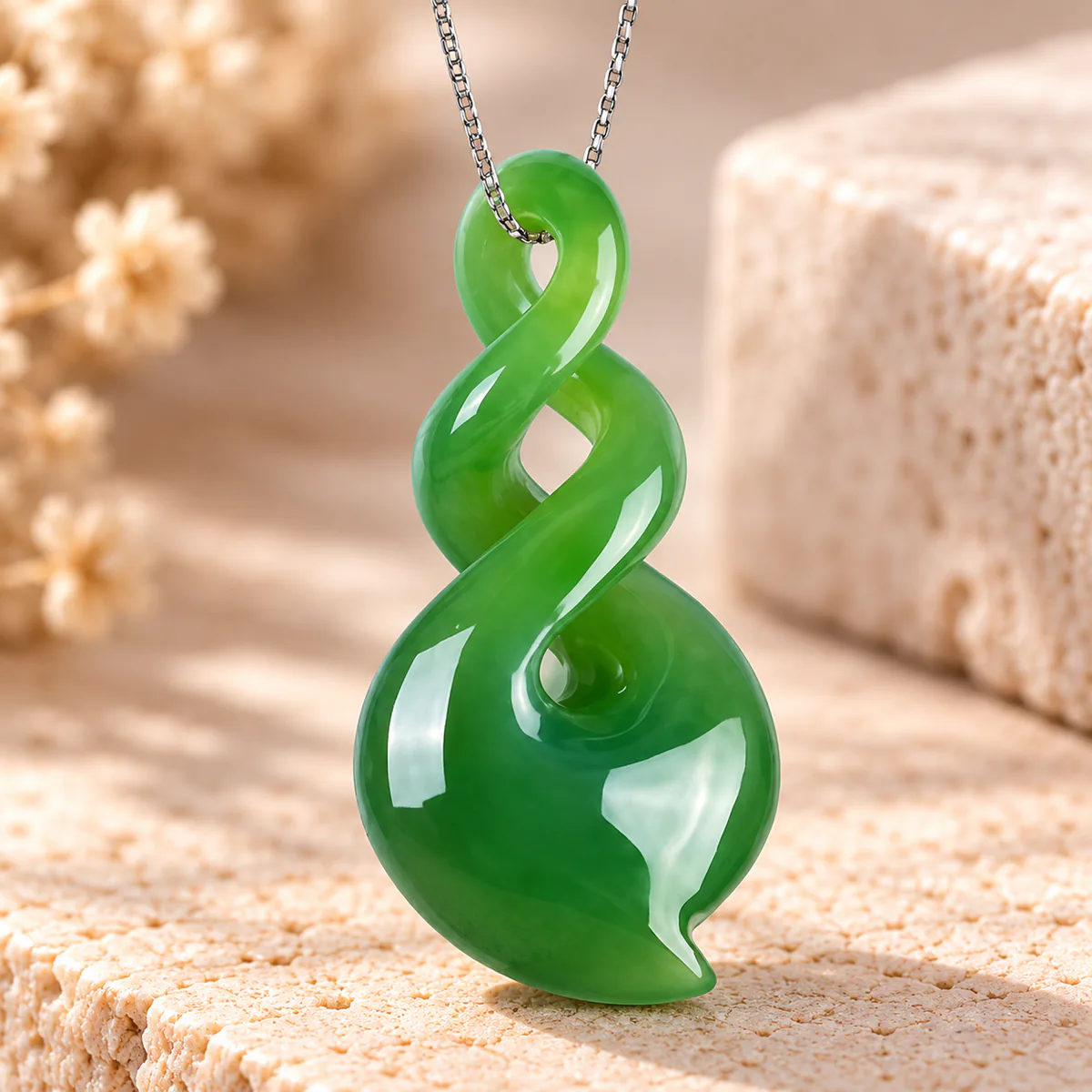
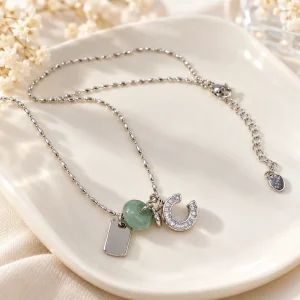
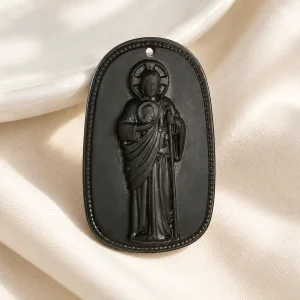
Jade and silver necklace: an openwork twist of bright green jade, two strands wound like a ribbon, slipped onto a fine silver-toned chain. A design born of Maori carving, the pikorua.
With no mount, the stone stays free and visible from every side. Five lengths to choose from, 40 to 55 cm; the twist shows best between 45 and 50 cm.
A jade and silver necklace with a rare design: an openwork twist of bright green jade, two strands that wind around each other like a ribbon, slipped onto a fine silver-toned chain. No mount at all: the chain passes through the upper loop of the stone.
In four lines
An openwork twist of bright green jade, with no mount.
A design born of Maori carving, the pikorua.
On a fine silver-toned chain, five lengths to choose from.
For a man as for a woman, and a gift that means something.
A twist that never ends
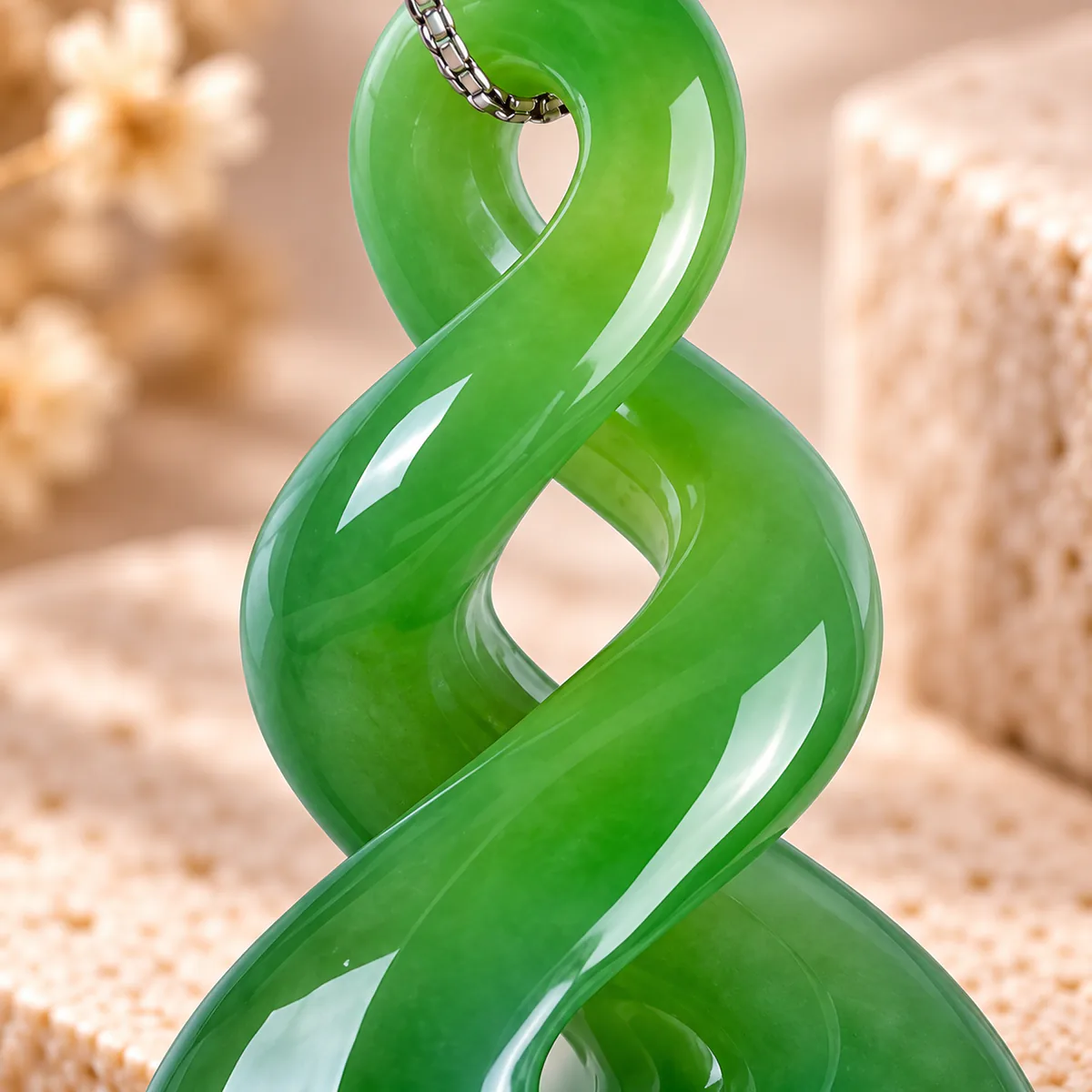
This jade and silver necklace rests entirely on the design of its stone. Two strands of jade leave the upper loop, cross, part, cross again, and meet at the bottom in a full curve. The light follows every twist, and between the strands, openings let the daylight through.
It is a demanding shape: it calls for hollowing the stone right through without breaking it, and polishing every curve down into the hollows.
A bright green that light passes through
The stone is a clear, luminous green. Where the strands thin out, it turns translucent and lights up almost to yellow; where it thickens, the green deepens. This play of transparency gives the twist relief, even from a distance.
A design that came from New Zealand
This twist is a motif of Maori carving, the pikorua. In New Zealand it is traditionally cut in pounamu, the green nephrite of the South Island, and it is one of the pendants people readily give there. This necklace takes up its shape; the stone itself is described in the record on this page.
Which length to choose
Choose the length above the buy button, clasp included, from 40 to 55 cm. As the twist is elongated, it shows best between 45 and 50 cm, where it sits below the collarbones or towards the top of the neckline. Over a jumper, 55 cm leaves it clearly visible.
What to wear it with
The silver-toned chain and the bright green like cool tones: white, grey, navy, denim. It is a pendant with no gender, as at home on a man’s tee shirt as on an open collar, and a gift with a story to tell. Giving a piece of jade jewellery, and the jade jewellery that suits men.
Wearing it, and keeping it beautiful
An openwork piece has its sensitive points: the thinnest strands. Nephrite and jadeite are both tough, but a sharp knock against a tiled floor can split any stone; take it off for sport and the pool. Clean the hollows with a very soft brush and warm soapy water, then dry. Never ultrasonic, never steam, never solvent. Store it flat, in its pouch. Hardness and toughness, and care in detail.
Additional information
Stone
Jadeite or nephrite, not resolved
Colour
Clear green
Stone shape
Carving in the round
Motif
Maori twist (pikorua)
Mounting
Chain
Metal
Silver tone, alloy not stated
Setting
Drilled stone
Worn by
Unisex
Paired stones
None, jade only
Mineral family
Calcic amphibole, Sodium aluminium pyroxene
Hardness (Mohs)
6 to 7
Reference density
2.90 to 3.36 g/cm³
Toughness
Exceptional, interlocking crystals
Treatment
Not determined
Origin
Outside Burma, country of extraction not confirmed
What tradition attributes to the jade twist
What follows changes register, and I flag it rather than blending it into the rest of the page. None of it is proven. These are customs and beliefs, old and documented, which I report because they are part of the history of this stone. No piece of jewellery in this shop is sold as a treatment, and I claim no effect for this one.
Two paths that meet againIn Maori tradition, the two strands of the pikorua stand for two lives that part and find each other again. It is given for a friendship, a couple or a family, as the promise of a bond that holds despite distance.
The stone that is givenIn New Zealand, custom has it that a pounamu pendant is given rather than bought for oneself. The gesture counts as much as the stone.
A treasure that is handed onPieces of pounamu are among the taonga, the treasures that pass from one generation to the next. A stone worn for a long time keeps, it is said, a little of those who wore it.
A stone of moral virtueAt the other end of the world, Confucian thought associates jade with qualities of character rather than effects on the body: uprightness, constancy, restraint. Two cultures, one same esteem.
Dispatched within 48 hours of your order being confirmed, for delivery within 14 days from dispatch. I keep no buffer stock, and I won’t promise a timeframe I couldn’t meet.
Postage charges
€6.99 to any destination, free on orders of €47 or more to France, Belgium, Switzerland and Luxembourg. The exact amount appears in the cart before you pay.
The packaging, and why it matters
Every piece ships in its own pouch, kept apart from the others. This isn’t about presentation: the hardness of jade is ordinary, between 6 and 6.5 for nephrite and 6.5 to 7 for jadeite, and the quartz in everyday dust sits at 7. Two pieces of jewellery that travel together end up scratching each other.
Fourteen days to change your mind
With no need to explain yourself. An email is enough to open a return, there is no form to fill in. Return postage is at your expense, unless the piece doesn’t match its listing or arrives damaged.
The wrong size is the main reason for a return in this category, and jade cannot be resized the way a solid metal band can. Two minutes of measuring almost always prevents it. The size guide.
Warm water, mild soap, a soft cloth. A very soft brush for the hollows of a carving. That’s all, and it’s enough.
What you must never do, and why
No ultrasonic cleaner, no steam, no solvent, no heat source. This isn’t a token precaution: the treatment status of my pieces is not established. My supplier doesn’t know, and weighing establishes the mineral without saying anything about a possible resin impregnation. Resin tolerates neither heat nor solvents, so every piece is handled as though it might contain some. The information sheet on treatments.
Scratches, and where they come from
Jade is tough, meaning very hard to break: its interlocking crystal structure resists fracturing, and that is why axes could be shaped from it in the Neolithic. Its hardness, on the other hand, is ordinary, 6 to 6.5 for nephrite and 6.5 to 7 for jadeite. The quartz in everyday dust sits at 7: that is what dulls jade, not knocks. The difference between the two.
Day to day
Put the piece on after perfume and cream, never before. Take it off for housework, gardening and sport, where the knocks against corners happen. Store each piece on its own, in its pouch. On a strand of beads, the thread wears out before the stone: it gets restrung, and there is nothing abnormal about that.
My name is Jade. I’m French, from Morbihan, and based in Tallinn. I choose the pieces and have them set: I mine nothing, I cut nothing, and I don’t do the metalwork myself. The work I do is the sorting, and with this material that is what decides everything.
I am neither a gemmologist, nor a lapidary, nor a therapist, and I don’t claim to be.
I weigh, I don’t certify
Before putting a reference online, I order one example of it for myself. When it reaches me unset, I weigh it in air, then suspended from a thread in a glass of water: the ratio of the two masses gives the density, and that figure separates jadeite, nephrite, serpentine and dyed quartzite without ambiguity.
One example per reference, not every piece. I don’t handle the piece that goes out to you, and I would rather say so than let you believe otherwise. The method, with its three limits.
What I can’t know
The treatment status of my pieces. My supplier doesn’t know, and the scales say nothing about it: they establish the mineral, not the resin impregnation. Only infrared spectroscopy in a laboratory would settle it, and I don’t have that done. So you will never read “jadeite A”, “type A” or “untreated” on this site. The information sheet.
Where my jade comes from
No Burmese jadeite, and the first reason is a legal one. Not the reason you read everywhere: the JADE Act of 2008 did indeed ban these stones in the United States, but that ban was lifted on 7 October 2016. What applies today dates from 8 April 2021: the US Treasury sanctioned Myanma Gems Enterprise, the state-owned company that controls the Burmese gem trade. So there is no general ban, but an American is not allowed to trade with that entity, and a stone never tells you where it has passed through. One single supply chain for ten markets: it has to hold up for the most demanding of them. When an origin isn’t confirmed to me in writing, the listing doesn’t state it. My sourcing policy.