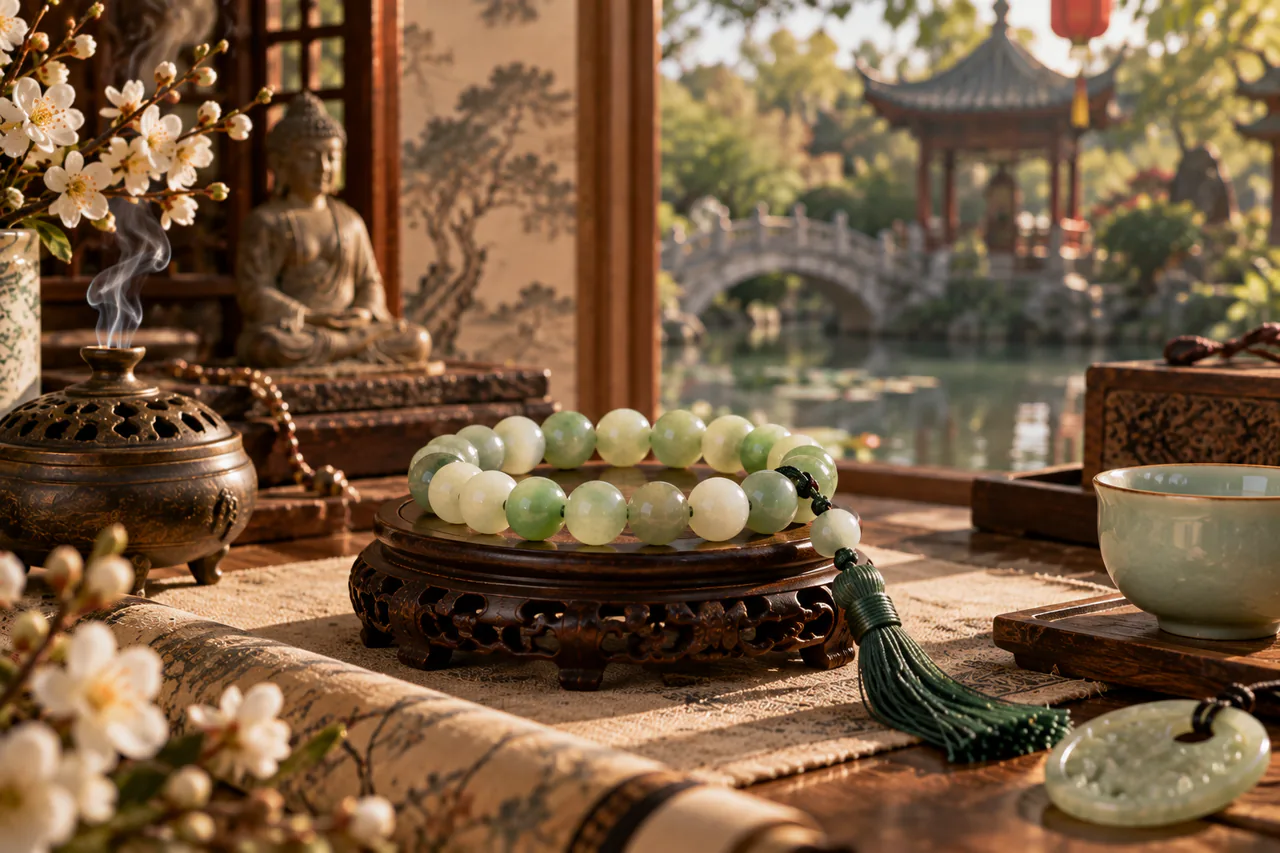
Jade bracelet meaning: what tradition puts on the wrist
This page deals with the piece you wear rather than the stone in general: what a search for “jade bracelet meaning” is looking for, which wrist custom assigns to the bangle, what green, white and the act of giving are supposed to say, and what I can prove about a bracelet before attributing anything to it.
The most commonly reported custom puts the jade bracelet on the left wrist, holds that a bangle should be given rather than bought, and that one day it will break in place of the person wearing it: three very widespread beliefs, none of which I have seen tied to a named source, and none of which a bracelet carries if it is not jade in the first place.
My name is Jade, and I run a jade jewellery workshop where pieces are set or chosen one by one, and I weigh one example of every piece before it goes on sale. I am neither a gemmologist, nor an ethnologist, nor a therapist: what is established is stated here as fact, what is believed is attributed.
What this page covers, and what it leaves to the stone
A search for jade bracelet meaning does not ask the same thing as the meaning of jade in general: it concerns an object that turns around a wrist, that you receive, keep for years and break. What ancient China, Mesoamerica and Neolithic Europe put into the material is written elsewhere: the meaning of the jade stone. The customs that follow almost all concern the Chinese bangle, where most of what circulates on the subject comes from.
Which wrist a jade bracelet is worn on
What follows changes register, and I flag it rather than blend it into the rest. Nothing in it is proven: it is what traditions have attributed to this stone.
A stone does not heal anything, and the full disclaimer is here.
The answer that comes up most is the left wrist. Two justifications go with it, and they are not the same from page to page: the left would be the side that receives, the right the side that gives; or the left would be the side of the heart. I have not seen either one tied to an author or a text I could open. That does not make the custom doubtful, since a rule about how to wear something is passed down in families and not in bibliographies; it makes doubtful the page that states it as law.
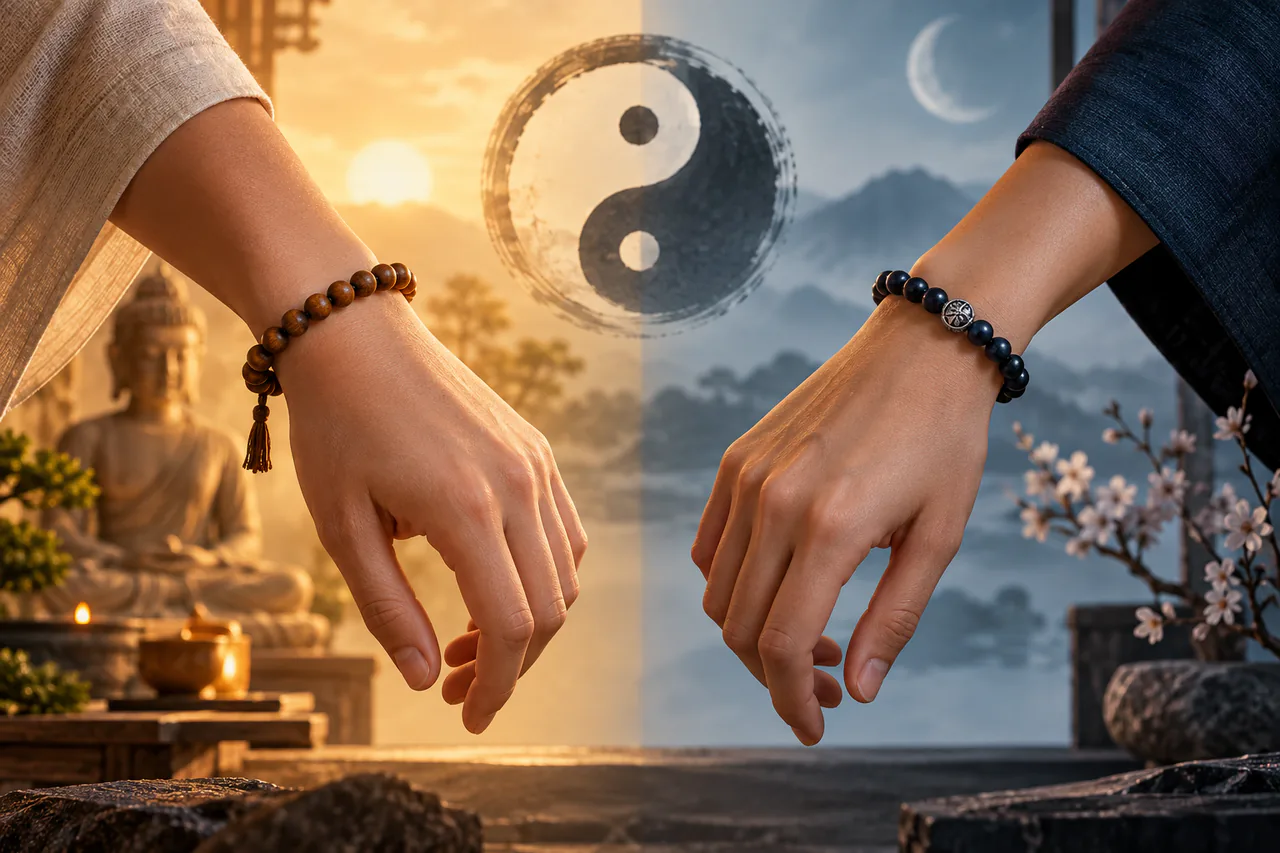
There is a reason to choose the left that owes nothing to tradition, and I keep it separate from the above: for a right-handed person, that hand bumps into doors and handles less. On a rigid bangle that does not come off easily, that matters more than a symbol. That is my reasoning, not a custom.
The single-block bangle, and why this form exists
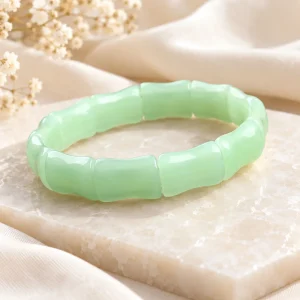
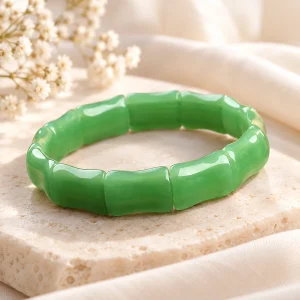
Back to what can be measured. The jade bracelet most loaded with meaning is the bangle, a closed ring carved from a single piece of stone, with no clasp or hinge. If jade allows this form, it is not because it is hard, it is only moderately so: it is because it is tough, difficult to break, and that quality is exceptional in jade. The two words are often confused: why jade almost never breaks.
Tradition is said to have attached meaning to the form itself, a circle with no opening that you do not take off at night; I report the idea without a source. The practical consequence, on the other hand, is certain: a bangle does not open, cannot be shortened and is sized by its inner diameter, which makes it the easiest format to get wrong (measuring your wrist). A strand of beads is not a bangle, and a mala is not a patterned bracelet but a counter.
Bracelets whose mineral and density I publish
Green, white, and what people attribute to them
Before symbolism, chemistry, because it changes what can be said about a colour. In jadeite, bright green comes from chromium and ordinary green from iron; in nephrite, from iron alone, and its white, which China calls mutton fat, is the colour of the material without those coloring elements: green jade stone, white jade stone.
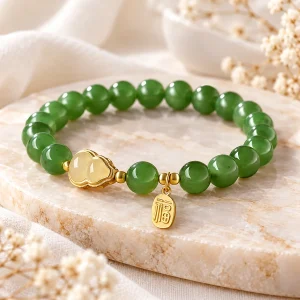
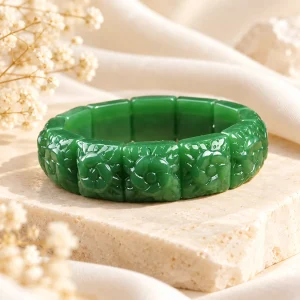
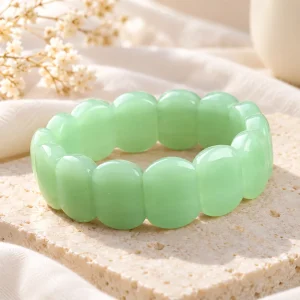
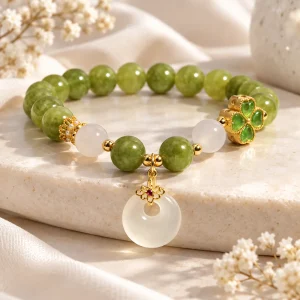
What people attribute to the green jade bracelet is what they attribute to jade in general, since that is the expected colour: balance, calm, luck, contemporary attributions that are reported, not established (what tradition attributes to this stone). The white jade bracelet has a more verifiable history: in China, white is not a second choice, it is a colour prized in nephrite long before the green of jadeite, which only arrives from Burma in the 18th century (Chinese jade jewellery).
One caution applies to every shade, and it is a physical one: a perfectly even green or a vivid pink on an inexpensive bracelet often comes out of a dye bath applied to quartzite, and looking for the meaning of a colour added in a factory is not very rewarding (dyed jade).
The bracelet you give
This is where the bracelet stands out most from other jade jewellery. What is reported, in China and in its diasporas, is an object that is passed down: a bangle handed from a grandmother to her granddaughter, given at a wedding or a birth, then worn for decades. Part of what people call the meaning of their bracelet is really the memory of who gave it.
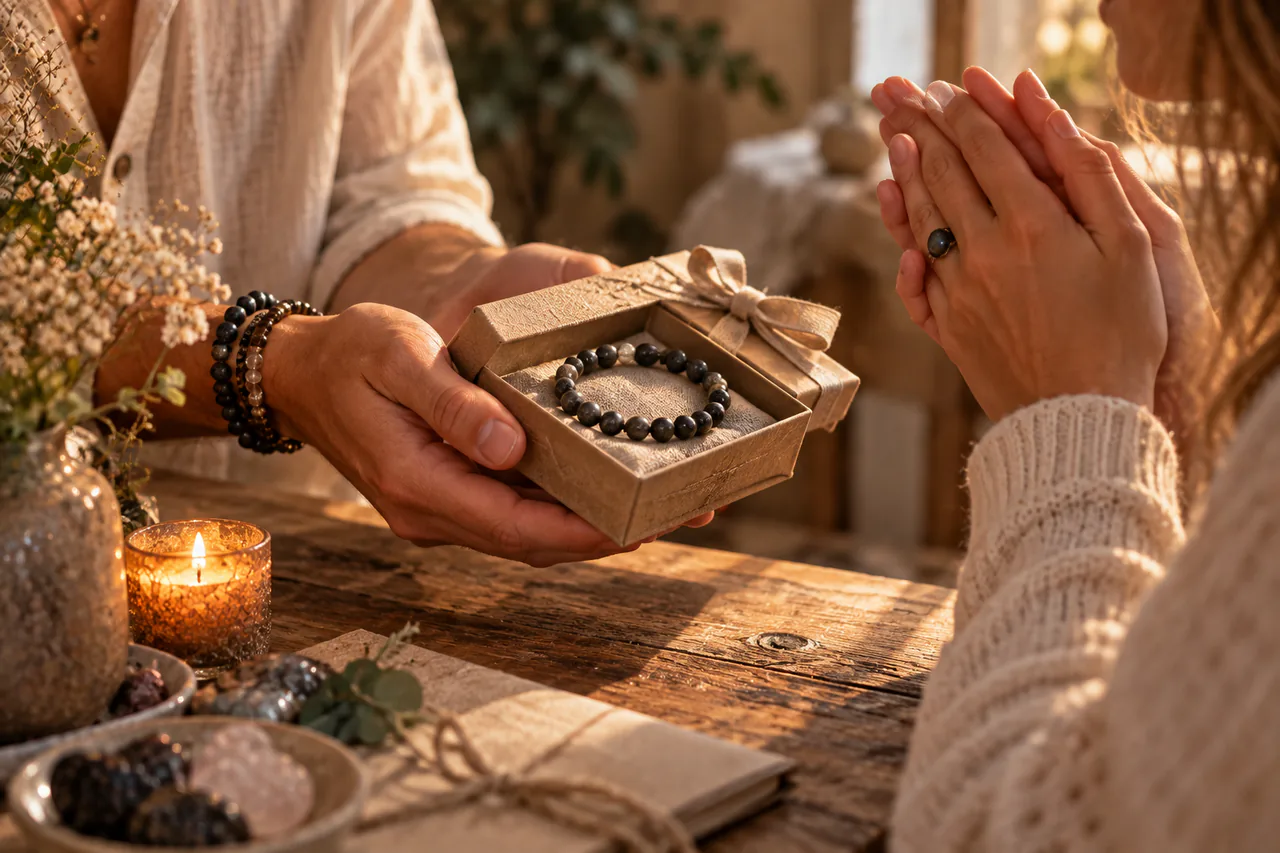
Hence the very widespread idea that a jade bracelet should not be bought for yourself. I report it without adopting it: it suits the gift trade very well, and I have read nothing that establishes it. The neighboring belief, that of the bracelet that breaks in place of its wearer, has its own page: a jade bracelet that breaks. In France, jade also has just one fixed date, the twenty-sixth wedding anniversary (jade wedding anniversary), and not all formats are equal when you give without knowing the size (giving jade jewellery).
Jade bracelets, chosen one by one
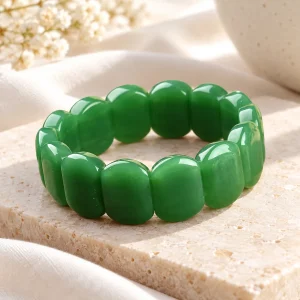
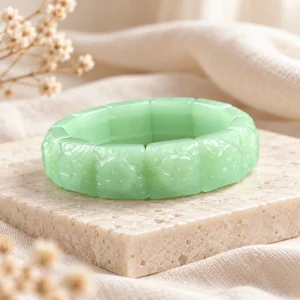
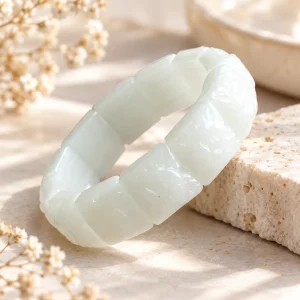
A piece for women, a piece for men
The customs I have just reported mostly concern bangles worn by women. That is not a rule about the material: worked jade was used in China for men’s objects, seals, belt plaques, scholars’ pieces, and nothing in the mineral depends on who wears it.
One observation that runs against expectations, recorded on 8 September 2026 from French searches for this stone: for bracelets, I counted seventy-nine phrasings containing the French word for men against forty-seven containing the word for women, when I expected the reverse in a jewellery market. See jade jewellery for women and jade jewellery for men.
And what about the jade ring
The question comes up often enough to be addressed, and the honest answer is short: the ring carries much less custom of its own than the bangle, and what you read about its meaning is almost always carried over from the bracelet. I see no reason to invent a ring tradition to balance out this page.
The difference I can observe is physical: a set stone cannot be weighed properly, because the metal enters the measurement. On a bangle, which is bare stone and nothing else, the measurement is clean; on a ring, it comes from the example weighed before setting (the weighing page).
What a bracelet has to be before it can mean anything
A large share of what is sold as a jade bracelet is not jade. Serpentine sits around 2.6 and dyed quartzite around 2.65, while nephrite is at 2.90 to 3.03 and jadeite at 3.25 to 3.36: the scale separates them, and that is all it does. The materials involved are covered in stones sold as jade, and the division between the two minerals on the jade stone page.
The consequence applies to everything above: a dyed quartzite bangle belongs to none of the customs on this page. It was not worn on the left wrist by generations, and the use attributed to it was built after the fact, on resemblance.
Three limits, which I write down rather than leave you to guess. I weigh one example per piece, the one I order before the piece goes on sale, not every order that ships. The measurement applies to the bare stone, since a cord or setting skews it. And it tells you the mineral, not the treatment: my supplier does not know the status of its stock, only infrared spectroscopy would settle it, and I do not have that (treatment information sheet).
The questions I get asked
Which wrist should a jade bracelet be worn on?
The most commonly reported custom says the left wrist, with two competing explanations, the receiving side or the heart side, and I have seen neither tied to a named source. For a practical reason rather than a symbolic one: the less active wrist takes fewer knocks, which matters on a rigid bangle.
What does a green jade bracelet mean?
Green is the expected colour of jade, and what people attribute to it is what they attribute to the stone in general, balance, calm, luck: contemporary attributions, reported and not established (the details). Chemically, that green comes from chromium or iron, and sometimes from dye.
What does a white jade bracelet mean?
White is not second-choice jade. In China, white nephrite known as mutton fat was prized long before the green of jadeite, which arrived from Burma in the 18th century. What people attribute to it follows that age rather than any particular property.
Does a jade bracelet have to be given as a gift to work?
It does not work, and I promise nothing of the kind. The idea that a bangle should be received and not bought is very widespread, it comes from a tradition of passing pieces down in families, and I have read nothing that establishes it as a rule. Buying your own takes nothing away.
What does it mean when a jade bracelet breaks?
The belief is that it breaks in place of its wearer. The physical fact is simpler: jade is tough but not unbreakable, and a resin-impregnated piece does not break the way another does. The two registers are kept apart in a jade bracelet that breaks.
Does a jade ring have the same meaning?
Not really, and certainly no well-established meaning of its own: what circulates about the ring is most often carried over from the bracelet. The difference I observe is physical, since a set stone cannot be weighed properly.
Where I checked
What comes from a named source. The density ranges and the distinction between hardness and toughness are those of the mineralogical literature: I repeat them, I did not measure them, and their limits vary by a few hundredths from one database to another, which prevents me from attributing them to a specific organization. The separation of jadeite and nephrite goes back to Alexis Damour’s note in the Comptes rendus of the French Academy of Sciences, volume 56, 1863; I do not give page numbers, as I have not read it.
What is an observation, with a date. On 8 September 2026, I opened the nine French competitors on the first page of results: one was offline, three sell almost no jade, and none of the remaining ones states the mineral of its pieces. The same day, my supplier confirmed that it cannot say whether its stock has been treated, and I recorded the French searches for this stone, which is where the men versus women count above comes from.
What is my own reasoning. I have read the customs of the left wrist, the bangle that is given and the circle with no opening in French without ever seeing them tied to a text: I report them as widespread practices, and not having found a source does not prove there is none. The argument about the less active wrist is mine, and so is the choice not to invent a symbolism for the ring. If you find a mistake, or if you know the source of one of these customs, write to me: I will correct it and note that I did.
In one sentence
What tradition puts on the wrist is an object passed down more than a power, and the left wrist, the bangle you receive and the circle that does not open are customs I report without vouching for their origin; the only thing I can prove about a bracelet is the mineral of the example I weighed. The method is on the weighing page, and the pieces are in the shop.