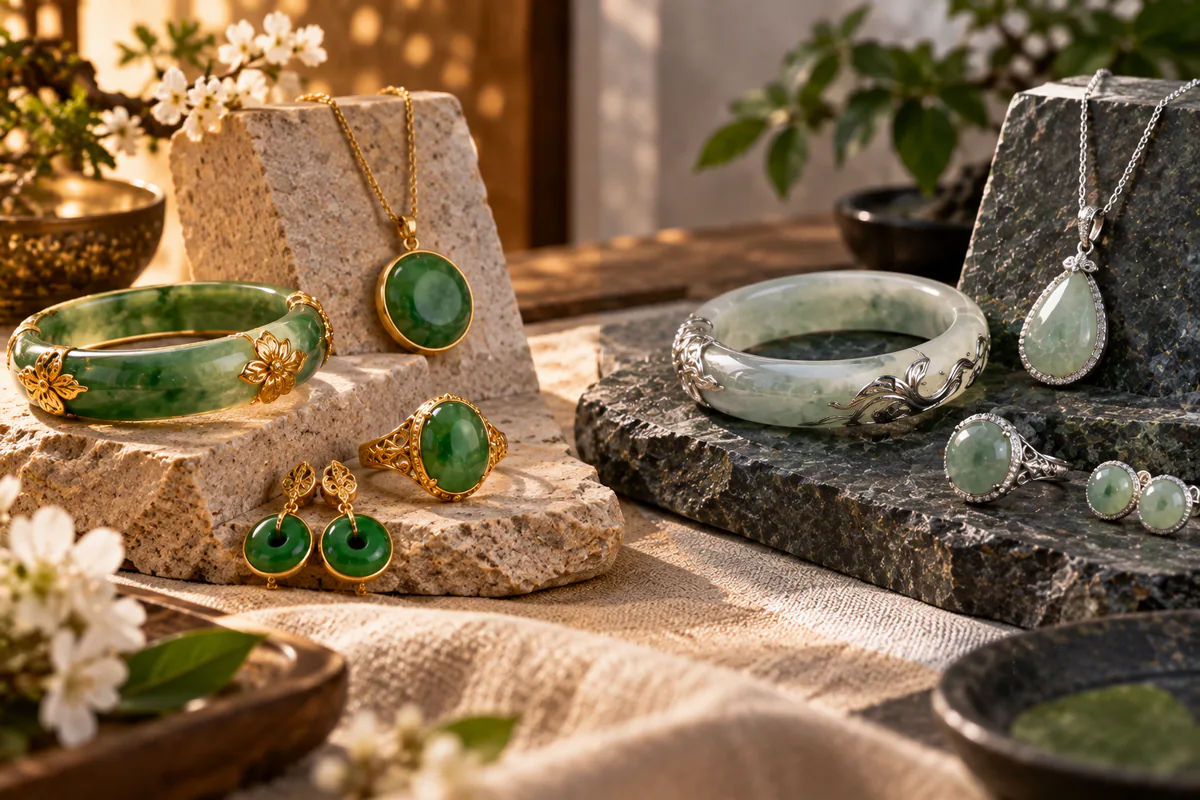
Jade jewellery in gold or sterling silver: choosing the metal
Between jade and gold jewellery and jade and 925 sterling silver jewellery, the stone does not change. This page explains what each metal does to the green you are looking at, where a setting wears first, what I can honestly write about the metal of my pieces, and why a setting prevents me from weighing.
The metal changes neither the mineral nor its density: it changes how the green reads, with yellow gold warming the stone while 925 silver leaves it cool, and it changes what ages, since on my pieces the gold is plating and the silver is solid metal.
| Metal | What I see on the green | What changes over time |
|---|---|---|
| Yellow gold, plated | It warms the stone and pulls a cool green toward olive | The plating wears at friction points |
| White gold | It leaves the green where it is | No white gold pieces in my catalogue |
| 925 silver | It sets off the green without warming it | It tarnishes, and the tarnish can be removed |
My name is Jade, I run a jade jewellery workshop: I choose the pieces, have them set, and weigh one sample of each reference before it goes on sale. I am neither a gemmologist nor a therapist, nor a jeweller either: on metal, I report what I have in hand, nothing more.
What the metal does not change
A jade and gold piece does not have a better stone than a jade and silver piece. The metal affects neither the mineral species, nor the density, nor the toughness. The word jade covers two unrelated minerals, jadeite and nephrite, and it is that split, settled on the scale, that decides what you are holding (the main guide, jadeite or nephrite).
What the metal can do to the stone is mechanical, and nothing more. Jewellery gold and silver sit around 2.5 to 3 on the Mohs scale, far below nephrite, at 6 to 6.5, and jadeite, at 6.5 to 7: when the two rub together, it is the metal that gets marked (hardness and toughness of jade).
What each metal does to the green
A colour is never seen on its own: it is seen next to what surrounds it. That is where the choice is made, and it is the most subjective part of this page.
Yellow gold warms
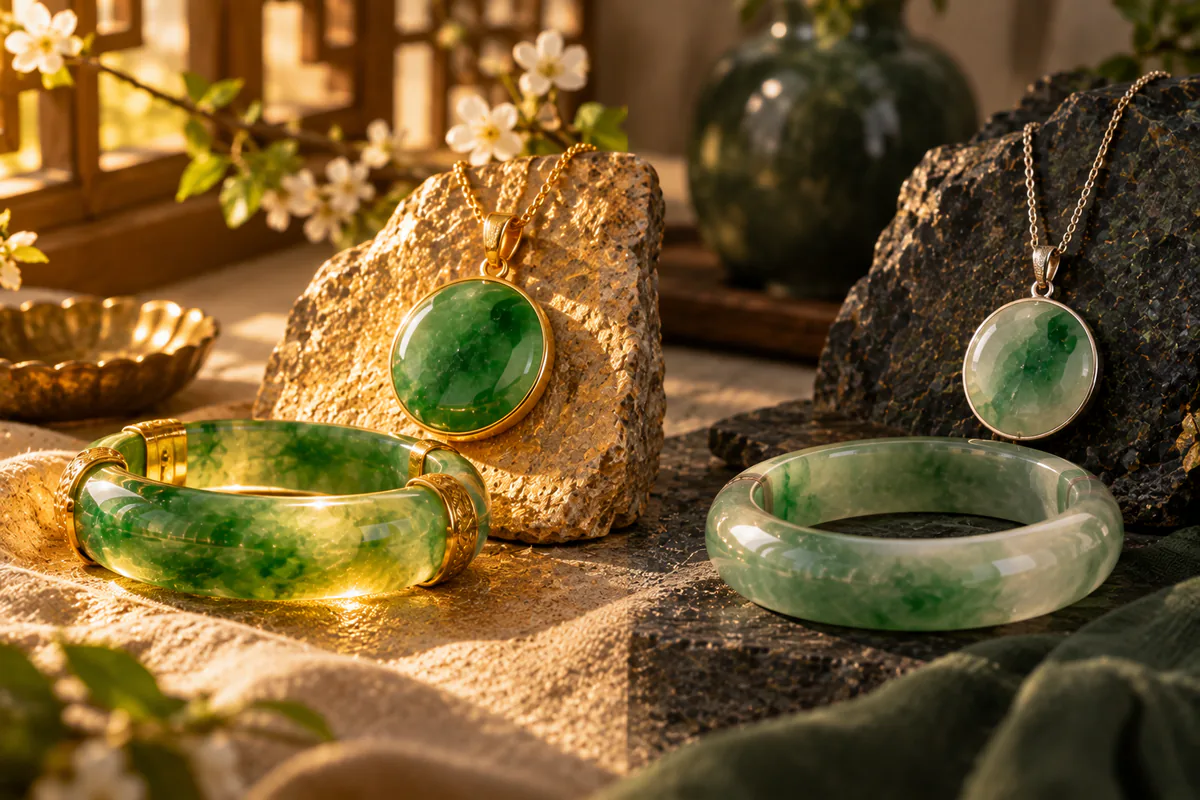
A gold surround adds yellow to the area right around the stone. On a green that is already warm, it intensifies it and gives the deep look people expect from catalogue jade. On a vivid, cool green, the one chromium gives some jadeites, it pulls it toward olive. On white or honey, it blends in until the line between stone and setting disappears (green jade stone, the colours).
Silver and white gold leave the green where it is
A white metal adds nothing to the neighboring hue: a bluish green, a jadeite lavender or a nephrite white keep their position, and the contrast plays on lightness rather than warmth. So I set in silver the stones whose coolness is the point. I have no white gold pieces in my catalogue, and I would rather say so than describe a setting I have never held.
In both cases, do not decide from a photo: the lighting of a shot shifts a colour far more than a change of metal does.
Plated or solid metal: what I can write
Under the word gold, the trade files four objects that do not last equally long: solid gold is gold all the way through, vermeil is silver covered with gold, gold-plated is a base metal covered with a layer of gold, and gold-tone is the same thing, thinner. To the eye they look alike; in use, only the first cannot wear through to the metal underneath. Here is what I can say about my pieces, reread reference by reference on 9 September 2026:
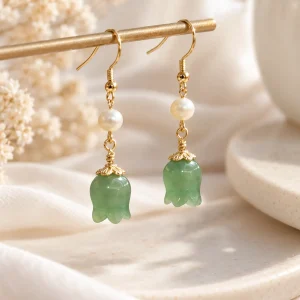
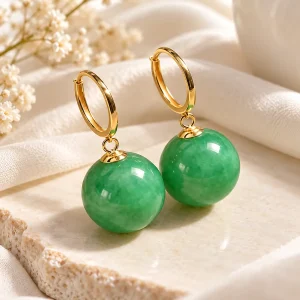
- All my gold-coloured settings are plated: gold-plated bails, chains, clasps, lever-backs and ring bands. None of my pieces is solid gold.
- All my white-coloured settings are solid 925 silver, including clasps and earring posts.
- I publish neither fineness nor plating thickness: I do not have them, and I will not put them online until I have obtained them.
It is the stone’s rule applied to the metal: I write down the gap rather than a plausible value, as I do for treatment status, which is also undetermined (the treatment information sheet, what I publish on each product page). French Decree No. 2002-65 of 14 January 2002, which I cite elsewhere for naming rules, says nothing about metal: it covers gems and pearls.
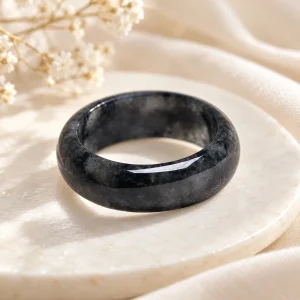
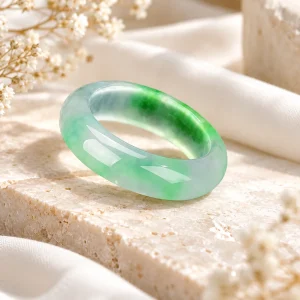
Jade rings, with the metal stated on the product page
The bail and the clasp, where things give way
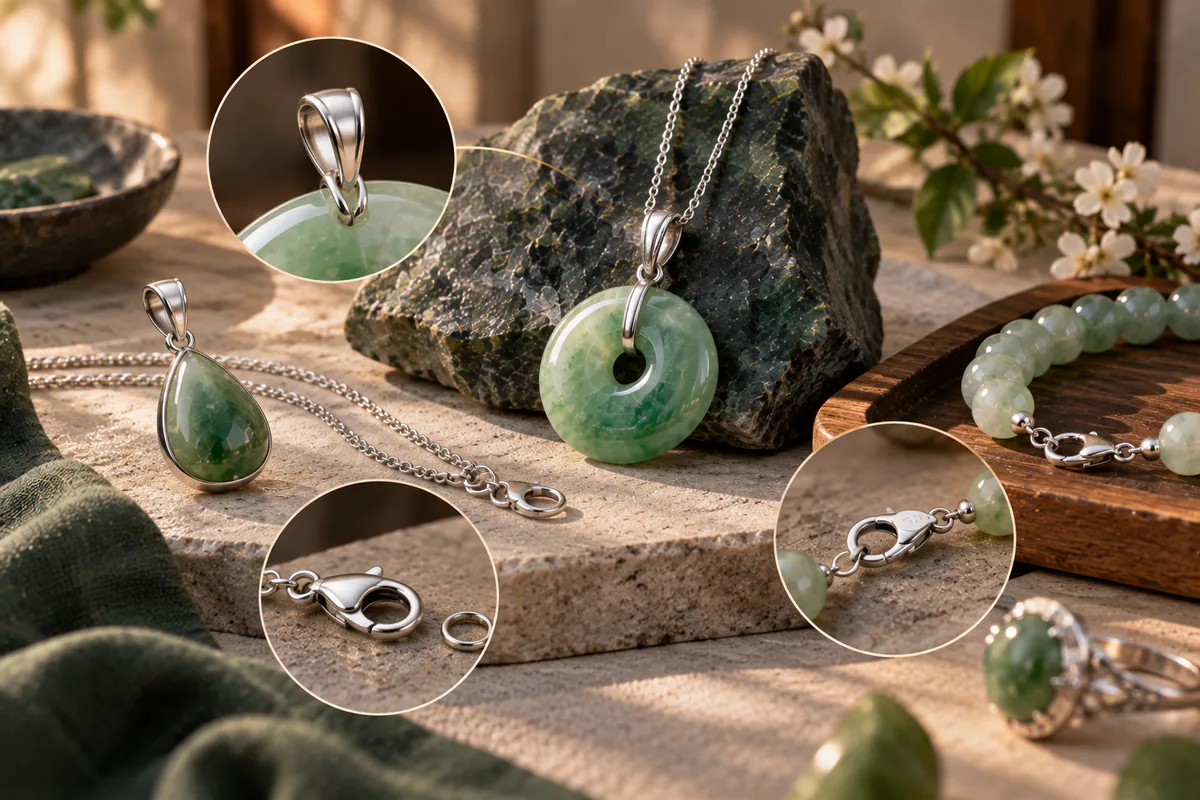
On a set piece, what gives way first is almost never the stone: the weak points can be counted, and they are points of metal or thread.
- The clasp, opened and closed every day, rubbing against a collar: that is where plating wears fastest.
- The bail of a pendant, which carries all the weight on two contact points and turns oval over time.
- The back of a ring band, in contact with the skin and with other rings.
- The thread or cord of a beaded strand, which breaks long before the stone (thread and cord).
The complaint I read most often is a green mark left on the skin after a few months of wear. It comes neither from the stone nor from the gold: it comes from the copper in the alloy under the plating, which reacts as soon as the gold layer has worn through at that spot. A solid 925 silver clasp cannot do this in the same way, since there is nothing else underneath.
On the stone side, the thing to watch is elsewhere: a setting that grips too tightly presses on a beveled edge, and a thin edge remains a thin edge, even on a stone this tough (storing jade jewellery).
What can be measured: silver, salt and glue
The previous section depended on what I see. This one does not depend on my eye but on ordinary chemistry, which is what makes it applicable to any piece.
Silver tarnishes, and that tarnish is silver sulfide, formed on contact with sulfur compounds in the air, in sweat, in wool or in rubber. It is superficial and it can be removed. 925 silver also contains a small share of copper, which can mark acidic skin; but what it does first is tarnish.
Salt, for its part, attacks solder joints and glue long before it touches the stone. Seawater, a salt bath, a stay in a bowl of coarse salt: the metal pits, a glued cabochon comes loose, a clasp loses its grip, and the jade comes out intact. What that bath is supposed to do belongs to another register, covered elsewhere (how to recharge a jade stone, a stone heals nothing).
The rest of the care routine protects the setting before the stone: lukewarm water, mild soap, immediate drying, no ultrasonic cleaning and no steam (how to clean jade stone).
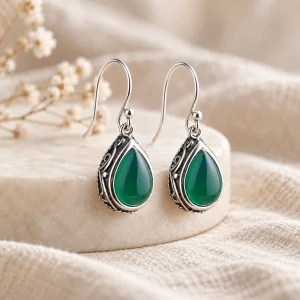
Jade earrings, chosen one by one
Why a setting skews my scale
What allows me to name a mineral is hydrostatic weighing: the stone weighed in air, then suspended underwater, gives its density, to be compared with the published ranges, 3.25 to 3.36 for jadeite and 2.90 to 3.03 for nephrite (the full protocol).
This measurement does not tolerate metal: a closed setting, a bail, a chain or a thread enters both weighings and skews the result. So I weigh the bare stone of the sample ordered before a reference is opened, never the finished piece. The same goes for yours: once set, it cannot be usefully weighed (how to recognise real jade stone).
Choosing by type of jewellery
With the stone being equal, the format decides more than taste does, because it decides the friction.
- Ring: constant contact, a band that rubs against everything. This is the format where solid metal holds up best (my jade rings).
- Bracelet: everything comes down to the clasp, and the diameter matters as much as the metal (measuring your wrist, the size guide).
- Pendant and necklace: the bail and the chain can be two different metals, and it shows (pendants, necklaces).
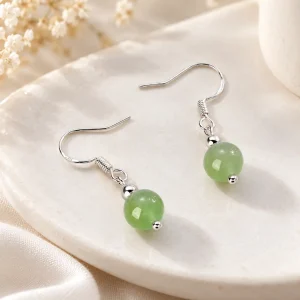
- Earrings: the post stays in the earlobe for hours, and for reactive skin solid 925 silver is the safest (earrings).
The wearer, for their part, changes nothing about the metal (men’s jade jewellery, women’s jade jewellery). For a gift, gold forgives a lapse in taste more easily than a poorly matched green does (giving jade jewellery).
The questions I get asked
Does jade look better with gold or with silver?
It depends on the green in front of you, not on jade in general. A warm green or a honey tone benefits from gold; a cool green, a lavender or a white keep their crispness against a white metal.
Is jade and gold jewellery solid gold?
Not in my shop: all my gold-coloured settings are plated, and it says so on the product page. Elsewhere, the word gold is used for solid gold as well as for plated or vermeil: ask which one before asking the price.
Why did my clasp turn green?
Because the plating wore through at that spot and the copper in the alloy underneath reacts to sweat. It is a setting problem: it is the metal part that gets replaced, not the piece.
Does 925 silver damage jade?
No: silver is much softer than the stone, and when they rub together it is the silver that gets marked. The risk comes from products: salt and chlorine attack solder joints and glue, and a cabochon that comes loose falls out.
Can I wear jade and gold jewellery every day?
Yes, taking it off before water, sports and housework. Plating worn every day wears at the friction points: that is predictable, and it says nothing about the stone (wearing jade jewellery every day).
Does the metal change the published density?
No, since I never weigh the set piece: the number refers to the bare stone. The price, for its part, depends on variables other than the metal (judging jade quality, the price of jade stone).
Where I checked
What comes from a named source. The density and hardness ranges, for jade as for jewellery metals, come from the mineralogical literature: I repeat them without having measured them and without attributing them to any organization, since I did not take them from a single one. French Decree No. 2002-65 of 14 January 2002 covers gems and pearls and contains nothing about metals: I have read it, which is why I do not invoke it here. The French hallmarking regime is a separate text that I have not opened: I cite neither thresholds nor fineness from it.
What is an observation, dated. On 8 September 2026, I looked at the nine French competitors on the first page of results: none states the mineral of its pieces, and most write gold without saying whether it is solid or plated. On 9 September 2026, I reread my catalogue reference by reference: all gold-coloured settings plated, all white-coloured settings solid 925 silver, and neither fineness nor plating thickness available to date.
What is my own reasoning. How green reads depending on the metal is what I see, not a measurement: two people may not see the same thing. The ranking of wear points and the preference for solid metal where contact is constant are decisions, not facts. If you find a mistake here, write to me: I will correct it and note the correction.
In one sentence
Between jade and gold jewellery and jade and 925 silver jewellery, the stone does not change: what changes is the green you see in it, and the fact that on my pieces gold is a layer while silver is the material itself. The number that names the stone is on the weighing page, the pieces in the shop.
Jade pendants, gold-plated bail or solid silver