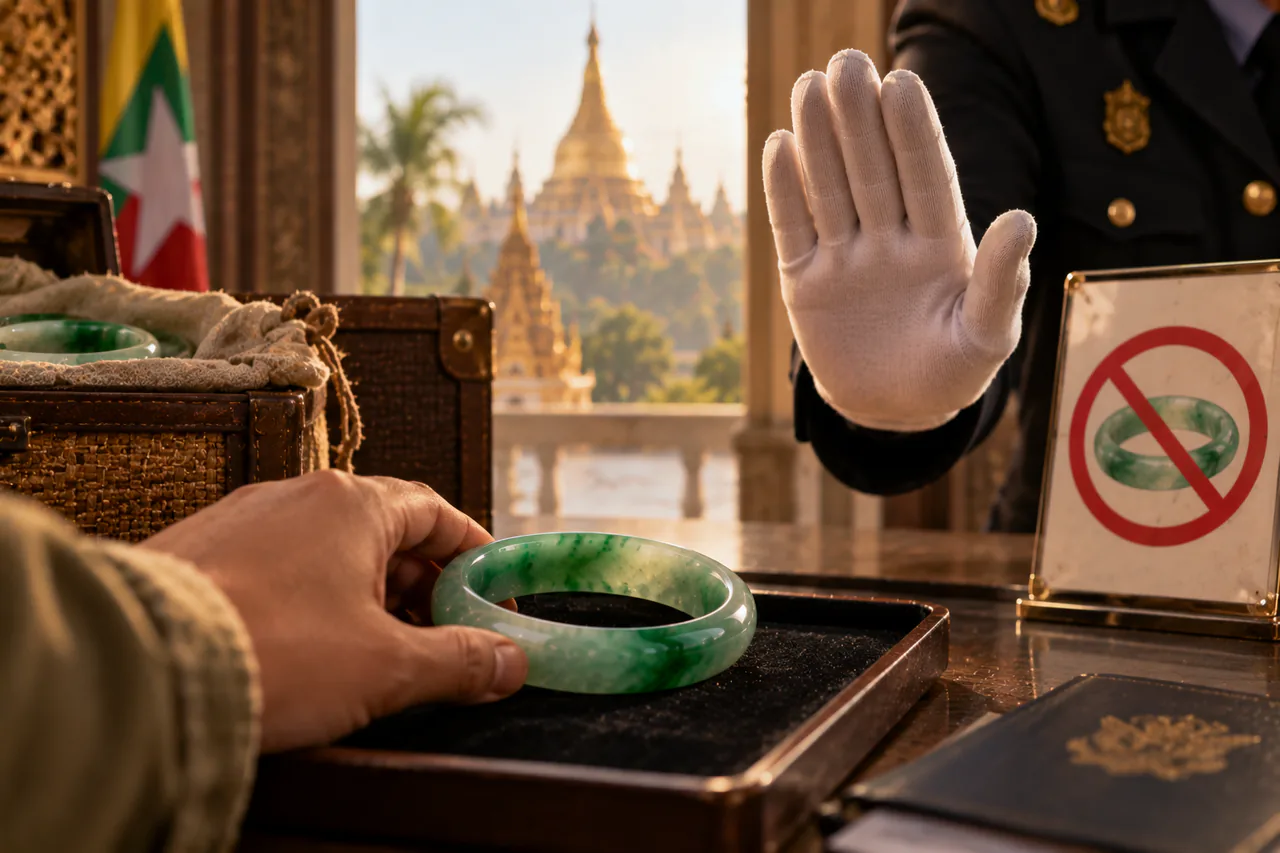
Burmese jade bracelet: why it will not be sold here
This page explains why no Burmese jade bracelet appears in this catalogue: what the name covers, the American law that settled it, what the European Union did and did not do, what the material costs in Hpakant, and what I set in its place.
I do not sell any Burmese jade bracelet, and what settles it is not my indignation but facts: the state-owned company that controls this trade has been under United States and European Union sanctions since 2021, and this jade largely benefits the military.
The word jade covers two unrelated minerals, jadeite and nephrite, told apart in 1863 by the French mineralogist Alexis Damour. Burma does not produce both: it is jadeite country, and that is what makes this refusal costly rather than comfortable. The distinction is laid out on the jade stone page.
My name is Jade, and I run a jade jewellery workshop: I choose the pieces, have them set, and weigh one example of every piece before it goes on sale. I am neither a gemmologist nor a therapist: here, the mineralogy is stated as fact, and everything else is attributed.
What “Burmese jade” covers
Behind this name are one specific mineral and one specific region. The mineral is jadeite, a pyroxene with a density of 3.25 to 3.36, not nephrite, which is lighter and comes from elsewhere (jadeite vs nephrite). According to the deposit lists I have read, most of the gem-quality jadeite on the world market comes from Burma, with the second source, Guatemala, far behind: where jade comes from.
The region is Hpakant, in Kachin State, in the north of the country. The name also serves as a pricing argument, often paired with the phrase “imperial jade”, which refers to a quality of translucent jadeite and not to an origin: what the term covers, and what really makes a piece valuable.
What US law said then, and says now
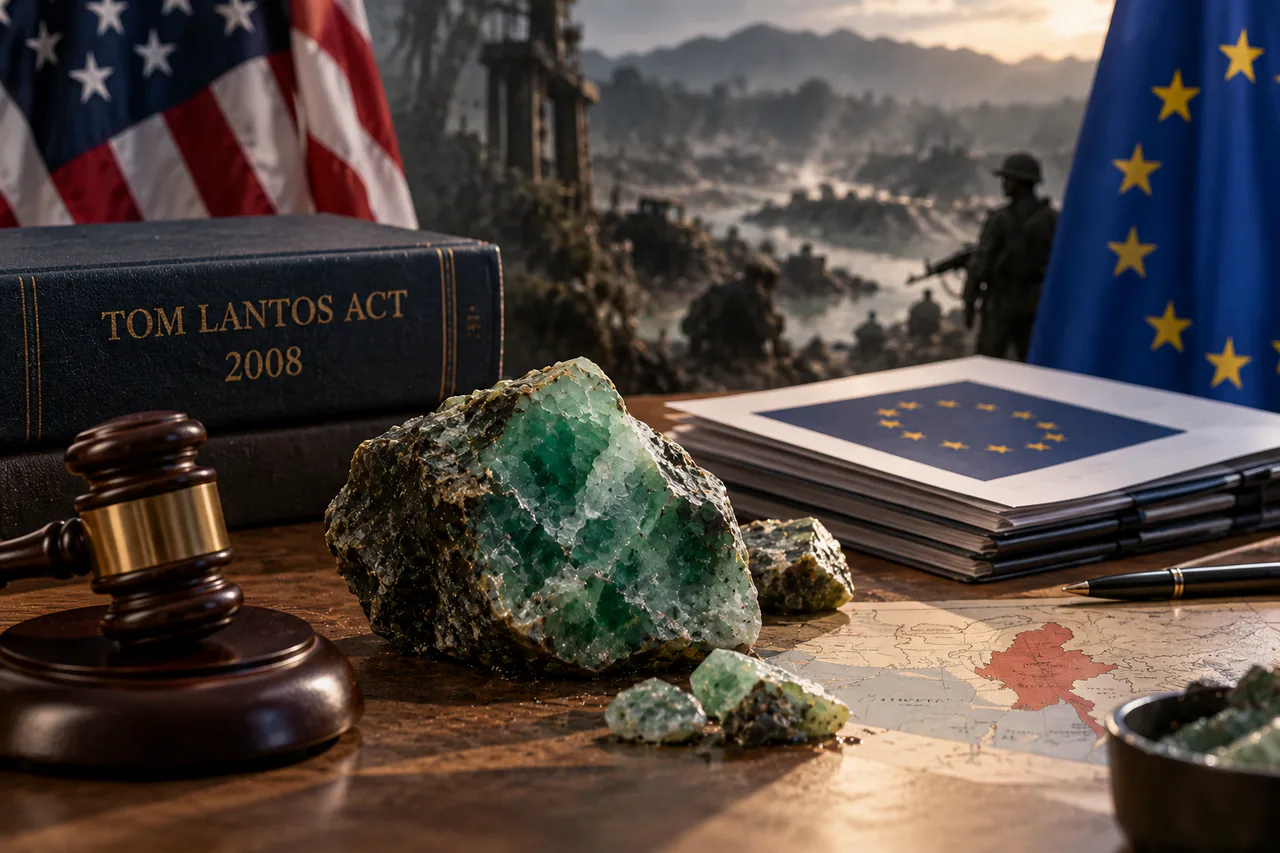
The law is the Tom Lantos Block Burmese JADE Act of 2008. The acronym JADE does not refer to the stone but to the junta’s anti-democratic efforts, and yet the law named jade and rubies explicitly: it banned their import into the United States regardless of where they were last cut or traded. That ban was lifted on 7 October 2016, by Executive Order 13742, along with all the sanctions on Burma. After the coup of February 2021, the United States responded differently: on 8 April 2021, the US Treasury sanctioned Myanma Gems Enterprise, the state-owned company that controls the gem trade, without reinstating a general ban.
For eight years, it was the material that was targeted, not the route: a stone mined in Hpakant, cut elsewhere and set in Europe was still Burmese jadeite. The ban is gone, the difficulty is not: the official Burmese jade supply chain runs through an entity that Americans are not allowed to do business with, and a stone never tells you where it has been. This site also serves American buyers, and I do not want a shop whose legality would depend on a supply chain nobody can verify.
I am not a lawyer, and I am describing the state of the texts as I checked it on 11 September 2026, not giving advice. What I can do is stay away from it.
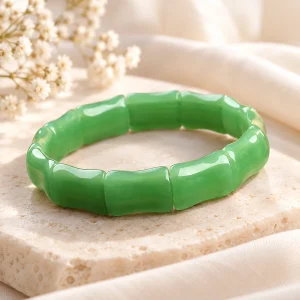
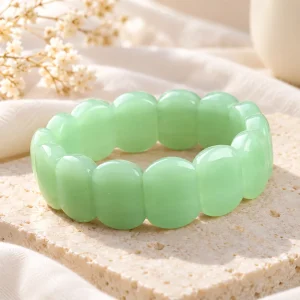
Jade bracelets available now
What the European Union did, and what it did not do
This is the point where I read the most approximations, in both directions: some claim Burmese jade is banned in Europe, others that no rule applies to it at all.
The European Union does not ban the import of Burmese gems. It did, under Regulation (EC) 194/2008, repealed in 2013; Regulation (EU) 401/2013, which replaced it, contains no ban of that kind. A page announcing a European ban is copying a text that has been dead for more than ten years.
What the Union did was target a company. On 21 June 2021, it added Myanma Gems Enterprise to its sanctions list: an asset freeze, and a ban on making funds available to it. This state-owned company controls permits, licences, royalties and the marketing of jade in Burma.
The practical consequence is less comfortable than an outright ban. Buying a Burmese stone in Europe is not prohibited; financing a sanctioned entity, even indirectly, is. And since the chain is opaque, nobody will ever show me where the money stops.
The ethical argument, which I put second
It is not weaker, it is harder to handle. A refusal based on a text can be checked line by line; a refusal based on my feelings can be argued about endlessly, and contradicts itself as soon as it becomes costly.
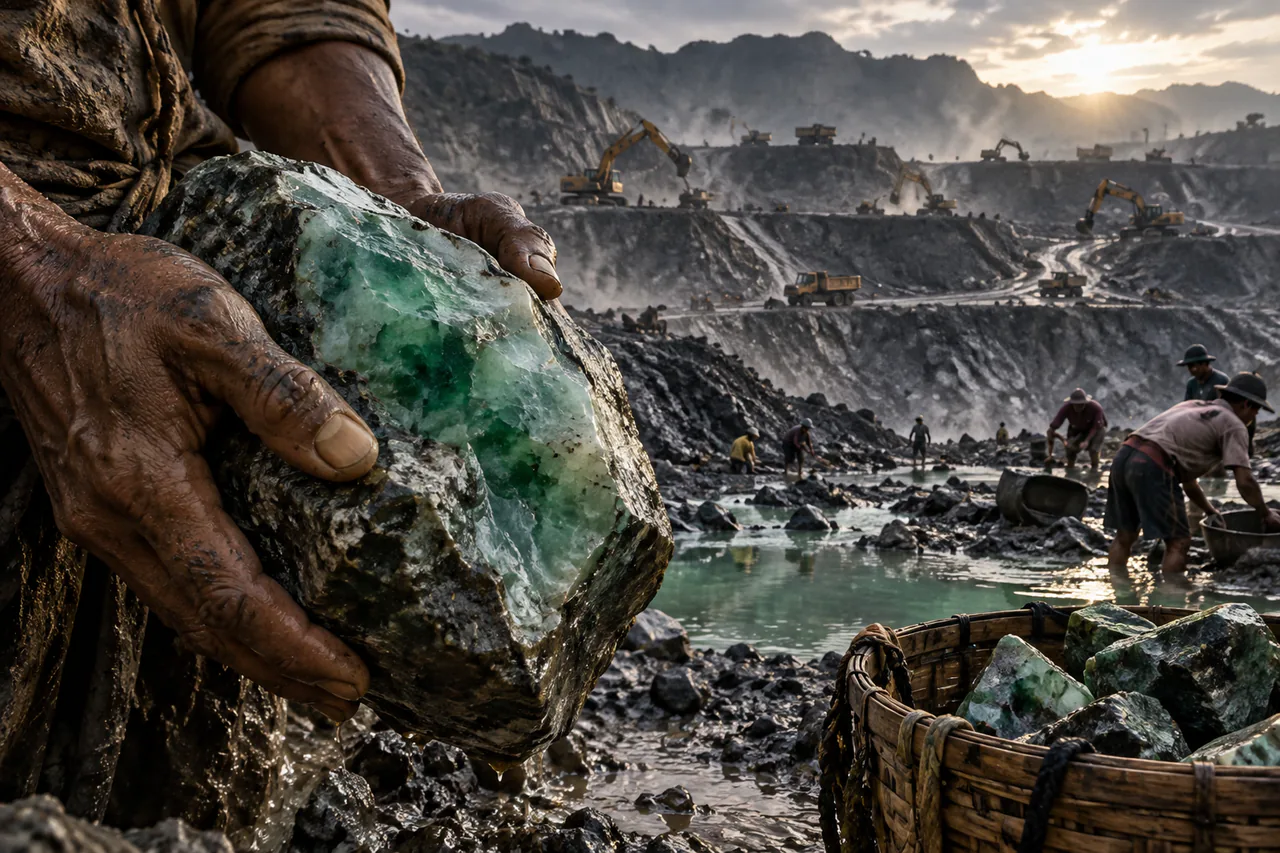
Two facts are enough to grasp the scale. Global Witness estimated Burmese production at up to 31 billion dollars for 2014 alone, under the control of military networks. And on 2 July 2020, the Wai Khar landslide in Hpakant killed between 175 and 200 miners, most of them scavengers searching through the waste left by the machines.
I draw no general lesson from this about the gemstone trade. I simply note that the most sought-after material in my line of work comes at that price, and that I can work without it.
Why nobody can guarantee the origin of a bracelet
A seller who tells you where a stone comes from is giving you a statement, not proof, and that applies to mine too. The material changes hands several times between the deposit and the counter, it is usually cut far from where it was mined, and the finished piece carries no mark of origin that I know how to read.
What my scale tells me, and what it does not
I weigh one example of every piece in air, then suspended in a glass of water, and the ratio gives the density: the protocol is published. That number gives me the mineral and rules out the serpentine or quartzite sold under the name jade (stones sold as jade). It gives me neither the origin nor the treatment: two jadeites from two continents weigh the same, and a resin-impregnated stone weighs about the same as any other, which only infrared spectroscopy, which I do not have, could tell apart (the A, B and C classification, my treatment information sheet).
What I know about the upstream supply of my pieces, and what I do not, is on where my jade comes from: I leave the rest blank, because a written blank is better than a guarantee I cannot back up. Counter checks, the scratch, the sound, the feeling of cold, prove almost nothing either (how to tell if jade is real).
What I set in its place
The refusal would be hollow if it left nothing behind. Nephrite makes up most of my pieces: Russia, Canada, Taiwan and China have the major deposits, and it is the material of green, white and black bangles. Its hardness, 6 to 6.5 on the Mohs scale, puts it below the quartz in ordinary dust, so it loses its polish a little faster than jadeite: why jade almost never breaks.
Jadeite remains possible outside Burma, with the Motagua Valley in Guatemala as the second source of gem quality. One material I do not imitate, on the other hand: New Zealand pounamu, whose ownership a 1997 law vested in the Ngāi Tahu iwi (Māori pounamu). For every piece, I publish the mineral, the two masses, the resulting density, the date of the measurement, and the fact that the treatment has not been determined: what I publish on each product page.
One last disclosure, since it explains the shape of this page. On 8 September 2026, the research tool I use showed about 180 searches a month around the French query “bracelet en jade de Birmanie”, with almost no competition: it was the easiest page to rank in my entire plan. I turned it into an argued refusal rather than a category, because opening a category for this origin would mean selling exactly what I have just written I will not sell.
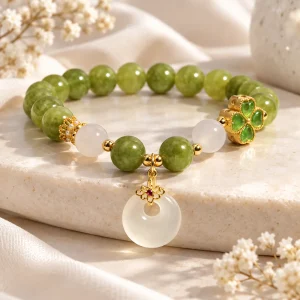
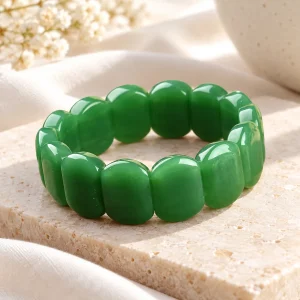
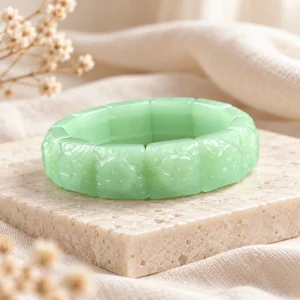
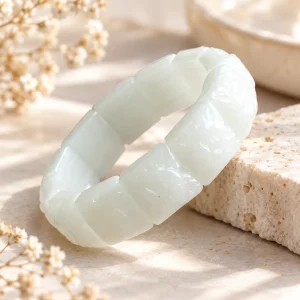
Bracelets whose density I publish
What tradition attributes to these bracelets
What follows changes register, and I flag it rather than blend it into the rest. Nothing in it is proven: it is what traditions have attributed to this stone.
A stone does not heal anything, and the full disclaimer is here.
Tradition is said to give the jade bracelet a value of protection and family continuity, the piece being handed down rather than replaced, and contemporary crystal healing authors are said to associate it with balance. These are reported attributions, never established, and nothing I have read makes them depend on the country the stone was mined in: the meaning of the jade bracelet.
In other words, Burma does not add meaning to a bracelet, it adds a price and a problem. What I will never write in my own name: that a piece of jewellery heals, protects or promotes fertility.
The questions I get asked
Do you sell Burmese jade bracelets?
No, none, and it is not a matter of being out of stock. The state-owned company that controls this trade has been under United States and European Union sanctions since 2021, and I do not want that origin in the catalogue: the shop.
Is Burmese jade banned in Europe?
No. The European Union has not banned the import of these gems since Regulation (EC) 194/2008 was repealed in 2013. It did something else: it added Myanma Gems Enterprise to its sanctions list on 21 June 2021, which prohibits making funds available to it.
How can I tell whether the bracelet I own comes from Burma?
You probably will not find out, and none of the tests I can run at home will tell you. Weighing establishes the mineral, not the origin: if the stone is jadeite, Burma is statistically the most likely origin, which proves nothing about your piece.
Is Burmese jade better quality?
Most gem-quality jadeite comes from there, so the most translucent pieces on the market often do too. But quality is judged on the stone in front of you, translucency, evenness, fineness of grain, never on the name of a country.
What should I do with the Burmese bracelet I already own?
Nothing in particular: the texts cited target import and financing, not ownership. Just avoid ultrasonic cleaners and steam, since you do not know, any more than I do, whether the stone is impregnated with resin.
Does refusing this origin push your prices up?
I give no figures here, since I have no comparable price series to publish. What I can say is that nephrite is more common than gem jadeite and that I work mostly with it: the price of a genuine jade bracelet.
Where I checked
What comes from a named source. Correction of 11 September 2026: a previous version of this page stated that the 2008 American ban was still in force; it was lifted in 2016, and the reasoning now rests on the 2021 sanctions. The texts are named in the body: the Tom Lantos Block Burmese JADE Act of 2008, US Executive Order 13742 of 7 October 2016, which lifted its ban, the designation of Myanma Gems Enterprise by the US Treasury on 8 April 2021, Regulation (EC) 194/2008 repealed in 2013, Regulation (EU) 401/2013, the listing of Myanma Gems Enterprise on the European Union sanctions list on 21 June 2021, and the 1997 New Zealand law vesting pounamu in the Ngāi Tahu iwi. The two figures in the ethics section come from Global Witness for the 2014 estimate, and from the public death toll of the Wai Khar landslide of 2 July 2020, given as a range because it always has been. The separation of jadeite and nephrite comes from Alexis Damour’s note to the French Academy of Sciences in 1863; I do not give page numbers, as I have not read it. The density and hardness ranges are those of the mineralogical literature, as are the deposit locations I cite, the Motagua Valley in Guatemala, Russia, Canada, Taiwan and China: I repeat them, I have neither measured nor seen them, and I attribute them to no particular organization, because I did not take them from any one of them. French law, for its part, says nothing about jade, and stating a real origin is not a false description (jade and the 2002 decree).
What is a market observation, with a date. On 8 September 2026, I looked at the nine French competitors on the first page of results: none states the mineral of its pieces, and one of them highlights sourcing its jade in Burma. The same day, the first page of French results for “bracelet en jade de Birmanie” contained only sales pages, nine out of nine. Also that day, my supplier confirmed that it cannot say whether its stock has been treated.
What is my own reasoning. The choice to put the law before ethics, the choice not to open a category for an origin, the idea that an origin stated on a product page remains unverifiable for me, and the reading that owning an older piece is not affected: these are decisions and readings by a non-lawyer, not established facts. I have seen neither the mines nor the documents of any supply chain. If you find a mistake here, write to me: I will correct it and note that I did.
In one sentence
A Burmese jade bracelet is not hard to find, it is in fact the most common jadeite on the market, and that is exactly why the refusal deserves to be written down rather than implied. What I set in its place is in buying jade jewellery, and the method is on the weighing page.