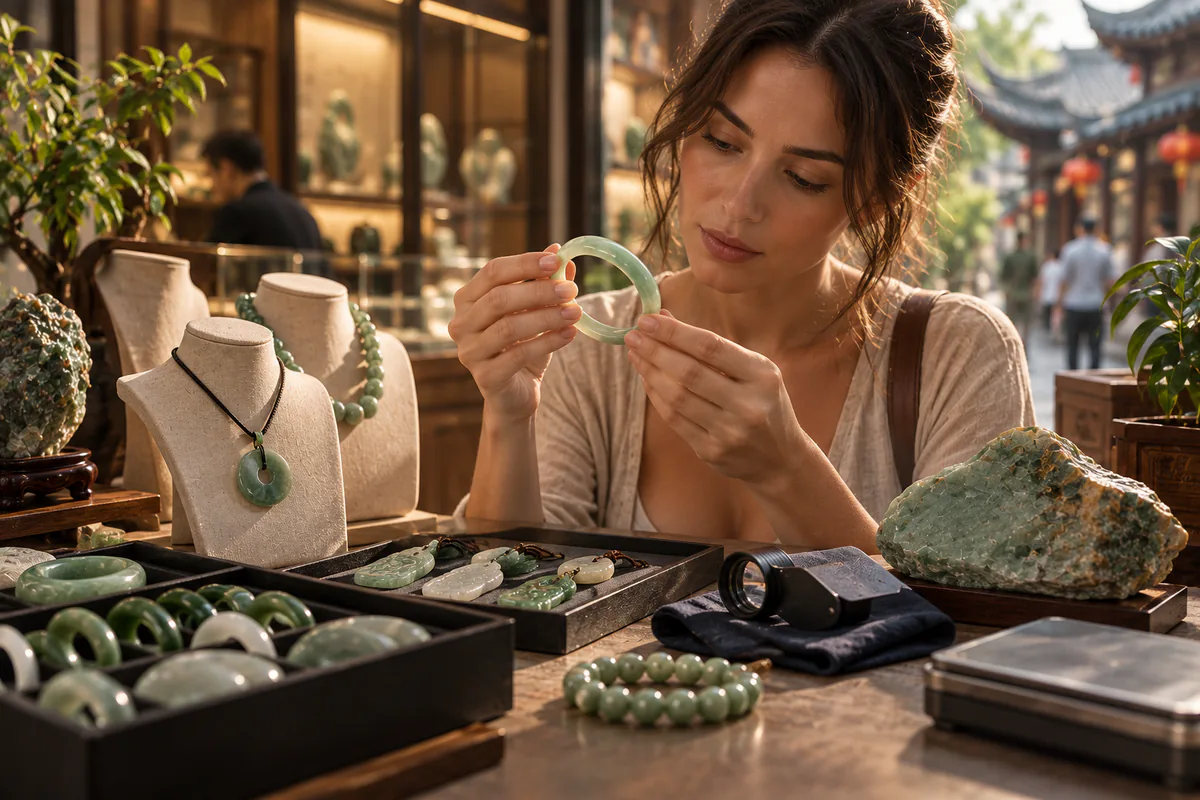
Buying jade jewellery: where, and what to watch for
Buying jade jewellery happens through four channels that do not offer the same footholds: this page explains what each one lets you check before paying, the six listing phrases that should make you close the tab, and what I ask a supplier myself.
There is no good channel: there are channels you can get out of if the piece is not what was advertised, and channels you cannot, and that criterion decides a jade purchase more reliably than the display or the price.
My name is Jade, and I run a jade jewellery workshop: my pieces are set or chosen one by one, and I weigh one example of each reference before it goes on sale. I am not a gemmologist or a therapist.
Four channels, and what each one lets you check
Jade is sold on marketplaces, in online shops, at flea market stalls and in shop windows abroad. None of these four is honest or dishonest by nature. What separates them comes down to three things: what the seller writes, what you can ask them, and what options remain if the piece does not match.
One reminder about the material shapes everything else: the word jade covers two unrelated minerals, jadeite and nephrite, and a good share of what is sold under that name is neither (jade stone).
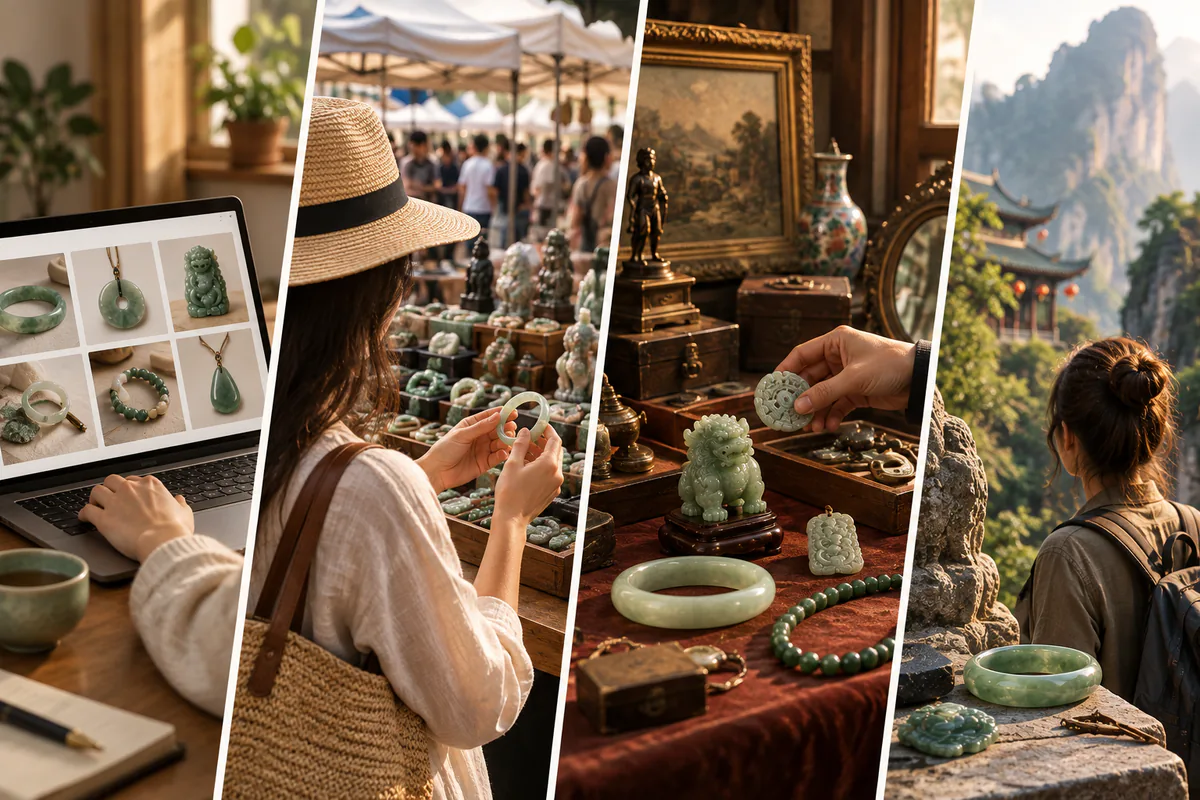
The marketplace, and the seller you cannot see
On a marketplace, the platform hosts, it does not write. So the first thing to establish is not the stone: it is whether you are dealing with a professional or a private individual. That disclosure is mandatory on these platforms in France, and it decides what comes next, since a purchase between private individuals gives no right of withdrawal.
What this channel does allow: asking a question in writing and keeping the answer. One is enough to sort things out, and it is this one: which mineral is it, and how do you know? An answer that gives a colour, a country or a letter instead of a mineral is an answer in itself.
What it does not allow: seeing the edge, the light passing through, the polish up close. And the same seller can list jadeite, nephrite and stones that are neither side by side, under a title where jade serves as a shelf label rather than a name.
That leaves the photos, where two reflexes help. A saturated, perfectly even colour that reaches right into the cracks is the signature of dye, which settles where the material is open. And a listing with no view of the edge, the back or the clasp rarely hides good news.
The online shop, and what to ask it
A specialist shop writes its own product pages, so it puts its name to them. That is its advantage, and it is what makes its silence readable. Three questions apply to a product page, in this order.
- Is the mineral named? Not “jade”, which is a trade word: jadeite or nephrite. On 8 September 2026, none of the nine French competitors I opened stated it piece by piece.
- What is the page based on? A claim with no measurement or source is only worth the trust you place in the business, which is why I publish my numbers (what I publish on every product page).
- Is treatment addressed or avoided? A shop that writes that it does not know the treatment status of its goods tells you more than a silent one (type A, B and C jade).
A legal point that is rarely respected and easy to check: Article 10 of French Decree No. 2002-65 requires a treatment information sheet, made available before the sale and handed over with the invoice. Look for it in the footer; mine is here.
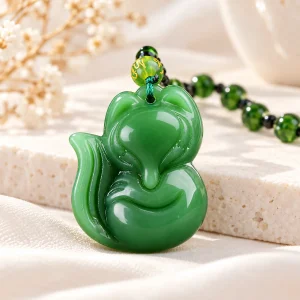
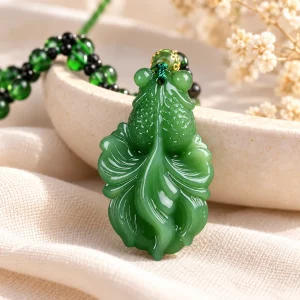
Pendants whose mineral and number I publish
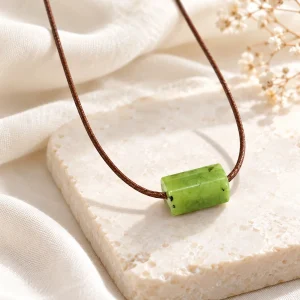
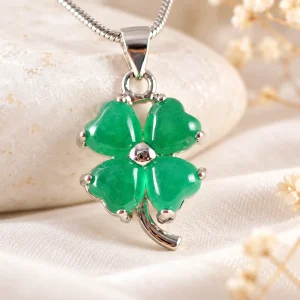
Flea markets, yard sales, inheritance
This is the channel where you can touch the most and have the least recourse. The piece is right there: you pick it up, hold it in front of a lamp, look at the edge and the polish. The criteria that make a jade’s quality are judged far better this way than on a screen (judging the quality of a jade).
In return, there is no written description and no possible return. The seller often does not know what they are selling, and says so without malice: “it was my mother’s.” That is not deception but a lack of information, and the way to handle it is to buy for what you see rather than for what you hope.
One more precaution for an old object, which applies to a new piece too: no ultrasonic cleaners or steam as long as you do not know whether it is resin-impregnated or glued (how to clean jade stone).
Buying while traveling
Bringing jade back from Asia is the scenario people tell me about most, and the one with the weakest recourse: once you are home, there is no reachable seller and no usable invoice. A souvenir is perfectly legitimate; it is best to pay a souvenir’s price for it.
One legal point is worth knowing before you leave, and it has changed. The United States banned imports of Burmese jadeite under the Tom Lantos Block Burmese JADE Act of 2008, and that ban was lifted on 7 October 2016. Today, neither the United States nor the European Union bans these gemstones, but both sanction the state-owned company that controls Burmese jade: the United States since 8 April 2021, and the European Union since 21 June 2021. Why I refuse this origin: Burmese jade bracelets, and where my jade comes from for the origins I accept.
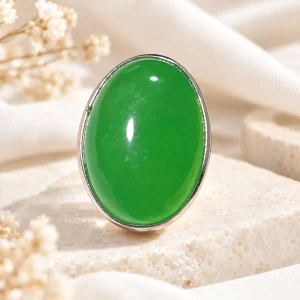
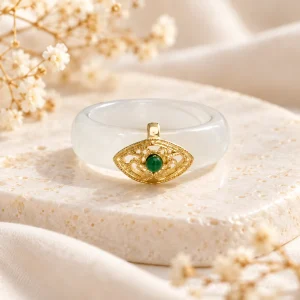
Jade rings, chosen one by one
The six phrases that should make you close the tab
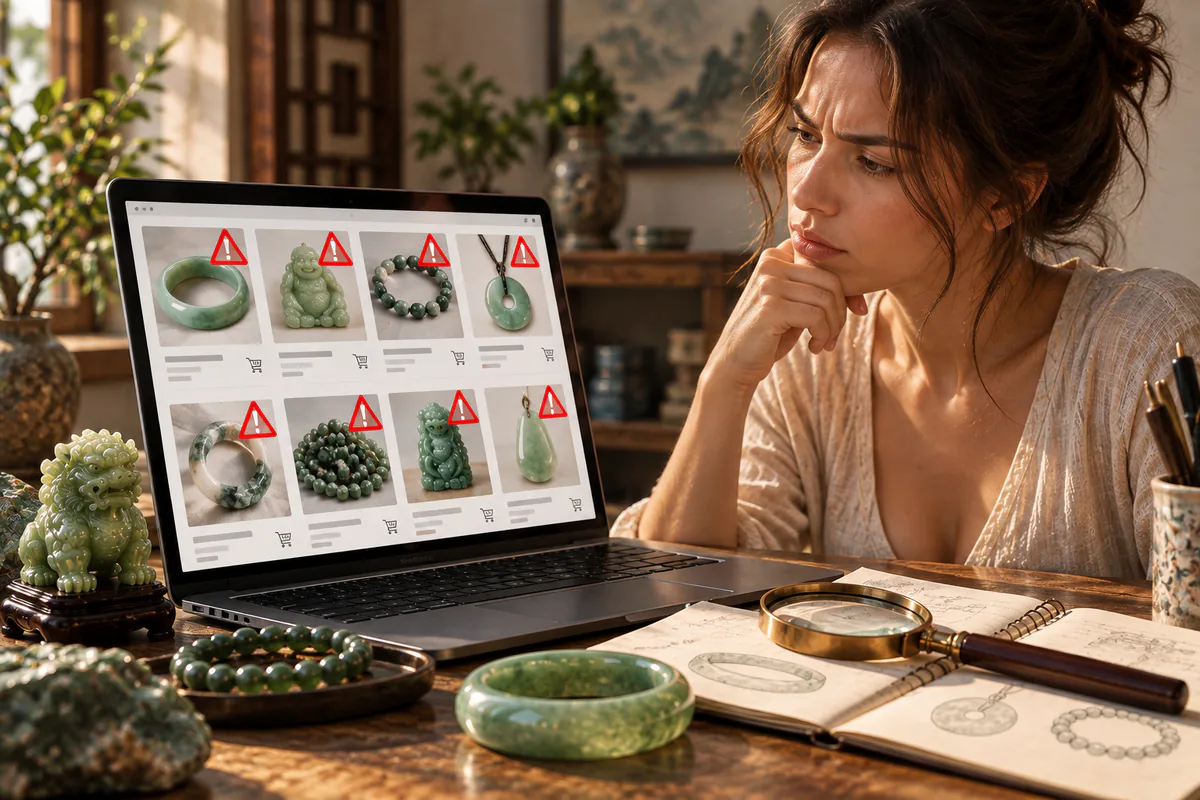
The six phrases below were noted in real listings. I quote them to explain what they cover; I use none of them myself.
“Jade A”, “jade AAA”
This scale has no standing in any standard: it borrows its alphabet from the A, B, C treatment classification and gives it the look of a school grade. I found it five times in the results I opened, once as AA quality on a massage accessory. What it is worth is covered in type A, B and C jade.
“Category A”
The intention is right: in the real classification, A refers to jadeite that has not been bleached with acid and then impregnated with resin. But that determination requires infrared spectroscopy, and the listing that states it rarely says who carried it out, on which piece, on what date. Without those three details, the letter is decoration.
“100% natural”
The phrase blends two meanings. The first contrasts the stone with an imitation, and Article 4 of French Decree No. 2002-65 in fact prohibits “natural” for a reconstituted, composite, synthetic, artificial or imitation product. The second implies no treatment, which the listing does not demonstrate. I do not write this word on any of my product pages: I cannot establish it.
“Certified”
The word says neither by whom, nor on what, nor when. A laboratory report covers an identified piece, on a date, and states what an analysis showed: it cannot be transferred from one piece to another and cannot be summed up in an adjective (how to recognise genuine jade).
“Malaysian jade”
This is dyed quartzite, with a density close to 2.65. Malaysia is not a jade deposit, and the country’s name works as a softener. Bright pink and fuchsia are its most common colours, and jadeite does not produce those clearly (dyed jade).
“New jade”
This is serpentine, at around 2.6. The English word sounds modern, the label sounds like a gemstone. The material has a respectable name, and that name is not jade. Similar labels are gathered in stones sold as jade.
One more word deserves a mention, not because it betrays the stone but because it is prohibited: “semi-precious” (semi-précieux), which Article 5 of French Decree No. 2002-65 bans along with “semi-fine” for all the materials it covers, without exception, and which I nevertheless read on most of the French gemstone pages I open (jade and the 2002 decree, the jade glossary).
What I check before paying a supplier
I am on the other side of the same problem. Here is what I do, including what leads nowhere.
- I order one example before putting a reference online, and I weigh it in air and then suspended underwater. The ratio gives the density, compared with the published ranges: jadeite 3.25 to 3.36, nephrite 2.90 to 3.03, serpentine about 2.6, quartzite about 2.65 (weighing).
- I ask for the mineral, in writing. An answer that gives a colour or a trade name is not an answer, and I would rather find that out before than after.
- I ask about treatment status, and I get nothing. On 8 September 2026, my supplier confirmed that they cannot say whether their goods are impregnated. That is the normal state of this market, and I write it down rather than keep quiet.
- I ask for the origin, and I refuse one, Burmese jadeite, for the legal reason set out above, even before the ethical argument.
Weighing separates real jade from serpentine and quartzite: that is what the word genuine means, and it is the only reliable method available in my workshop. It says nothing about resin, it is thrown off by the metal of a setting or the thread of a strand, and it loses its value on very small pieces. That is why I measure and do not certify.
What you can still do once the piece arrives
Three options, from the simplest to the heaviest.
Weigh it. A scale accurate to a tenth of a gram, a thread, a glass of water: nothing that needs gemmologist’s equipment, and it settles whether you have jade or a stone sold in its place. On a set piece, the setting distorts the measurement.
Withdraw from the sale. In France, a distance purchase from a professional opens a 14-day legal withdrawal period, with no reason required. It does not apply at a flea market, between private individuals, or in a shop you visited while traveling (delivery and returns).
Invoke the name. Article 9 of French Decree No. 2002-65 prohibits selling a stone under another name, on labels as on any commercial or advertising document, and a product page is one. Writing jade on serpentine is not a loose choice of words.
Questions I get asked
Where can I buy jade jewellery with confidence?
No channel is safe in itself. What earns trust is a product page that names the mineral, says what it is based on and addresses treatment instead of avoiding it. A seller who writes down what they do not know is more reliable than one who only writes what reassures.
How can I tell whether the seller is telling the truth about the material?
Ask the question in writing and see whether the answer names jadeite or nephrite. When the piece arrives, hydrostatic weighing of the bare stone settles whether it is jade or serpentine or quartzite. It says nothing about treatment.
Does a paper that comes with the jewellery prove anything?
That depends on three details: which laboratory, on which identified piece, on what date. An analysis report states what a measurement showed on a given object; an adjective printed on a label is not an analysis report.
Should you buy jade in Asia to pay less?
The price goes down, and so does your recourse: without a usable invoice or a reachable seller, a mistake about the material stays with the buyer. And for one specific origin, Burma, the official supply chain has been sanctioned by the United States and the European Union since 2021.
Does a low price mean it is not jade?
No, and a high price proves nothing either. A small, opaque, simply set piece can legitimately cost little. What makes the difference is covered in the price of jade stone and the price of a genuine jade bracelet.
Can I return a piece that is not what was advertised?
With a professional and at a distance in France, the 14-day withdrawal period is usually enough, without having to prove anything. Beyond that, it is the name that grounds the claim, since Article 9 of the decree prohibits selling under any name other than the stone’s own.
Where I checked
What comes from a named source. The Articles 4, 5, 9 and 10 cited are those of French Decree No. 2002-65 of 14 January 2002 on the trade in gemstones and pearls; this text mentions neither jade, nor jadeite, nor nephrite, and contains no positive list of gemstone names. The US import ban comes from the Tom Lantos Block Burmese JADE Act of 2008, and its lifting from Executive Order 13742 of 7 October 2016; the sanctions targeting the state-owned Burmese jade company are those of the US Treasury, on 8 April 2021, and of the European Union, on 21 June 2021. The density ranges are those of the mineralogical literature: I cite them, I did not measure them, and their limits vary by a few hundredths from one database to another. So I do not attribute them to any single organization.
What is a dated market observation. On 8 September 2026, I opened the nine French competitors on the first page and the results for purchase searches. None of those nine states the mineral of its pieces, the A, AA, AAA scale appeared five times, once on a massage accessory advertised as AA quality, and my supplier confirmed the same day that they do not know the treatment status of their goods. I do not name any of these sites: noting a practise is within my reach, qualifying it legally is not.
What is my own reasoning. Ranking the four channels by what they let you check, choosing these six phrases over others, and the rule of never writing “natural” or “untreated” without spectroscopy: these are decisions, not established facts. If you find an error here, write to me: I will correct it and note the change.
In one sentence
Buying jade jewellery is not about finding the right channel but about choosing one you can still get out of, and preferring a seller who names the mineral and says what they do not know over one who promises a letter. What I write about my pieces is in what I publish on every product page, where they come from in where my jade comes from, and the pieces themselves in the shop.