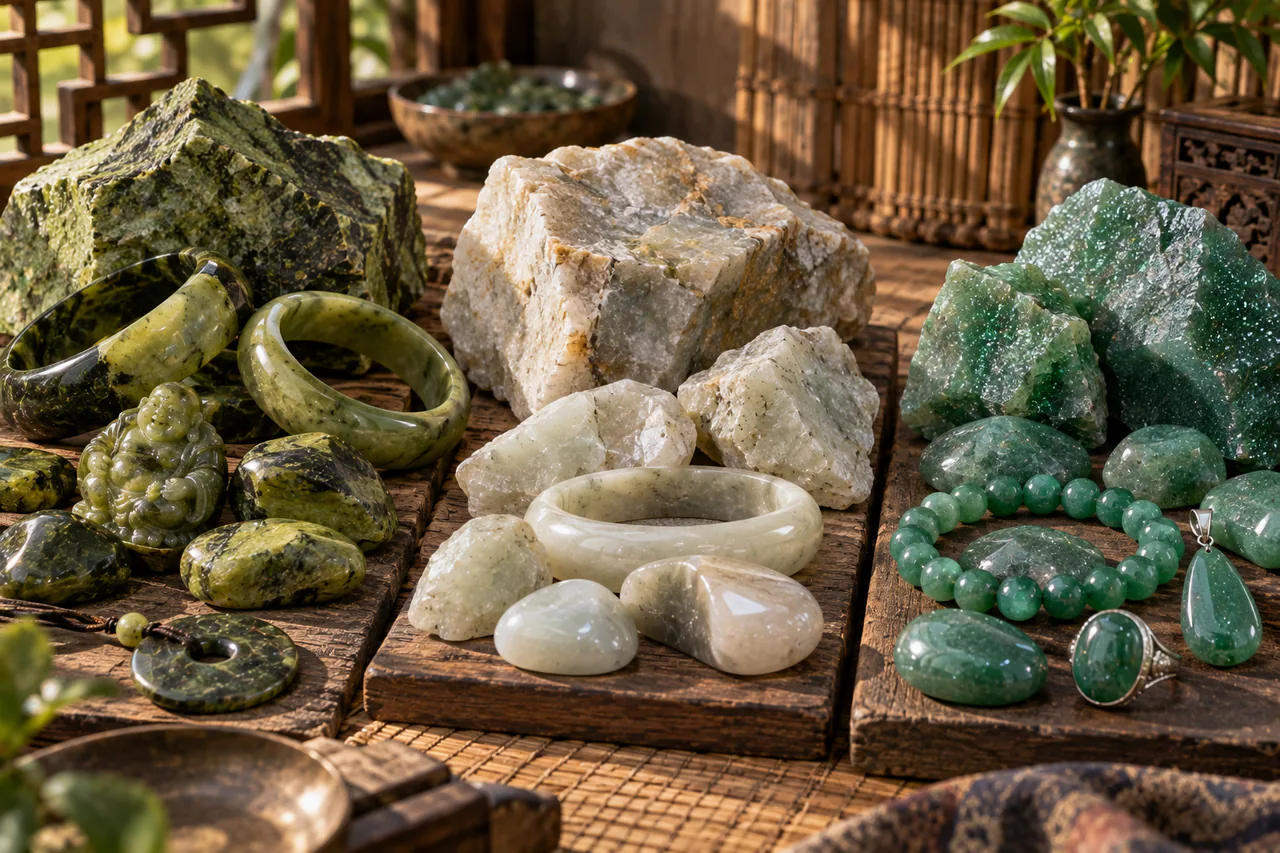
Serpentine, quartzite, aventurine: the stones sold as jade
This page gathers the labels the trade attaches to the word jade, new jade, olive jade, Korean jade, Malaysia jade, Australian jade, African jade, mountain jade: what each one covers, the density that gives it away when I have one, and why none of them comes into my shop.
None of these names is the name of a mineral: behind most of them is serpentine, around 2.6, or dyed quartzite, around 2.65, while jadeite sits at 3.25 to 3.36 and nephrite at 2.90 to 3.03. The compound name is itself the warning sign, because a word added in front of jade is there to prop up a word that cannot stand on its own.
| Material | Density |
|---|---|
| Jadeite | 3.25 to 3.36 |
| Nephrite | 2.90 to 3.03 |
| Serpentine | about 2.6 |
| Quartzite, dyed or not | about 2.65 |
The word jade covers two unrelated minerals, jadeite and nephrite, told apart in 1863 by the French mineralogist Alexis Damour. What is neither already has a mineral name, and that name does not downgrade it: a carved serpentine is still a beautiful carved stone. The distinction is laid out on the jade stone page.
My name is Jade, and I run a jade jewellery workshop: I choose the pieces, have them set, and weigh one example of every piece before it goes on sale. I am neither a gemmologist nor a therapist: here, the mineralogy is stated as fact, and everything else is attributed.
Why the deception works through an added word
A seller who writes serpentine is selling serpentine, and nobody blames them for anything. A seller who writes new jade is selling the word jade with an alibi stuck in front of it: the added word looks like a clarification and works like a permission slip.
The alibi takes three forms. A place: Korea, Australia, Africa, Malaysia. Novelty: new jade, as though there were such a thing as recent jade. A colour or a setting: olive jade, mountain jade. None of them tells you anything about the material, and most do not tell you anything about the origin either. Hence the question to ask as soon as a word comes before or after jade: not which variety of jade, but which mineral (the jade glossary).
The labels, their real names, and the number that gives them away
| Trade label | What it is | Density |
|---|---|---|
| New jade | Serpentine | about 2.6 |
| Olive jade | Serpentine | about 2.6 |
| Korean jade | Serpentine | about 2.6 |
| Malaysia jade | Dyed quartzite | about 2.65 |
| Aventurine sold as jade | Green quartzite | about 2.65 |
| Australian jade | Chrysoprase, a chalcedony | not recorded here |
| African jade | Grossular, sometimes serpentine | not recorded, 2.6 for serpentine |
| Mountain jade | A label I could not trace to a material | not applicable |
The right-hand column is the only one that decides, and it stops where I have no number to cite: two cells show a gap rather than a plausible value. Where it does reach a conclusion, it does so without argument, because the ranges do not overlap between 2.65 and 2.90. The protocol is published on the weighing page.
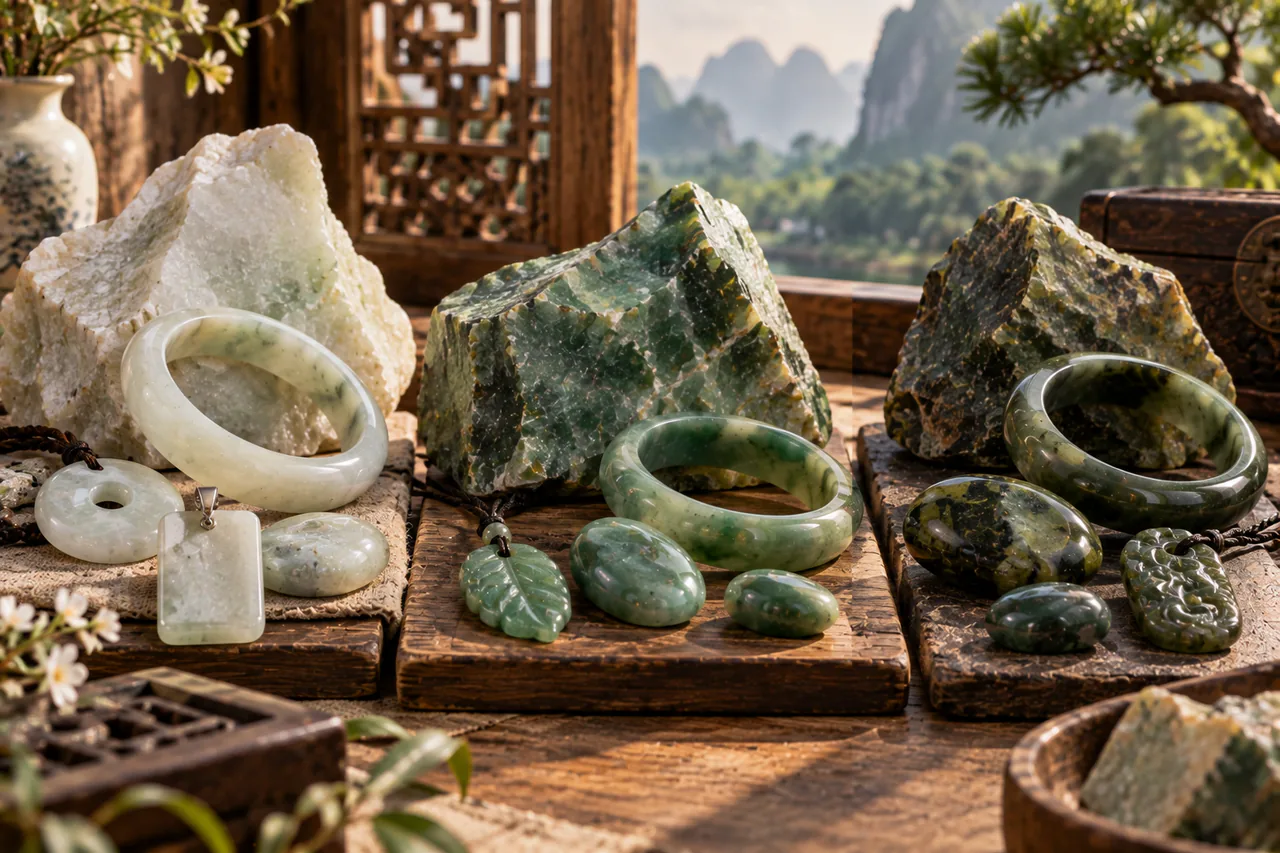
Jade rings available now
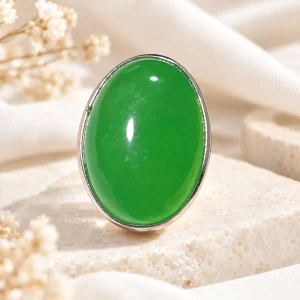
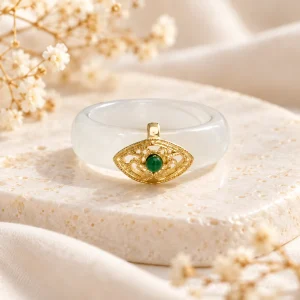
Serpentine, under at least three labels
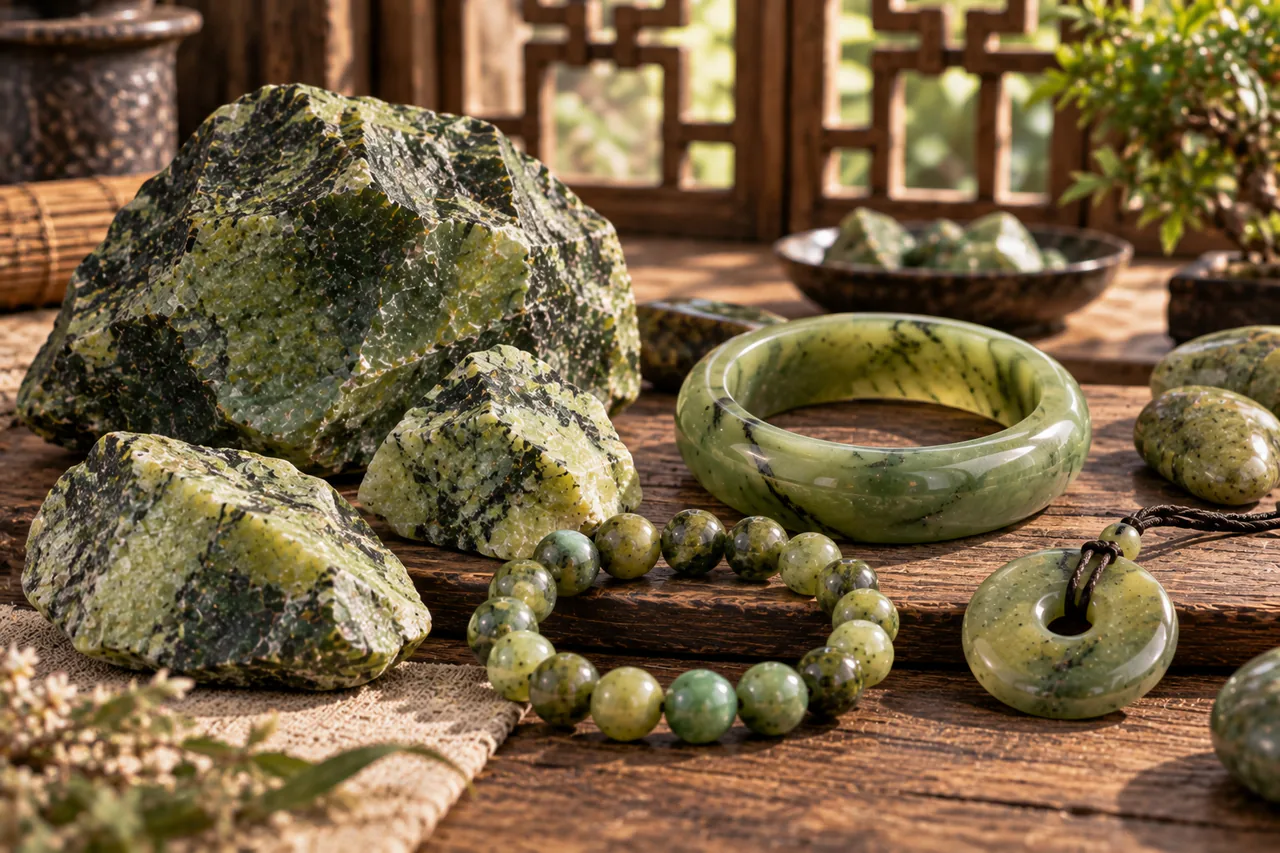
This is the most frequent mix-up among the ones I come across. Serpentine refers to a group of green to yellow-green minerals with a greasy look, often veined with darker streaks. It works and polishes well, and people have been carving it for a long time.
The trade sells it as new jade when it is pale green and translucent, as olive jade when it leans toward olive green, and as Korean jade whether or not Korea has anything to do with it. Three names, one stone, one number: about 2.6, when nephrite starts at 2.90. At the same volume, the difference can be felt in the hand and read in the glass of water. I refuse the word, not the material: a serpentine piece sold as serpentine is an honest piece.
Dyed quartzite, and colours that do not exist
Quartzite takes dye very well: soaked in a coloured bath, it comes out in an even, saturated tone that jade does not produce. It is the material of most fuchsia, bright blue and apple green bracelets sold as Malaysia jade. The added colour is sometimes visible, concentrated in microfractures and around drill holes, where it becomes denser than at the centre of the stone: a clue, not proof (dyed jade, pink, blue and red jade stone).
White has its own page, because white nephrite really exists and bleached quartzite is sold under its name: white jade stone. Aventurine belongs to the same row of the table, a green quartzite whose sparkle comes from mica inclusions, around 2.65. I find it mostly in bead lots, where nothing on the label sets it apart from nephrite.
Australia, Africa, mountains: the last three labels
Australian jade is chrysoprase, a chalcedony, and therefore quartz. Its apple green comes from nickel, and it is a stone sought after in its own right, which never needed to borrow another stone’s name.
African jade covers two materials depending on the lot: grossular, which is a garnet, and serpentine. For the second, my table reaches a conclusion, at 2.6. For the first, it does not, since I have not recorded a figure, and I say so rather than suggest a method that works everywhere.
Mountain jade is the one of the eight I could not trace: no consistent material behind the label, and I would rather write down the gap than fill it. The reason to refuse it holds without that anyway: mountain is not the name of a mineral.
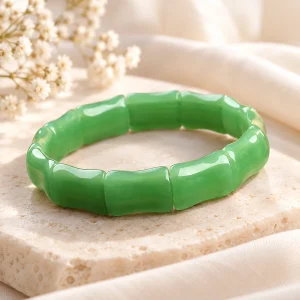
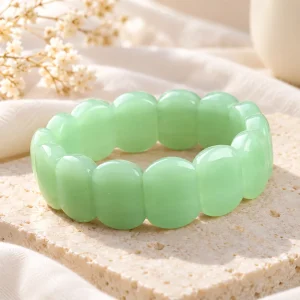
Bracelets whose density I publish
What the scale settles, and where it stops
A stone weighed in air, then hung from a thread in a glass of water, gives its density by a simple ratio. That is what I do on the example I order before putting a piece online, never on the item that ships to you, which comes from the supplier without passing through my hands.
Three limits, and a fourth specific to this page. The measurement applies to the bare stone: a strung strand or a set stone puts the cord and the metal on the scale. It loses its value on very small pieces. It tells you the mineral, never the treatment: only infrared spectroscopy, which I do not have, would distinguish a resin-impregnated stone from another (the A, B and C classification, my information sheet).
The fourth has to do with this particular subject: between serpentine at 2.6 and quartzite at 2.65, my scale hesitates. It tells me the stone is not jade, not which of the two it is, and I stop there. Scratching, sound and the feeling of cold prove even less: how to tell if jade is real.
If you bought it for its symbolism
What follows changes register, and I flag it rather than blend it into the rest. Nothing in it is proven: it is what traditions have attributed to this stone.
A stone does not heal anything, and the full disclaimer is here.
Many of these pieces are bought for what tradition is said to attribute to jade, and the substitution then matters twice over: the traditions you were told about grew up around nephrite in China and jadeite in Mesoamerica, not around the materials on this page. What they report is gathered, stated conditionally, in what tradition attributes to jade stone. What I will never write, whatever the stone: that a piece of jewellery heals, protects or promotes fertility.
What the decree prohibits, and what it does not
French Decree No. 2002-65 of 14 January 2002, which governs the trade in gemstones and pearls, mentions neither jade, jadeite nor nephrite, and contains no positive list of names. It therefore does not, and will not, list the labels on this page.
Its Article 9 is enough, though: it forbids selling a stone under another name, on labels as on any commercial or advertising document, and calling serpentine jade falls squarely under it, with or without an added word. Its Article 2 requires the treatment undergone to be stated, and its Article 5 bans outright two words that many gemstone sites still use, semi-precious and semi-fine (jade and the 2002 decree, is jade a precious stone). The decree itself provides no penalty: enforcement goes through the French Consumer Code, Article L.441-1 for deception about the nature, species or origin, punished under Article L.454-1 by three years’ imprisonment and a fine of 300,000 euros.
Why none of these labels comes into my shop
None of my product pages and none of my categories carries any of these names, neither in its title nor in its URL. The second half of that sentence needs saying: I treat a page URL as one commercial document among others, so I do not put in it a word I refuse on a label.
For every piece, I publish the mineral, the mass in air, the mass in water, the resulting density, the date of the measurement, and the fact that the treatment has not been determined, because my supplier does not know it and my scale does not tell me (what I publish on each product page). One last false marker lies next to the eight labels: the A, AA, AAA scale has no standard behind it and borrows its letters from the real classification, the one for treatments (judging jade quality, buying jade jewellery).
The questions I get asked
Is new jade real jade?
No. It is a trade name given to serpentine, around 2.6, when nephrite starts at 2.90 and jadeite at 3.25. The stone has nothing new about it, and nothing of jade.
What is Malaysia jade?
Dyed quartzite, around 2.65: the usual material of bracelets in bright, perfectly even colours. Malaysia has no more to do with it than Korea has with the neighboring label.
Does African jade exist?
The label exists, but the stone is not jade: depending on the lot, it is grossular, which is a garnet, or serpentine. For the second, weighing reaches a conclusion; for the first, I have no range to cite, and I refrain.
Is serpentine sold as jade a scam?
The stone is not the problem, the name is. Selling serpentine under the name jade falls under Article 9 of French Decree No. 2002-65, and can amount to deception under the French Consumer Code.
How can I check at home that a bracelet is not serpentine?
With hydrostatic weighing on the bare stone, in air and then suspended in water. Around 2.6 or 2.65, it is neither jadeite nor nephrite. On a strung strand, the measurement is skewed and proves nothing.
Are aventurine and jade the same thing?
No. Aventurine is a green quartzite, around 2.65, whose sparkle comes from mica inclusions. It has had its own name for a long time, and that name is not jade.
Where I checked
What comes from a named source. The legal texts are named in the body: French Decree No. 2002-65 of 14 January 2002, Articles 2, 5 and 9, and the French Consumer Code, Articles L.441-1 and L.454-1. The separation of jadeite and nephrite comes from Alexis Damour’s note to the French Academy of Sciences in 1863; I do not give page numbers, as I have not read it. The density ranges are those of the mineralogical literature: I repeat them, I did not measure them, and their limits vary by a few hundredths from one database to another. I therefore attribute them to no particular organization, because I did not take them from any one of them, and the two empty cells in the table are empty for the same reason.
What is a market observation, with a date. On 8 September 2026, I looked at the nine French competitors on the first page of results for jade queries: none states the mineral of its pieces, one shows two contradictory origins on the same product page, and another uses the A, AA, AAA scale. The same day, my supplier confirmed that it cannot say whether its stock has been treated.
What is my own reasoning. The idea that a word added in front of jade serves as an alibi is an interpretation, not an established fact. Placing chrysoprase in the quartz family is mineralogy, but the use I make of it to rank it in my lower range is mine. The refusal to put any of these labels in a page URL comes from my reading of Article 9, which refers to any commercial document, not from case law. On mountain jade as on grossular, what I write is that I do not know. If you find a mistake here, write to me: I will correct it and note that I did.
In one sentence
The stones sold as jade are not bad jades; the ones I could identify are other minerals that already have a name, and weighing the bare stone is enough to separate the 2.6 from the 2.90. The method is on the weighing page, and the pieces, named by their mineral, are in the shop.