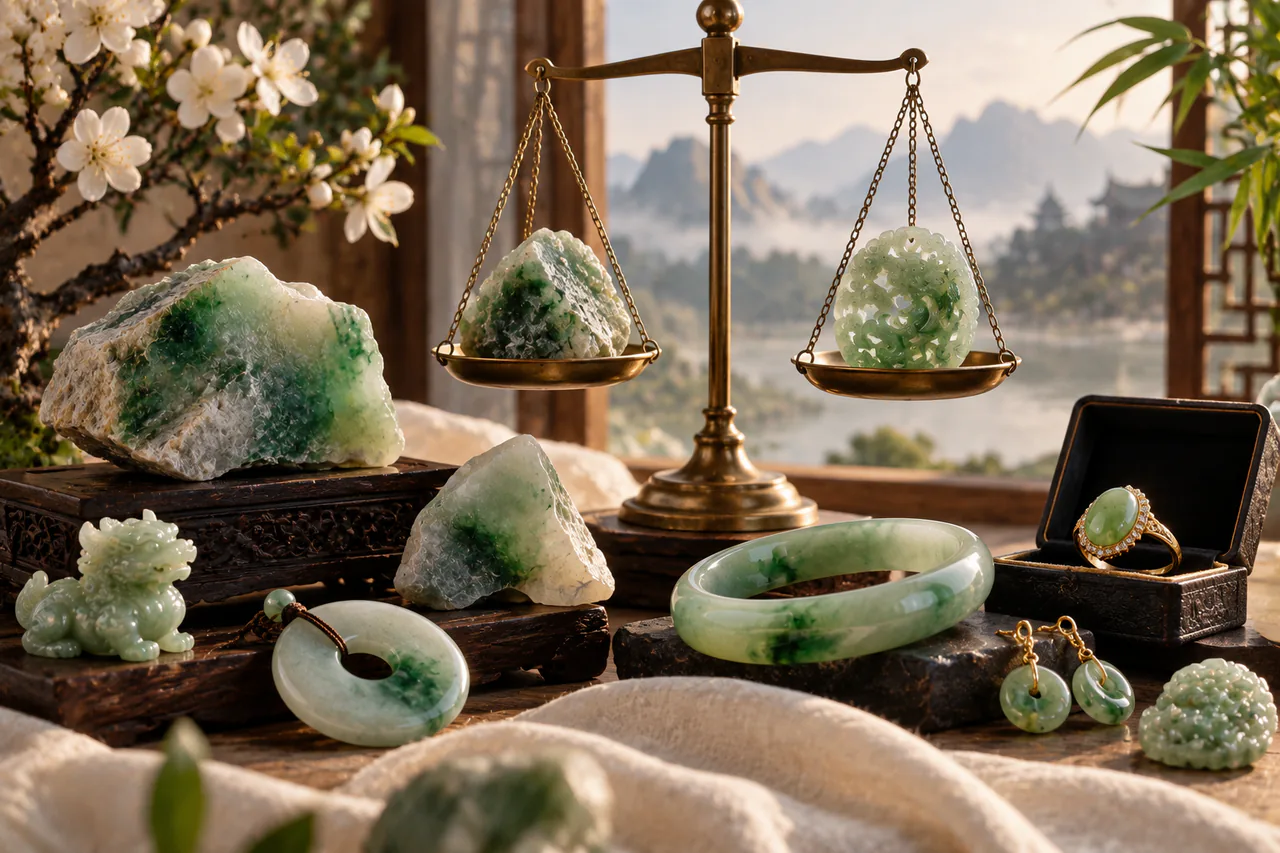
Is jade a precious stone?
This page answers the question “is jade a precious stone”: what the word actually covers, who set the list, what the 2002 French decree forbids writing on a label, and how to name a jade stone without getting it wrong.
No: trade usage reserves the word precious for four stones, diamond, ruby, sapphire and emerald, and jade is not one of them. Yet this usage is not a legal category, and the word many people use instead, “semi-precious”, is the one French Decree No. 2002-65 prohibits.
The useful answer comes next: this two-camp ranking says nothing about a stone’s value, and the first word that informs a buyer is the name of the mineral, jadeite or nephrite, followed by the figure that backs it up.
My name is Jade, and I run a jade jewellery workshop: I choose the pieces, have them set, and weigh one example of every piece before it goes on sale. I am neither a gemmologist, nor a lawyer, nor a therapist: I quote the texts rather than summarizing them from memory.
What precious stone means, and who decided
It is a trade habit, and it is far older than the 2002 decree. Its other half is quoted less often: everything outside the four is called a fine stone in French usage, from garnet to opal and from jade to tourmaline. Two categories: a list of four names on one side, all other gems on the other.
One question remains that people rarely ask: who fixed this list. I looked for the French text that would establish it, and I did not find it. The only text in force on the gem trade, Decree No. 2002-65, contains no positive list of stone names and creates no category of precious stones. It does not even mention jade, jadeite or nephrite.
A seller who tells you that jade is, or is not, a precious stone is therefore quoting a trade custom. It ranks words, not hardness, not rarity, not prices.
What the 2002 decree forbids writing on a label
The text is called Decree No. 2002-65 of 14 January 2002, on the trade in gemstones and pearls, in force since 1 February 2002. It does not say what a precious stone is: it says what you are not allowed to write.
Its Article 5 prohibits “semi-precious” and “semi-fine” across its entire scope, without exception. It is its only outright ban on vocabulary: everywhere else the decree regulates a word in a context, here it removes two words from the language of trade. And it is the word that four of the nine French sites opened for this question use in their own text.
Its Article 4 targets something else, and that is what sheds light on the matter. Eight words are prohibited there for describing reconstituted, composite, synthetic, artificial and imitation products: raised, cultivated, cultured, real, precious, fine, genuine, natural. So the decree does not define the word precious, it prevents it from dressing up an imitation.
One last thing, which I did not read on any of the pages opened that day: the decree provides for no penalty. Enforcement goes through the French Consumer Code, Article L.441-1, deception as to the nature, kind, origin or substantial qualities, punished under Article L.454-1 by three years’ imprisonment and a 300,000 euro fine. The rest of a seller’s obligations can be read in jade and the 2002 decree, which goes through the text article by article.
Jade rings of the moment
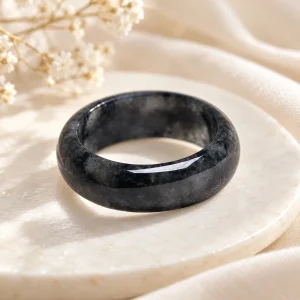
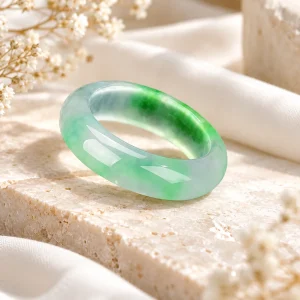
How to name jade correctly
The most useful word is neither precious nor fine: it is the name of the mineral. Jade covers two unrelated species, jadeite, a pyroxene, and nephrite, an amphibole, separated in 1863 by the French mineralogist Alexis Damour. The full file is in jade stone, and the detail in jadeite or nephrite.
- What you can say. Jadeite, nephrite, fine stone, gemstone. And “genuine”, whose place Article 4 confirms: prohibited for describing an imitation, on a real stone it means it is neither serpentine nor dyed quartzite.
- What you cannot say. The two words of Article 5. The A, AA, AAA scale, which has no normative existence and borrows its alphabet from the real classification, the one for treatments: jade A, B, C. And the compound names that cover another stone, new jade, Malaysia jade, Korean jade, olive jade: stones sold as jade.
Professional organizations have their own nomenclature rules, without force of law and not cited by the decree: how jade is named. The words you need to read a product page are gathered in the jade glossary.
The word does not make the price
If the two-camp ranking settled anything, two jades of the same green would be worth the same. The gap is decided elsewhere, and first of all by the mineral: a translucent jadeite and an opaque nephrite of a similar shade are not on the same market, and no label word brings them closer. The six criteria that do the rest are detailed in judging the quality of jade. Price ranges are in the price of jade stone: I write none here, because I have not surveyed them.
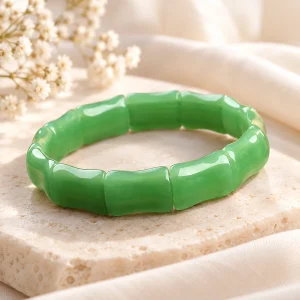
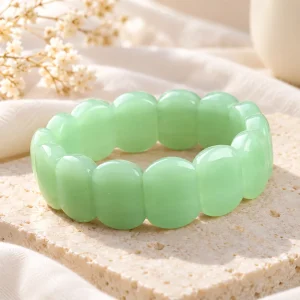
Bracelets whose mineral and density I publish
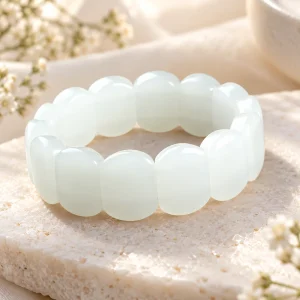
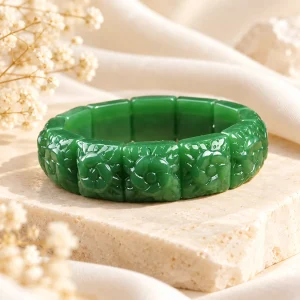
Where the habit of sorting gems into two camps comes from
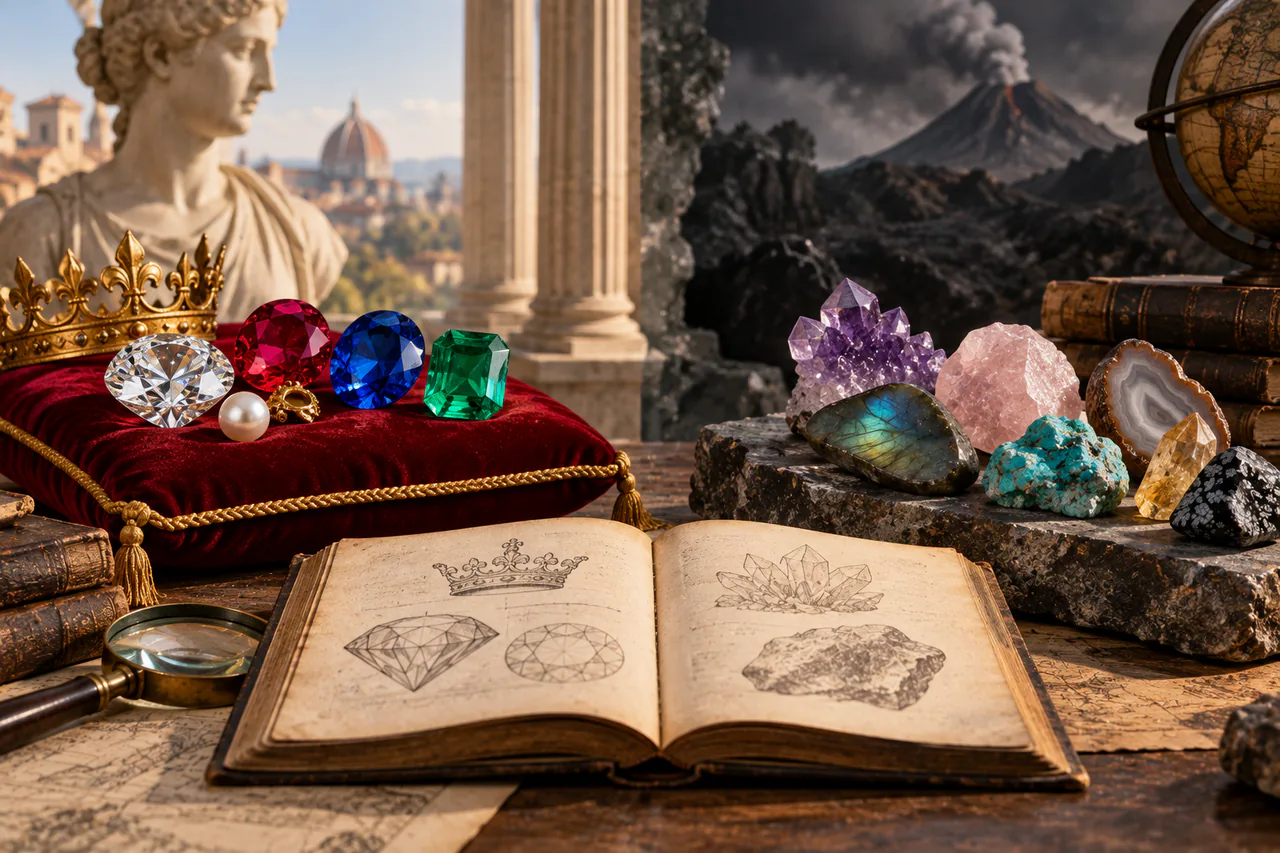
The four stones at the top share a model: transparent, faceted, very hard, rare, of stable colour. Two of the ten reference minerals of the Mohs scale in fact come from this list: corundum, of which ruby and sapphire are two varieties, at rank 9, and diamond at rank 10.
Jade fits none of the boxes in this model. It is not a single crystal but an aggregate, fibrous in nephrite and granular in jadeite. It ranges from translucent to opaque, it is carved rather than faceted, and its hardness, 6 to 6.5 for nephrite and 6.5 to 7 for jadeite, places it below the four. Its toughness, resistance to breaking rather than to scratching, on the other hand exceeds theirs: why jade almost never breaks.
Other cultures ranked things differently: China has worked nephrite since the Neolithic for ritual (jade jewellery from China), and the Maya placed Motagua jadeite above gold. It was this tradition the Spanish encountered in the 16th century, and the word jade itself comes from that encounter (the meaning of jade stone).
The two camps are therefore a European commercial taste turned into vocabulary. I did not find the text that would have established them; I did find the one that prohibits their “semi” version.
What I check before writing the word jade
Since vocabulary guarantees nothing, a measurement is needed. Mine is hydrostatic weighing: the bare stone, weighed in air then hanging in a glass of water, gives its density by a simple ratio. Jadeite 3.25 to 3.36, nephrite 2.90 to 3.03, serpentine about 2.6, quartzite, dyed or not, about 2.65. The protocol and its limits are on the weighing page.
I weigh one example per piece, the one I order before it goes on sale, and not every order that ships. And weighing tells the mineral, not the treatment: a jadeite impregnated with resin weighs about the same as any other, only infrared spectroscopy would settle it, and my supplier does not know either (jade A, B, C, the treatment information sheet). So I never write “untreated” or “natural”: one more refusal of vocabulary, of the same kind as the first.
What this changes when you read a listing
- Look for the name of the mineral. Jadeite or nephrite. A listing that only says jade does not tell you which of the two species you are buying.
- Spot the prohibited word. If it appears on the product page, the page was written by copying the web rather than by reading the decree: this is not an offense I am finding, it is a source I am guessing.
- Be wary of the alphabet. A quality advertised as AA or AAA is backed by nothing, and it muddles the only classification that exists.
- Ask for a figure. A density, a date of measurement, a weight: what I publish on each product page.
The other questions to ask are in buying jade jewellery, and how to check a stone you already own in how to recognise genuine jade stone.
What traditions attribute to the stone
What follows shifts register, and I say so rather than blending it into the rest. None of it is proven: it is what traditions have attributed to this stone.
The word precious comes back in another literature, that of crystal healing, where it no longer means a commercial rank but a supposed power. Contemporary authors associate jade with balance and luck, and classical Chinese thought is said to have seen moral qualities in it rather than a power: reported attributions, never established, gathered in what tradition attributes to jade stone. What I will never write: that a piece of jewellery heals or protects.
The questions I get asked
Is jade a precious stone?
No, in the sense of trade usage, which reserves the word for diamond, ruby, sapphire and emerald. But this usage is not a legal category: French Decree No. 2002-65 draws up no list of precious stones and does not even name jade.
Can jade be called a semi-precious stone?
Not under French rules, and it is the only point that is truly settled. Article 5 of Decree No. 2002-65 prohibits “semi-precious” and “semi-fine” across its whole scope, without exception. The term the French trade uses for everything outside the four is fine stone.
What is the difference between a precious stone and a fine stone?
A list of four names on one side, all other gems on the other. The boundary is a trade convention: it measures neither rarity, nor hardness, nor price.
Does the 2002 decree mention jade?
No. It mentions neither jade, jadeite nor nephrite, and contains no positive list of gem names. What it imposes are naming and information rules that apply to jade as to everything else: the detail is here.
Does jade have value, then?
The word that ranks it says nothing about that. A fine jadeite and an ordinary nephrite of the same green belong to different markets, and it is the material, not the label, that separates them.
How can I tell if my stone is really jade?
With hydrostatic weighing, the only reliable method I have at home: around 2.6 it is serpentine, around 2.65 quartzite, above 2.90 nephrite or jadeite. It says nothing about treatment. The instructions are on the weighing page.
Where I checked
What comes from a named source. Articles 4 and 5 of French Decree No. 2002-65 of 14 January 2002, and the absence of any penalty in that text; the penalties are those of the French Consumer Code, Article L.441-1 for deception and Article L.454-1 for the sentence. The separation of jadeite and nephrite comes from Alexis Damour’s note in the Comptes rendus hebdomadaires de l’Académie des sciences, volume 56, 1863: I do not give the page numbers, because I have not read it. Ranks 9 and 10 are those of corundum and diamond on the Mohs scale, which uses them as reference minerals. The density and hardness ranges are those of the mineralogical literature, whose limits vary by a few hundredths from one database to another: I repeat them without attributing them to an organization, since I did not take them from a single one.
What is a market observation, with a date. On 8 September 2026, I opened the nine French sites on the first page of results for this question. Four used the word prohibited by Article 5 in their own text, one of them in a section heading, and none stated the mineral of its pieces. I do not name them and I do not characterize the legal position of any of them: I report a practise, I am not a judge. The same day, my supplier confirmed that it cannot say whether its stock is treated.
What is my own reasoning. Treating the list of four as a trade custom rather than a legal category comes from the fact that I did not find the text that would establish it, which is not proof that it does not exist. The link between the model of the faceted stone and the exclusion of jade is a reading, not an established fact. If you find a mistake here, write to me: I will correct it and note that I did.
In one sentence
Jade is not a precious stone in the sense the trade uses that word, it is above all not “semi-precious”, a word the French decree prohibits for all gems, and the only thing that tells you about a piece is still the name of its mineral together with the figure that backs it up: the method, and the pieces.