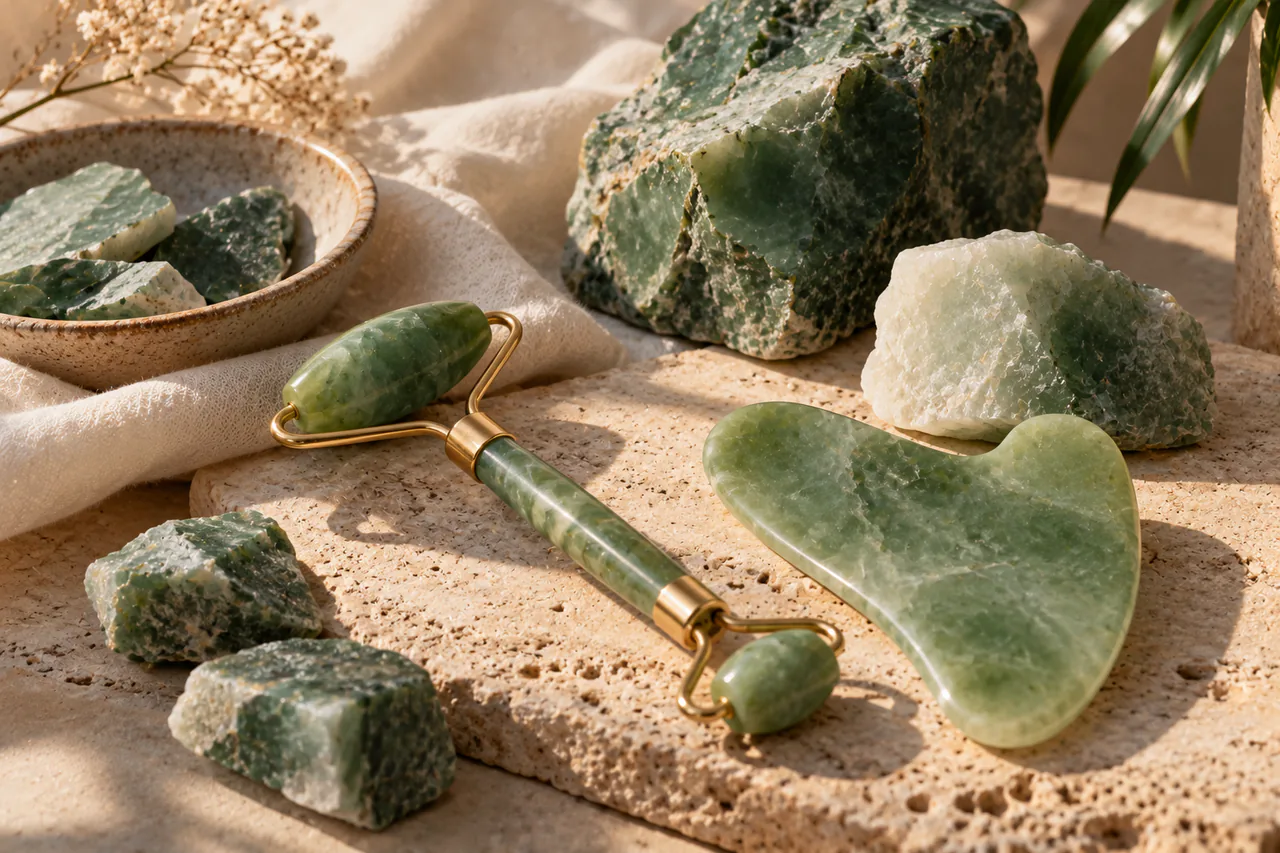
Jade roller and gua sha: what they are made of
This page answers the question “is my jade roller real” through the material: what these objects most often contain, what the scale says about them, why the scratch test cannot tell you, and what I answer when people ask me how to use them.
A roller or a gua sha sold under the name jade very often contains something else: serpentine or aventurine, which are neither jadeite nor nephrite. A single measurement separates them, the density of the bare stone, and none of the seven French pages I opened on 8 September 2026 publishes it.
| Material | Density |
|---|---|
| Jadeite | 3.25 to 3.36 |
| Nephrite | 2.90 to 3.03 |
| Serpentine | about 2.6 |
| Quartzite, dyed or not, including aventurine | about 2.65 |
The word jade does not designate one mineral species but two, jadeite and nephrite, with no kinship between them: the distinction is laid out on the jade stone page.
My name is Jade and I run a jade jewellery workshop: I choose the pieces, have them set, and weigh one example of each reference before it goes on sale. I am neither a gemmologist nor a therapist: here, mineralogy is stated as fact, and everything else is attributed.
What a roller and a gua sha are
They are two very different objects to weigh, and that is what interests me here.
- The roller is an assembled piece: one or two stone heads held by an axle and a frame, most often metal.
- The gua sha is a bare plate, polished on both faces and all around its edge.
Neither word tells you the material: roller describes a shape, gua sha names a gesture from traditional Chinese medicine, and a gesture has no density. It is adding the word “jade” that commits the seller.
Serpentine and aventurine, the two most common materials
The two stones I expect to find behind these objects have a name, and that name is not jade. Serpentine sits around 2.6: green, soft, inexpensive, sold under compound names that borrow the word jade, “new jade”, “olive jade”, “Korean jade”. Aventurine is a green quartzite, and quartzites sit around 2.65. These labels are reviewed in stones sold as jade, and added colour in dyed jade.
Neither is a bad stone. They are simply not the one written on the label.
From 2.65 to 2.90, the gap looks slim on a page. On a scale, it is beyond argument: the ranges never overlap.
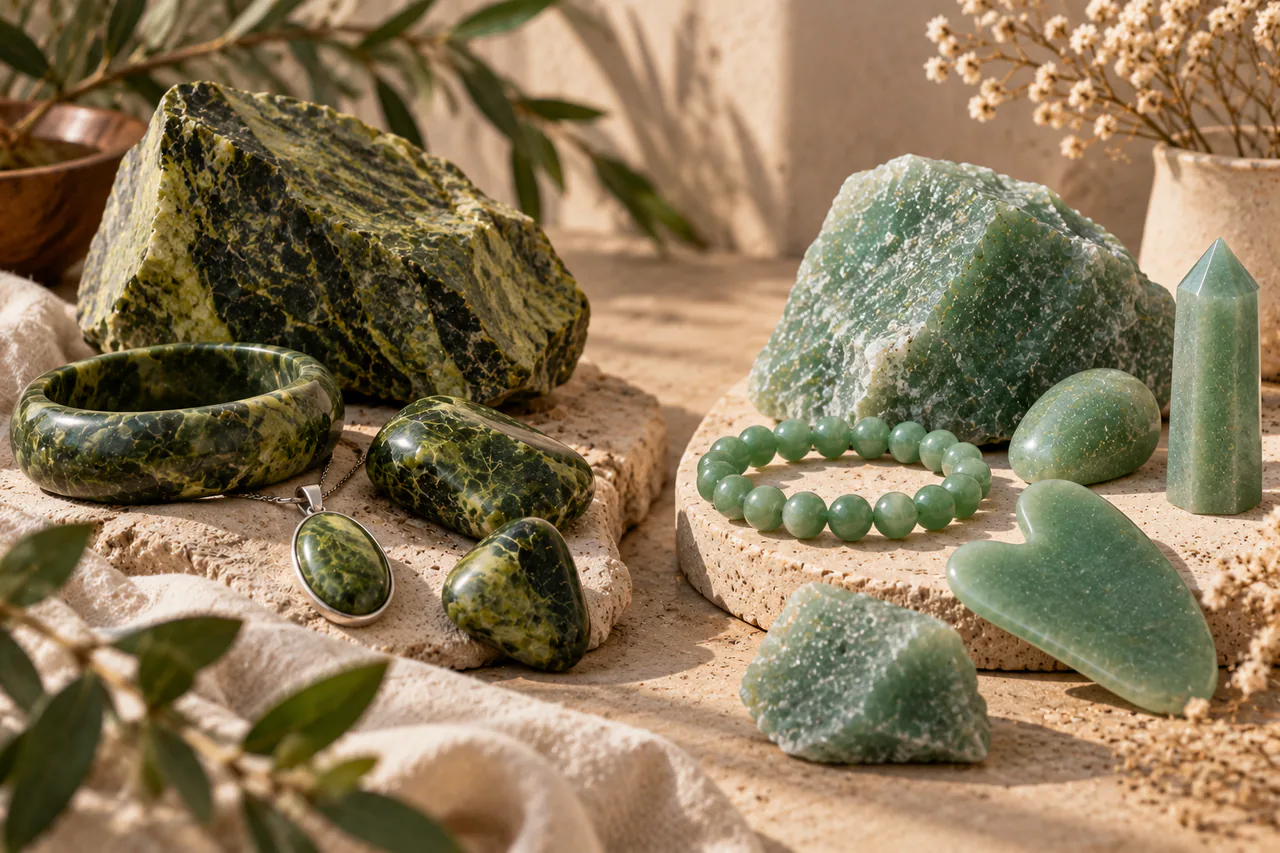
Jade objects available now
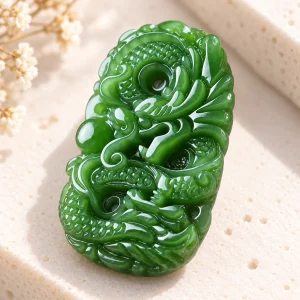
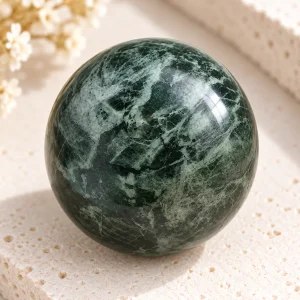
What the scale settles, and what scratching does not
Hydrostatic weighing takes a scale, a thread and a glass of water: the stone is weighed in air, then suspended underwater, and the ratio gives the density, to compare with the table at the top of the page. The protocol is on the weighing page.
It applies to the bare stone, and that is a real constraint with these objects. A gua sha can be weighed as it is. A roller cannot: the axle and the frame go onto the scale too. A measurement announced for an assembled roller means nothing, and if you see one, ask what it was taken on.
The scratch test, which all seven pages suggest
The advice that recurs on those seven pages is to scratch the stone with a blade: if it resists, it would be jade. The reasoning turns against itself. Nephrite sits around 6 to 6.5 on the Mohs scale, jadeite at 6.5 to 7, and quartz rates 7: a quartzite resists your blade better than a nephrite does. The test rewards the very stone it was supposed to rule out, and it marks an object you just bought. What each home test proves is detailed in how to tell if jade is real, and the confusion between hardness and toughness in why jade almost never breaks.
A shelf name, not a mineral name
“Jade roller” groups objects by their shape: the word jade has slipped from the mineral to the colour, then to the product category. Buyers, for their part, read it as the name of a material, and they are right to read it that way.
French Decree No. 2002-65 of 14 January 2002 mentions neither jade, jadeite nor nephrite, and contains no positive list of gem names. It does, however, prohibit in its article 9 selling a stone under another name, on labels as on any commercial or advertising document: a product page is one. The details are in jade and the 2002 decree.
On one of the pages opened that day, the roller was advertised as “AA quality”. This scale has no normative existence and borrows its alphabet from the only classification that exists, the one for treatments: jade A, B, C. What gives a piece its value can be said without letters: judging the quality of a jade.
How they are used, and what I will not say
What follows changes register, and I flag it rather than blending it into the rest. Nothing in it is proven: it is what traditions have attributed to this stone.
The gesture can be described in one line: you glide the object over the skin, from the centre of the face outward, without pressing. That is already outside my trade.
What I will not say: what this gesture changes, or does not change. I sell jade jewellery, I am neither a dermatologist nor a therapist, and I have measured nothing on that front. So you will find here no photo of the gesture and no before and after comparison. For wearing a piece of jewellery every day, which is my real question, the answer is in how to use jade stone.
What damages these objects, and it is not the stone
An object you run over your skin picks up oil, serum and dust. Lukewarm water, mild soap, a soft cloth, then immediate drying, and nothing else: the method is in how to clean jade.
Never ultrasound, never steam. As long as a stone’s treatment has not been determined, you have to assume resin, which withstands neither cavitation nor thermal shock. For the same reason, I do not recommend putting it in the fridge: cold, then warm skin, makes a cycle I would rather avoid on a glued frame whose treatment I do not know. The word treatment is explained on the treatment information sheet.
On a roller, the stone is not the fragile part anyway: jade is remarkably tough, the axle and frame are not. A gua sha is a thin plate, and the toughness that absorbs a flat impact does not save a corner dropped on a tiled floor.
The two I sell, and what their product pages publish
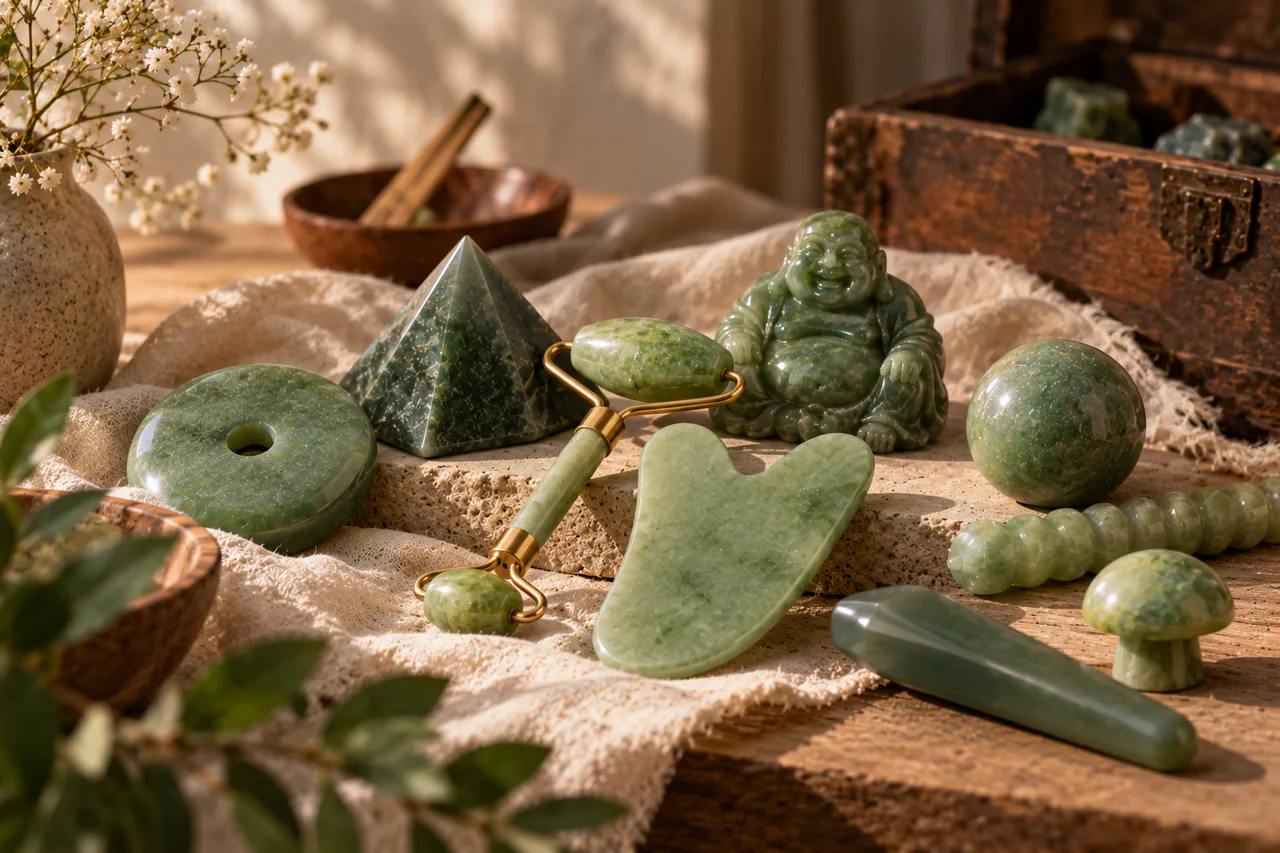
I have put two in the catalogue, a green nephrite roller and a polished nephrite gua sha, filed under jade objects. The mineral is in their title, their first line and their URL, before any sales argument.
The rule I set myself for this family fits in one sentence: if weighing the example, stone out of its frame, does not confirm nephrite or jadeite, the word jade comes out of the title, the H1 and the URL, and the piece bears the name of its mineral. That is article 9 applied to my own shop: what I publish on each product page.
What the weighing does not tell you is written in the same block: it gives the mineral, not the treatment. A resin-impregnated stone weighs about the same as another, only infrared spectroscopy would settle it, and I do not have that. So you will never read “untreated” on my pages.
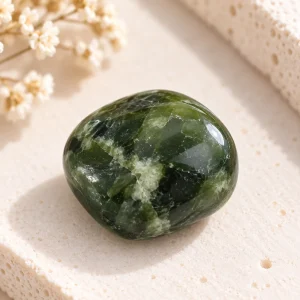
Jade objects whose mineral I publish
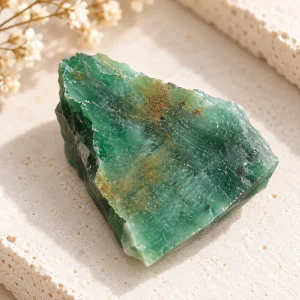
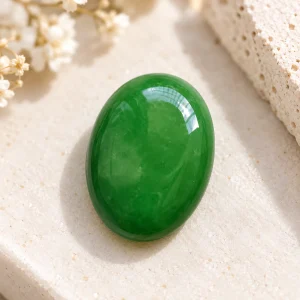
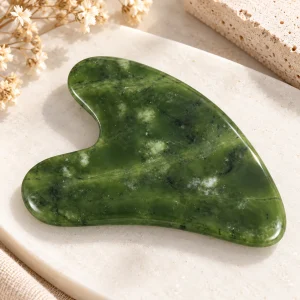
The questions I get asked
How do I know if my roller is real jade?
By weighing it, in air and then suspended in a glass of water. Around 2.6 or 2.65, it is serpentine or a quartzite; from 2.90 upward, it is nephrite. On a roller, the measurement only counts if it is taken on the stone alone.
How do you use a jade roller on your face?
You glide it over the skin, from the centre outward, without pressing. I stop there: I run a jewellery workshop, not a practise, and I have measured nothing of the effects attributed to this gesture. What I can tell you is what stone the object is made of.
My roller stays cold for a long time, does that prove it is jade?
No. A dense stone stays cold longer than plastic, and that separates stone from plastic, nothing more. A quartzite and a serpentine are cold too.
Is a gua sha made of the same stone as a roller?
Not necessarily, even when they are sold together and are the same colour: they are two objects made separately. A gua sha is easier to check, since it is a bare plate that nothing prevents you from weighing as it is.
What does a roller advertised as “AA quality” mean?
Nothing normative: no text defines it. An AA label tells you neither the mineral, nor the treatment, nor the quality of the cutting.
Can you clean a jade roller with ultrasound?
No, and even less on these objects than elsewhere: the frame adds glued joints that like neither soaking nor vibration. Lukewarm water, mild soap, immediate drying.
Where I checked
What comes from a named source. The density and hardness ranges are those of the mineralogical literature: I repeat them, I did not measure them, and their bounds vary by a few hundredths from one database to another. I do not attribute them to any particular body, because I did not take them from a single one. The legal text is named in the body: French Decree No. 2002-65 of 14 January 2002, article 9.
What is a market observation, dated. On 8 September 2026, I opened seven French pages devoted to jade rollers and gua sha. All of them already take this page’s angle, namely that these objects are often serpentine: I am not the first to write it, and I would rather say so. All of them suggest the scratch test, and none publishes a density. The same day, my supplier confirmed to me that they cannot say whether their goods are treated.
What is my own reasoning. Turning the scratch test around through the hardness of quartz, the weighing constraint specific to an assembled object, the reservation about the fridge, the rule that takes the word jade out of a title when weighing does not confirm it, and the refusal to comment on the effects of a gesture I have not measured: these are decisions, not established facts. As for the word gua sha, I am not a sinologist and I only say what it does not say, the material. If you find a mistake here, write to me: I will correct it and note that I did.
In one sentence
A roller and a gua sha sold as jade raise a question of material before any question of use, and that question has a numerical answer almost nobody publishes. The method is on the weighing page, and the pieces are in the shop.