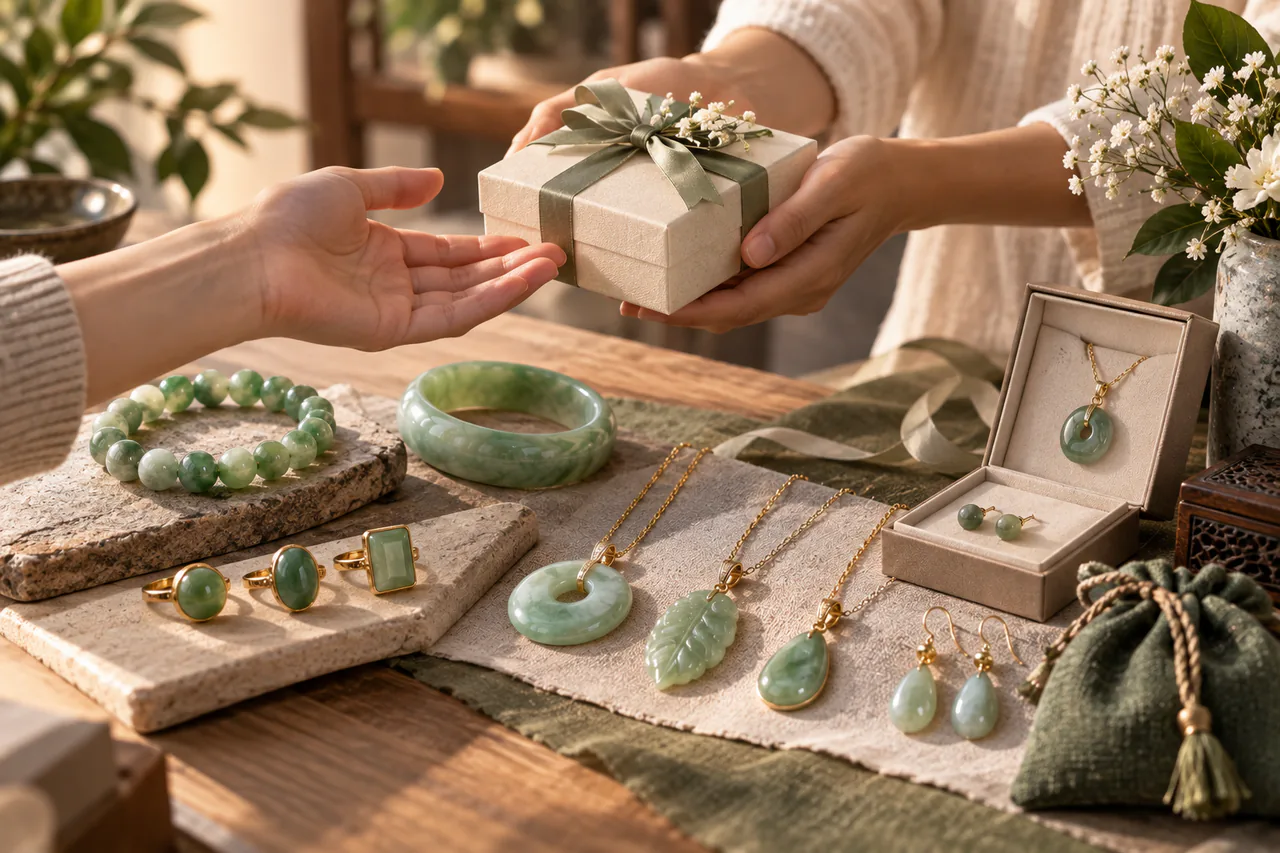
Giving jade jewellery: which piece, which size
Choosing a jade jewellery gift means choosing for someone whose ring size, wrist size and opinion you don’t have. This page reviews six formats: what you need to know about the person for each one, what can be fixed after the gift, and what I look at in the stone before I look at the setting.
To give jade without knowing the person’s measurements, a pendant on a cord and earrings have no size at all; a bangle, on the other hand, is sized by its inner diameter, it has to pass over the thumb joint, and it is the only format in my catalogue that cannot be adjusted afterward.
| Format | What you need to know about the person | If you get it wrong |
|---|---|---|
| Pendant on a cord | nothing | not applicable |
| Earrings | whether the ears are pierced | not applicable |
| Beaded necklace | a length | can be restrung |
| Beaded bracelet | a wrist size | can be restrung |
| Ring | a ring size | depends on the setting |
| Bangle | an inner diameter | nothing can be done |
The whole page comes down to the last column, and nothing in a shop photo tells its rows apart.
My name is Jade, I run a jade jewellery workshop: I choose the pieces, have them set, and weigh one sample of each reference before it goes on sale. I am neither a gemmologist nor a therapist: here, mineralogy is stated as fact, and the rest is attributed.
Formats ranked by the risk of getting it wrong
Two questions decide a gift chosen without the person: does the format have a size, and if it is wrong, can it be undone. The answers do not overlap, and it is the second one that counts. A length mistake on a strand of beads costs a trip to the jeweller; the same mistake on a bangle costs the piece.
Size conversions and how to take each measurement live in the size guide. One case falls outside this ranking, a piece given to a baby, where the question is not size but whether it should be worn at all: jade necklace for a baby.
The pendant on a cord, the format least likely to go wrong
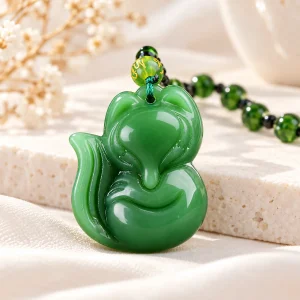
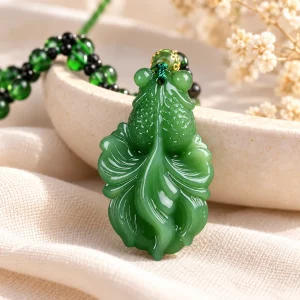
A pendant on a cord has no size. The stone hangs where it hangs, the cord is knotted, shortened or replaced, and nothing depends on a measurement taken on someone. It is the format I recommend when the person giving the gift knows nothing.
What you choose instead is the motif, and there is room to go wrong in another way: the shapes of Chinese jade are not decorative, and the pierced disc, the leaf, the padlock and the laughing Buddha are not given on the same occasions (jade motifs, the meaning of the Buddha pendant).
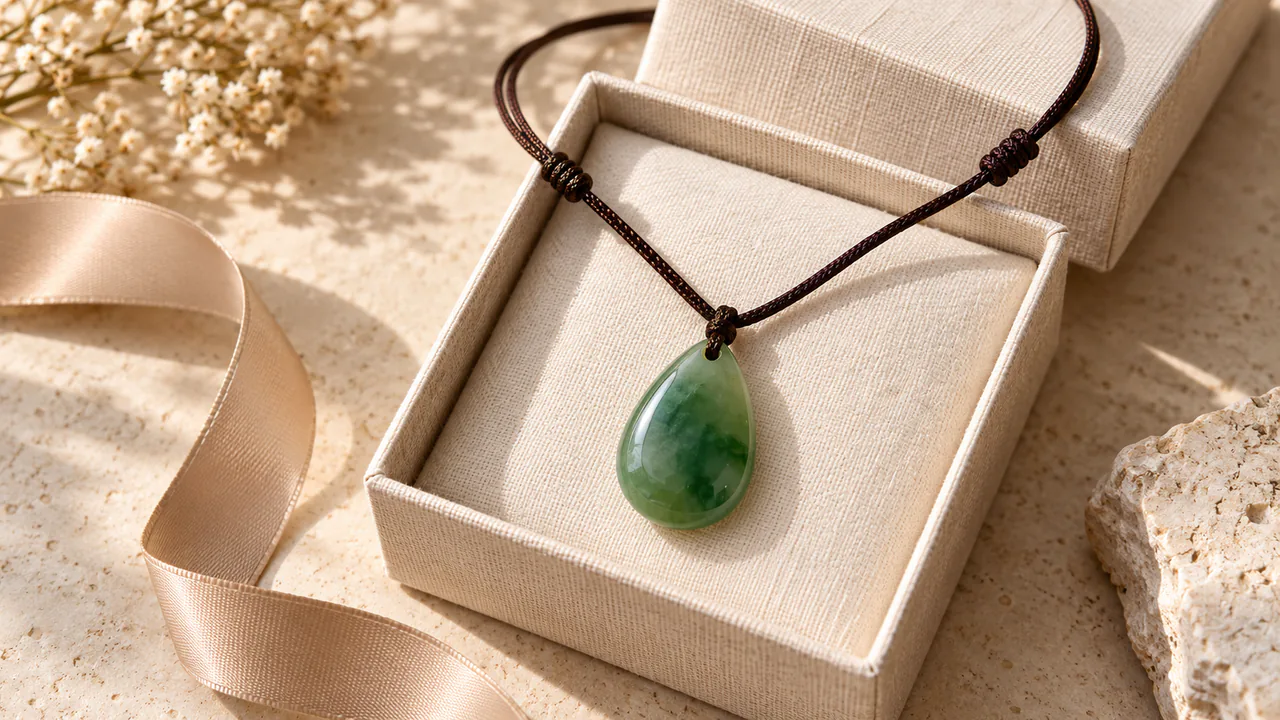
One thing to know before giving it: the cord has a lifespan, the stone does not (thread and cord for jade).
Pendants you can wear without a measurement
Earrings, and the limit of my scale
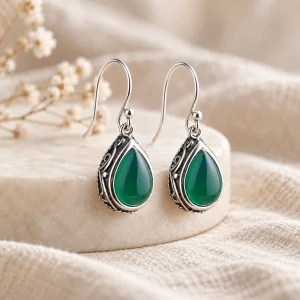
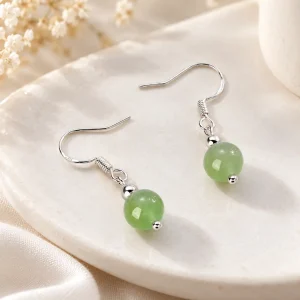
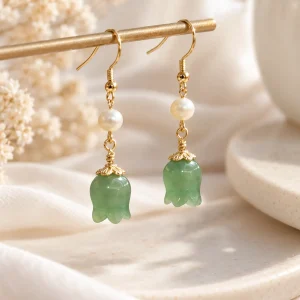
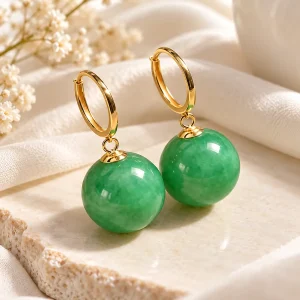
Earrings have no size either. You need to know one thing, which a family photo can confirm: whether the ears are pierced. Then comes the metal, for people who react to certain alloys (choosing the metal).
This format, however, requires me to write down a limit that bothers me. My check is hydrostatic weighing: a stone weighed in air, then suspended in a glass of water, gives its density. On very small stones, the uncertainty of the scale becomes the same order of magnitude as the gap I am looking for, between nephrite at 2.90 to 3.03 and quartzite around 2.65. The measurement loses its value, and I do not publish a number I do not believe. The set pairs are among the earrings.
Beaded necklaces and bracelets, a length that can be adjusted
A threaded strand has a size, but it is the one that is easiest to undo: a jeweller takes it apart, removes or adds beads, and reties the knots. That is what puts these two formats in the middle of the table rather than at the bottom.
Two consequences before giving one. The thread gives way first on this kind of piece, and you can see it coming before it breaks, when it turns grey between two beads or some play appears at a knot. And a threaded strand cannot be weighed: the thread and knots enter the measurement and skew it, so I weigh the bare stone of the sample I order, never the finished strand (the weighing page). The strands are among the necklaces and the bracelets.
The bangle, the only format in my catalogue that cannot be adjusted
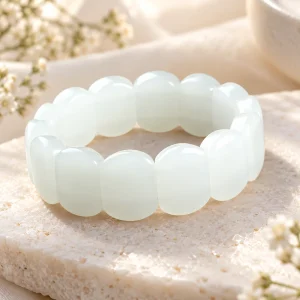
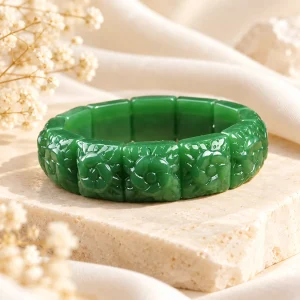
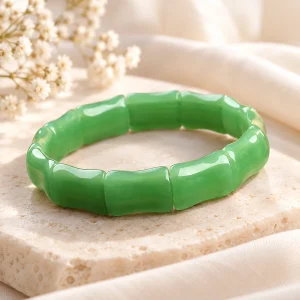
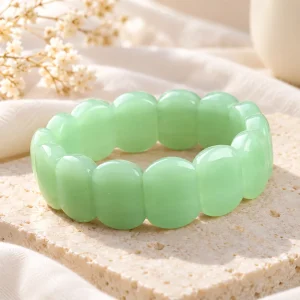
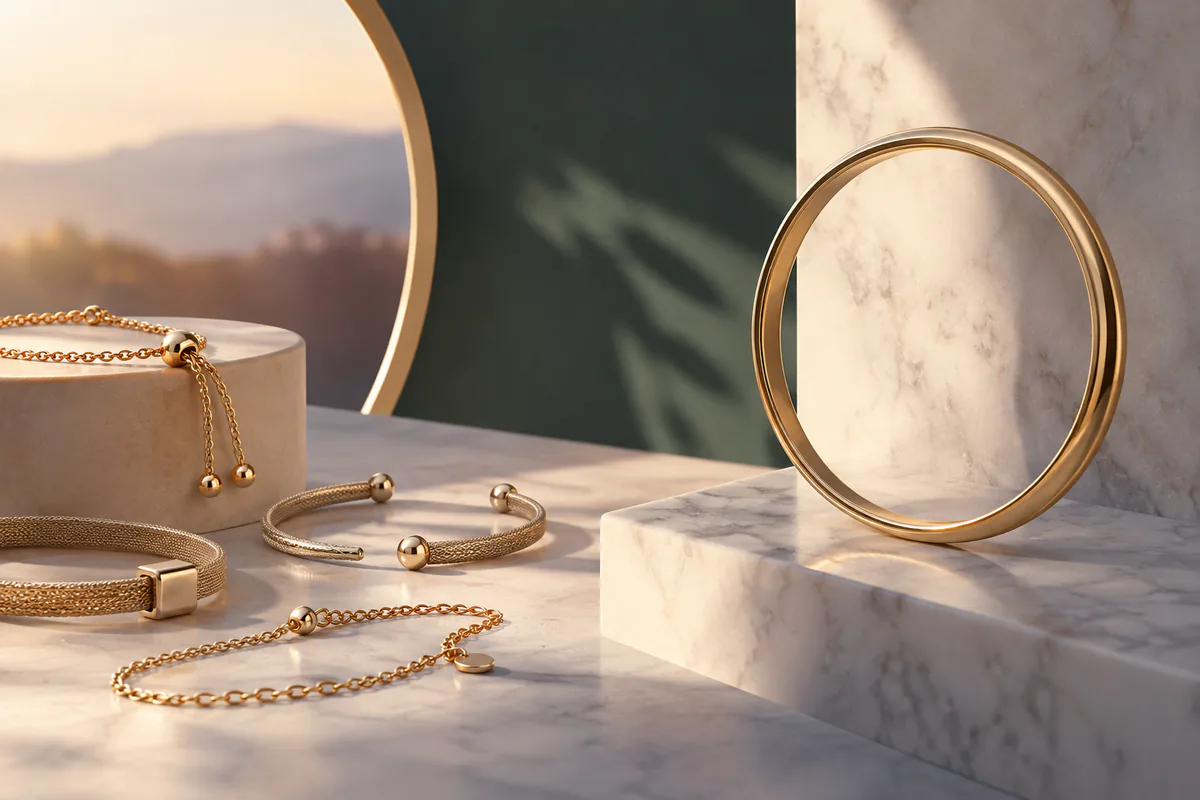
A bangle is a closed ring, cut from a single block. Nothing opens, nothing can be restrung. It is sized by its inner diameter, and that measurement cannot be deduced from the wrist: to slip it on, the hand folds into a cone, and the widest point of the passage is the thumb joint. A slender wrist therefore does not mean a small bangle, and this confusion is what makes people get the size wrong.
This format exists because the material allows it. Jade is moderately hard and exceptionally tough: hardness resists scratching, toughness resists breaking, and a good share of the pages I opened confuse the two. It is toughness that makes a whole ring in one piece possible (why jade almost never breaks).
Taking this measurement on someone without telling them is doable, and it is a subject in its own right: measuring your wrist before buying a bangle. I do not write a single millimetre here, and the reason is at the bottom of the page.
The ring, and the ring size you don’t have
The ring is the second format with a fixed size, and its fate depends on the setting. A stone set on a metal band lets a jeweller work the metal. A ring carved from a block of jade leaves nothing to work on: it is a bangle for the finger, with the same passage constraint.
One precaution applies to the first case, and it follows from what I do not know: I cannot determine whether a stone has been bleached and then impregnated with resin, my supplier does not know, and only infrared spectroscopy would settle it. As long as that is not determined, the piece is handled as if it were treated, so no heat, no ultrasonic cleaning and no steam, and the jeweller needs to be told before starting (jade A, B and C, the treatment information sheet).
The old trick still works: borrow a ring the person already wears and have it measured. The settings are among the rings.
Jade earrings, chosen one by one
What I look at in the stone before the setting
A format mistake can usually be fixed; a material mistake, never. So that is what I check first: the word jade covers two unrelated minerals, whose densities do not overlap, and my scale mainly separates them from serpentine and dyed quartzite, which circulate under compound names containing the word jade (jade stone, stones sold as jade).
One more marker, found in listings. The A, AA, AAA scale has no standard behind it and borrows its letters from the real classification, the one for treatments. What makes a piece valuable is in judging the quality of jade, and the wording that should make you close the tab in buying jade jewellery.
What a jade gift is supposed to say
What follows changes register, and I flag it rather than blending it into the rest. Nothing in it is proven: it is what traditions have attributed to this stone.
Classical Chinese thought is said to have associated jade with moral qualities rather than a power, which would have made it a gift of esteem before it was an ornament (the moral virtues of jade). Contemporary authors link it to balance and luck, hence the lucky charm reputation of a jade gift (where the lucky charm idea comes from). Jade also has its own dated occasion in the French list of wedding anniversaries, which is a custom rather than a rule, and whose exact year is worth checking rather than copying: the jade wedding anniversary.
What I will never write on a gift card: that a piece of jewellery protects, heals or brings luck. And yet the word in my shop’s name comes from a sixteenth-century Spanish promise of healing, which is exactly what I do not sell.
If the size is off
A strand of beads can be restrung, a cord can be changed, a ring can be resized depending on its setting. The bangle is the only one that leaves nothing to rework, and that is not a policy of mine: nothing can be removed from a closed ring without cutting it.
What follows is predictable, and it is the real reason I insist: a bangle that is too tight ends up forced, soaped and pushed, and a thin ring under strain cracks. Jade’s toughness absorbs impacts, not constant pressure (a broken jade bracelet). I promise neither a delivery date nor a price here: my orders ship directly from my supplier, and the terms are on delivery and returns.
The questions I get asked
Which jade piece should you give when you don’t know the size?
A pendant on a cord or earrings: neither has a size. The bangle and the ring are the two formats to avoid when you have no measurement.
How can you find out someone’s bangle size without asking?
By measuring a bangle they already wear, or by measuring the hand folded into a cone rather than the wrist: the widest point of the passage is the thumb joint. The method is in measuring your wrist before buying a bangle.
Can a jade bangle be made larger?
No. A bangle is a closed ring cut from a single block: no clasp to move, no link to add, no metal to work. It is the only format in my catalogue where a size mistake cannot be corrected.
Is jade suitable for a man?
Yes, and for this stone it is far from a side section. The formats are simply not the same, and I have covered both sides: men’s jade jewellery, women’s jade jewellery.
What colour of jade should you give?
Green is expected, but it is neither the only colour nor the most interesting: white, honey and lavender come from the same deposits. Two shades call for caution when buying, bright pink and pure blue, almost always dyed quartzite (jade stone colours, green jade stone).
How can you be sure the jade you give is real jade?
The only check I know how to do at home is hydrostatic weighing, and it separates jade from its substitutes without saying anything about treatment. What the checks you can do without a scale are worth is in how to recognise real jade stone.
Where I checked
What comes from a named source. The two densities cited, nephrite at 2.90 to 3.03 and quartzite around 2.65, are those of the mineralogical literature: I repeat them, I did not establish them, and their limits vary by a few hundredths from one database to another. I therefore attribute them to no organization, since I did not take them from a single one.
What is an observation, dated. On 8 September 2026, surveying French search demand across seven families of jade-related queries, I found no published volume for phrasings built with “acheter”, “achat” or “offrir” (buy, purchase, give). This page carries no more than that, and I say so because it is information in itself: in French, for this stone, the gift question is not typed into a search engine. This article exists for someone who is already here and hesitating between two formats, not to catch a query. The same day, my supplier confirmed that they cannot tell whether their stock is treated.
What is my own reasoning. The ranking of the six formats by risk is a judgment, drawn from what each setting allows to be undone, not a record of customer returns. The warning to give the jeweller before heating a setting follows from my inability to determine treatment, not from a test I ran. And if no millimetre appears here, it is because I have not yet weighed and measured all the samples whose figures I will publish. If you find a mistake, write to me: I will correct it and note the correction.
In one sentence
Giving jade jewellery comes down to a single question, whether a size mistake can be undone, and only one format out of six allows no second chance. The measurements are in the size guide, the pieces in the shop.